IndianSanskriti

Navratri Series – Day 2: Goddess Brahmacharini – The Embodiment of Penance and Devotion

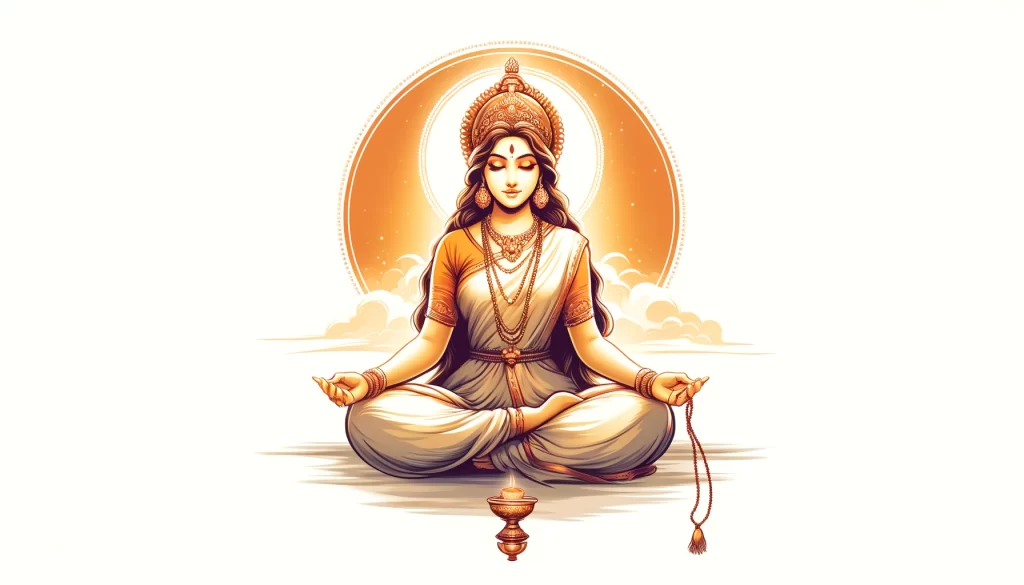
On the second day of Navratri, we celebrate Goddess Brahmacharini, the second form of Goddess Durga. Her name symbolizes a devoted female student who pursues knowledge and spiritual learning.

Who is Goddess Brahmacharini?
Goddess Brahmacharini is depicted as a serene figure, walking barefoot with a rosary in her right hand and a Kamandalu (water pot) in her left. This form of Goddess Durga epitomizes penance and austerity, leading her devotees towards the path of wisdom and emancipation.

Symbolism and Significance
Worshipping Goddess Brahmacharini is believed to invoke a spirit of perseverance and dedication. She represents loyalty and wisdom, inspiring devotees to remain steadfast in their goals. Her austere form teaches the importance of self-discipline and inner strength.

The Story of Brahmacharini
The legend of Goddess Brahmacharini is one of determination and resilience. She undertook severe penances to win Lord Shiva as her consort. Her story teaches the values of endurance and patience in the pursuit of one’s goals.

Cultural Practices and Rituals
Devotees observe rigorous fasts and engage in prayers, chanting mantras dedicated to Goddess Brahmacharini. The color orange, symbolizing tranquility and brightness, is associated with this day.

Contemporary Reflections
In today’s fast-paced world, Goddess Brahmacharini’s ideals remind us of the virtues of patience and consistent effort. Her story encourages us to face life’s challenges with grace and dignity.

Call to Action
Join us tomorrow for Day 3 of our Navratri series as we delve into the divine virtues of Goddess Chandraghanta. To enrich your understanding of Hindu culture and spirituality, explore more articles at Sanskriti Magazine.
You may also like

Search the website

Like us on Facebook

Get daily updates via Email

Enter your email address:

Recent Posts

Adi Shankaracharya Jayanti 2026 — Advaita Vedanta, Om symbol, and four Amnaya Peethas

Adi Shankaracharya — The Monk Who Reunited Bharata

Shankaracharya Jayanti 2026 — the 1238th birth anniversary of Adi Shankaracharya. His extraordinary life, the Digvijaya, the debate with Mandana Mishra, Advaita Vedanta, the four Amnaya Peethas, and his timeless literary legacy.

Akshaya Tritiya 2026 — royal purple hero banner with Akshaya Patra vessel and Devanagari text

Akshaya Tritiya 2026 — The Day That Never Diminishes

Akshaya Tritiya (April 19, 2026) is one of the most auspicious days in the Vedic calendar — when any act of dharma, dana, or japa yields imperishable merit. Discover the five sacred Puranic events, complete puja vidhi, timings, mantras, and the deeper spiritual teaching beyond gold-buying.

Baisakhi 2026 — Mesha Sankranti Hindu Solar New Year hero banner with rising sun, Om symbol and wheat harvest

Baisakhi 2026 — Harvest, Hope, and the Hindu Solar New Year

Baisakhi 2026 falls on Tuesday, April 14 — the day Bhagavan Surya enters Mesha Rashi at 9:39 AM, marking the Hindu Solar New Year. Discover the sacred science of Mesha Sankranti, the Punya Kaal rituals, and how this one cosmic moment is celebrated across Bharata as Vishu, Puthandu, Pohela Boishakh, Bohag Bihu, and Pana Sankranti.

Varuthini Ekadashi 2026 — sacred vrat guide hero banner with Vishnu Chakra mandala

Varuthini Ekadashi 2026 — The Sacred Vrat That Shields from Sin

Varuthini Ekadashi (April 13, 2026) is one of the most powerful Ekadashi vrats — dedicated to Lord Vamana, it dissolves lifetimes of karmic burden and shields the devoted soul with Bhagavan Vishnu’s protective grace. Complete vrat vidhi, timings, mantra, and the sacred Vrat Katha from the Bhavishya Purana.

css.php