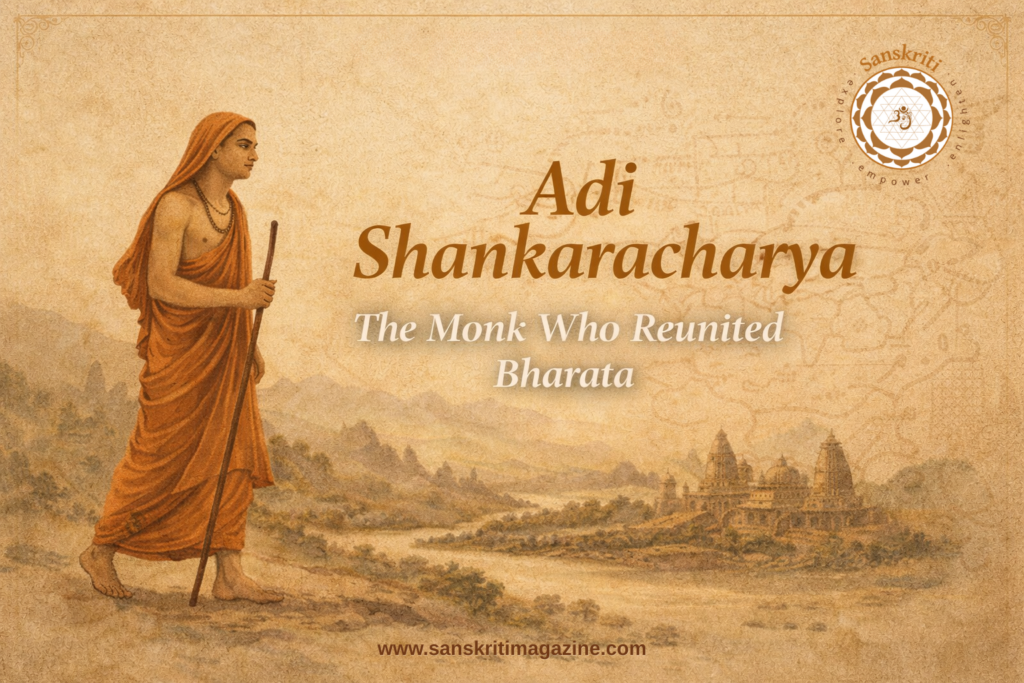
Adi Shankaracharya — The Monk Who Reunited Bharata
Shankaracharya Jayanti — Tuesday, April 21, 2026 | Panchami, Shukla Paksha, Vaishakha
In the long memory of Sanatana Dharma, few names carry the weight that Adi Shankaracharya does. Born in the small village of Kaladi in Kerala in 788 CE, this extraordinary child-sage would, in a life of barely thirty-two years, traverse the entire breadth of Bharata on foot — debating, teaching, composing, and establishing institutions that hold firm to this day. He found a civilisation fragmented by sectarian rivalries and philosophical confusion. He left behind a unified Dharmic framework that became the very backbone of Hindu thought.
Shankaracharya Jayanti 2026 falls on Tuesday, April 21 — marking the 1238th birth anniversary of this towering Acharya. It is a day to remember not only the philosopher, but the monk who reunited Bharata under the banner of one Dharma.
Shankaracharya Jayanti 2026 — Tithi Details
- Date: Tuesday, April 21, 2026
- Tithi: Panchami, Shukla Paksha, Vaishakha
- Panchami Tithi Begins: 4:14 AM on April 21, 2026
- Panchami Tithi Ends: 1:19 AM on April 22, 2026
The Life of Adi Shankaracharya — From Kaladi to the Four Corners of Bharata
Birth and Early Years
Adi Shankara was born to Shivaguru and Aryamba, a devout Namboodiri Brahmana couple in Kaladi, a village on the banks of the Periyar river in Kerala. According to tradition, his parents were childless for many years and performed intense tapasya at the Vadakkunnathan Temple in Thrissur, praying to Bhagavan Shiva for a son. Bhagavan Shiva appeared in a dream and offered a choice: many sons of ordinary intellect, or one son of extraordinary brilliance but a short life. They chose the latter. The child born to them was named Shankara — “He who bestows auspiciousness” — after Bhagavan Shiva himself.
From the earliest age, Shankara displayed an intellect that astonished all who encountered him. He mastered the Vedas, the Upanishads, and the six Darshanas (schools of Vedic philosophy) while still a boy. By the age of eight, a profound vairagya (detachment) had awakened in him, and he sought his mother’s permission to take sannyasa — the renunciate’s path. The famous account of the crocodile that seized young Shankara’s leg while he bathed in the river — and released him only when his mother, in her terror, gave consent to his renunciation — is one of the most beloved episodes in all of Hindu tradition.
Initiation and the Guru
After receiving his mother’s permission, Shankara travelled north to the banks of the Narmada, where he found his Guru — Govinda Bhagavatpada, a direct disciple of the great Gaudapada, author of the Mandukya Karika. Under Govinda Bhagavatpada’s guidance, Shankara was initiated into sannyasa and received the complete transmission of Advaita Vedanta. The Guru recognised in his young disciple a vessel capable of carrying this supreme teaching to the entire world.
The Digvijaya — The Conquest of the Four Directions
What followed was one of the most extraordinary journeys in the history of Bharata. Adi Shankaracharya undertook a Digvijaya — a philosophical conquest of the four directions — travelling on foot across the length and breadth of the subcontinent. In an age without roads or railways, this young monk walked from Kerala to Kashi, from Kashi to Badrinath, from Badrinath to Dwarka, from Dwarka to Puri, and from Puri to Sringeri — debating the foremost scholars of every tradition, establishing mathas, composing treatises, and awakening the Dharmic consciousness of the land.
His was not a conquest by force. It was a conquest by clarity, by the sheer luminosity of his thought and the depth of his realisation. Wherever he went, confusion gave way to understanding, fragmentation gave way to unity, and sectarian rivalry gave way to the recognition of one Brahman manifesting as many.
The Debate with Mandana Mishra — The Turning Point
Perhaps the most celebrated episode of the Digvijaya was Shankaracharya’s debate with Mandana Mishra, the foremost scholar of the Purva Mimamsa tradition, at Mahishmati (identified with modern-day Maheshwar in Madhya Pradesh).
Mandana Mishra was a householder-scholar of immense learning who upheld the primacy of Vedic karma-kanda — the path of ritual action — over jnana (knowledge). His wife, Ubhaya Bharati, herself a formidable scholar, was appointed as the judge of the debate. Garlands of flowers were placed around both debaters’ necks; the one whose garland wilted first — indicating rising agitation — would be declared the loser.
The debate lasted for days. Through the power of his arguments, rooted in the Upanishads and the Brahma Sutras, Shankaracharya demonstrated that jnana — the direct knowledge of Brahman — is the ultimate means to Moksha, and that all karma, however meritorious, is ultimately a preparation for this knowledge. Mandana Mishra’s garland wilted. He accepted defeat with grace, took sannyasa under Shankaracharya, and became one of his foremost disciples, known thereafter as Sureshvaracharya.
This debate was a watershed moment for Sanatana Dharma. It did not destroy the Mimamsa tradition — Shankara honoured the role of karma and ritual — but it established, beyond dispute, that the highest goal of all Vedic teaching is the realisation of Brahman, and that Advaita Vedanta provides the clearest map to that realisation.
Advaita Vedanta — The Philosophy That United a Civilisation
At the heart of Adi Shankaracharya’s teaching is Advaita Vedanta — the philosophy of non-duality. In accessible terms, its core tenets are:
Brahma Satyam — Brahman alone is Real. The ultimate reality is one, infinite, consciousness — without form, without attribute, without a second. This is Brahman, and it is the substratum of all existence.
Jagan Mithya — The world as we perceive it is not the final reality. The phenomenal world — with its names, forms, and distinctions — is not unreal in the sense of being an illusion, but it is not the ultimate truth either. It is mithya — an appearance superimposed upon Brahman, much as a rope may appear to be a snake in dim light. When true knowledge dawns, the appearance is seen for what it is.
Jivo Brahmaiva Na Aparah — The individual self (Jiva) is none other than Brahman. The Atma — the innermost self of every being — is not a fragment of Brahman, not a part of Brahman, but Brahman itself. The sense of being a separate, limited individual is the result of avidya (ignorance). When avidya is removed through Jnana, the Jiva recognises its identity with Brahman — and this recognition is Moksha.
These three mahavakyas form the foundation of Advaita Vedanta, and through them, Shankaracharya offered Sanatana Dharma a unifying vision. Whether one worshipped Bhagavan Shiva or Bhagavan Vishnu, Devi Shakti or Bhagavan Surya — the ultimate truth toward which all paths converged was one: Brahman. This vision dissolved sectarian walls without destroying the beauty of each tradition.
The Four Amnaya Peethas — The Spiritual Anchors of Bharata
Adi Shankaracharya’s genius was not only philosophical but institutional. Recognising that a teaching without a living lineage would eventually fade, he established four Amnaya Peethas (monastic seats) at the four cardinal points of Bharata — ensuring that the light of Vedanta would be tended and transmitted across the centuries:
1. Sringeri Sharada Peetham — South (Karnataka)
Established on the banks of the Tunga river in Sringeri, this was the first of the four Peethas. Shankaracharya installed his senior disciple Sureshvaracharya as its first head. The Peetham is associated with the Yajur Veda and the mahavakya “Aham Brahmasmi” (I am Brahman). To this day, the Sringeri Peetham remains one of the most revered centres of Vedantic learning in the world.
2. Dwaraka Sharada Peetham — West (Gujarat)
Located at the sacred city of Dwaraka on the western coast, this Peetham was entrusted to Hastamalaka. It is associated with the Sama Veda and the mahavakya “Tattvamasi” (Thou art That).
3. Jyotirmath (Joshimath) — North (Uttarakhand)
Established near the sacred Badrinath Dham in the Himalayas, Jyotirmath was entrusted to Totakacharya. It is associated with the Atharva Veda and the mahavakya “Ayam Atma Brahma” (This Atma is Brahman).
4. Govardhan Peetham — East (Odisha)
Located at Puri, near the great Jagannatha Temple, this Peetham was entrusted to Padmapadacharya. It is associated with the Rig Veda and the mahavakya “Prajnanam Brahma” (Consciousness is Brahman).
These four Peethas — spanning from the Himalayas to the western ocean, from Kerala’s coast to the Bay of Bengal — form a sacred geography that mirrors the unity Shankaracharya sought to create. They continue to function today, each headed by a Shankaracharya in an unbroken lineage stretching back over twelve centuries.
The Literary Legacy — Treasures for Every Seeker
In his short life, Adi Shankaracharya produced a body of work that is staggering in both its depth and breadth:
- Brahma Sutra Bhashya — his magnum opus, the definitive commentary on Badarayana’s Brahma Sutras, establishing Advaita Vedanta as the primary interpretation of the Upanishads
- Upanishad Bhashyas — commentaries on ten principal Upanishads (Isha, Kena, Katha, Prashna, Mundaka, Mandukya, Aitareya, Taittiriya, Chandogya, and Brihadaranyaka)
- Bhagavad Gita Bhashya — a commentary on the entire Gita through the lens of Advaita
- Vivekachudamani — “The Crest-Jewel of Discrimination,” a practical guide to Vedantic sadhana
- Atma Bodha — “Self-Knowledge,” a concise introduction to Advaitic teaching
- Bhaja Govindam — a devotional hymn of piercing directness, reminding seekers that all learning is futile without surrender to the Divine
- Soundarya Lahari — a magnificent hymn to Devi Shakti, blending tantra, mantra, and the highest Vedantic insight
- Nirvana Shatakam — six verses distilling the essence of Advaita into its purest form: “Chidananda Rupah Shivoham Shivoham” — “I am the form of Consciousness-Bliss, I am Shiva, I am Shiva.”
These works range from the most rigorous philosophical commentary to the most heart-stirring devotional poetry — revealing a mind that was as vast in its bhakti as it was sharp in its logic.
The Final Teaching — Eka Shloki
किं ज्योतिस्तव भानुमानहनि मे रात्रौ प्रदीपादिकं
स्यादेवं रविदीपदर्शनविधौ किं ज्योतिराख्याहि मे ।
चक्षुस्तस्य निमीलनादिसमये किं धीर्धियो दर्शने
किं तत्राहमतो भवान्परमकं ज्योतिस्तदस्मि प्रभो ॥“What is your light? By day, the Sun. By night, a lamp. And when the eyes are closed? The mind. And when the mind is still? Then — I am. That supreme light — I am, O Lord.”
This dialogue, attributed to Shankaracharya, strips away every external support — Sun, lamp, eye, mind — until only the Atma remains, self-luminous and imperishable. This is the essence of all that Adi Shankaracharya taught: You are not the body. You are not the mind. You are Brahman — infinite, eternal, free.
Why Shankaracharya Matters Today
Twelve centuries after his mahasamadhi, Adi Shankaracharya’s legacy is not a relic of the past — it is a living force. The four Amnaya Peethas continue to guide millions. His commentaries remain the primary texts in every Vedanta school. His devotional hymns are sung in temples and homes across Bharata every single day.
But perhaps his greatest gift to our age is the vision of unity. In a time when the world is fractured by identity, ideology, and division, Shankaracharya’s teaching offers a radical alternative: that beneath all difference lies one indivisible reality, and that recognising this reality is not only the highest philosophy but the deepest compassion.
He walked the length of Bharata to prove that Sanatana Dharma is not a collection of competing sects, but a single river flowing from many tributaries toward one ocean. That message has never been more needed than it is now.
On this Shankaracharya Jayanti, may we honour not only the Acharya, but the teaching — by turning inward, by seeking the light that needs no other light, and by recognising, even for a moment, the Brahman that shines in all.
Om Namah Shivaya 🙏
Sanskriti Magazine — Sharing Indian Heritage, Achievements, Practices and Values with the world.