Tuesday, June 16, 2026 · Nija Jyeshtha begins · Shukla Paksha Pratipada · Religion · Festivals
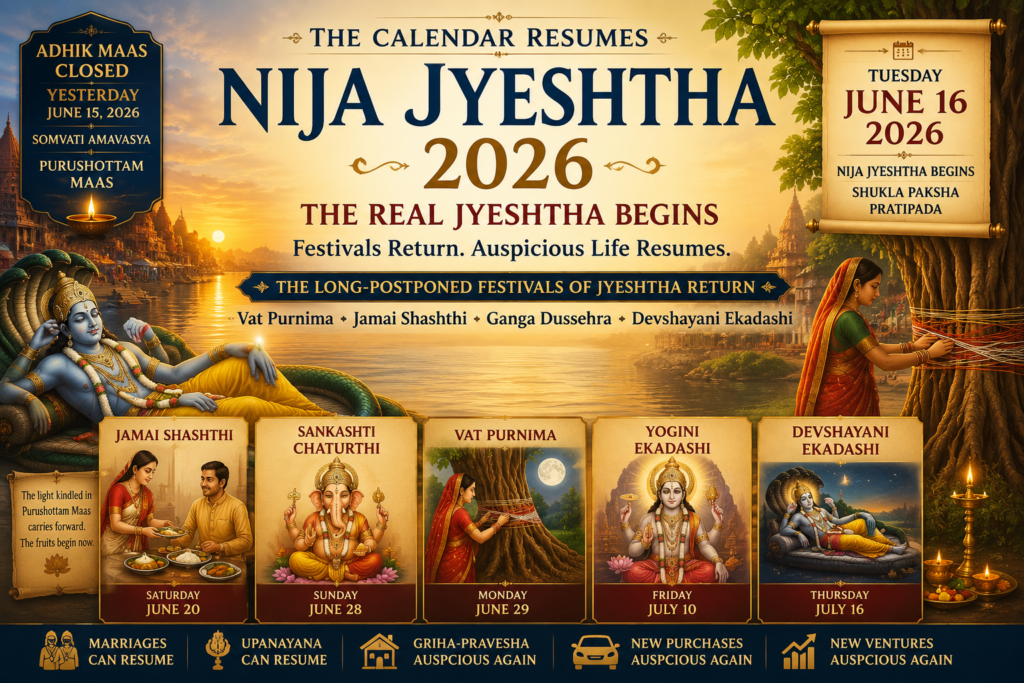
With Adhik Maas now closed, the long-postponed festivals of Jyeshtha return — Vat Purnima, Jamai Shashthi, Ganga Dussehra of the real Jyeshtha, and the long approach to Devshayani Ekadashi.
Yesterday, on the Somvati Amavasya of June 15, the rare thirteenth chamber of the calendar — the Adhik Jyeshtha Maas, the Purushottam Maas of Bhagavan Vishnu — quietly closed. For thirty days the lunar month had paused. The festivals had waited. The auspicious acts of a lifetime — the marriage, the upanayana, the griha-pravesha — had been set aside.
This morning, the calendar resumes its ordinary breath.
Nija Jyeshtha — the real Jyeshtha, the original lunar month whose ordinary rhythm was paused by the insertion of the intercalary one — begins today. The Shukla Paksha Pratipada of Nija Jyeshtha falls on Tuesday, June 16, 2026. And from this morning forward, all that was postponed returns. The Acharyas have always taught that the great festivals fall in the Nija maas, not the Adhika. Those festivals are now upon us.
This is a brief guide to what the next four weeks hold.
Why “Nija” — The Real Jyeshtha
When an Adhik Maas is inserted into the calendar, the lunar month of that name appears twice. The first occurrence, the added month, is called Adhika Jyeshtha. The second, the original lunar month it was added to, is called Nija Jyeshtha — the real or true Jyeshtha. The Shastras are exact: the great festivals always fall in the Nija month. The Adhika is reserved for the rare observances of Purushottam Maas alone.
So Vat Purnima, Ganga Dussehra of common reckoning, the Jamai Shashthi of the Bengali calendar, and the Sankashti Chaturthi of Jyeshtha — all of these are observed in Nija Jyeshtha, not Adhika.
Nija Jyeshtha 2026 runs from Tuesday, June 16 to Thursday, July 16 — opening on this Shukla Paksha Pratipada and closing on the Shukla Ekadashi (Devshayani Ekadashi) and the Purnima a few days after.
What Returns This Month
Jamai Shashthi — Saturday, June 20
The first major festival to land in Nija Jyeshtha is the Bengali festival of Jamai Shashthi — the day on which a Bengali mother formally welcomes her married daughter and son-in-law home, performs the Shashthi Vrata for them, and lays out the legendary jamai-aador feast. The story behind the festival — the grihini who stole the household hilsa, blamed the cat (the vahana of Maa Shashthi), and was finally forgiven — is one of the most beloved Vrat Kathas of the eastern Vaishnava tradition.
📖 Read the full story of Jamai Shashthi 2026
Sankashti Chaturthi — Sunday, June 28
The Krishna Paksha Chaturthi of Nija Jyeshtha — Sankashti Chaturthi — falls on Sunday, June 28. This is the monthly Ganesha vrat for the removal of obstacles, observed by fasting until moonrise and offering twenty-one durva blades and a single modak to Bhagavan Ganesha.
Vat Purnima — Monday, June 29
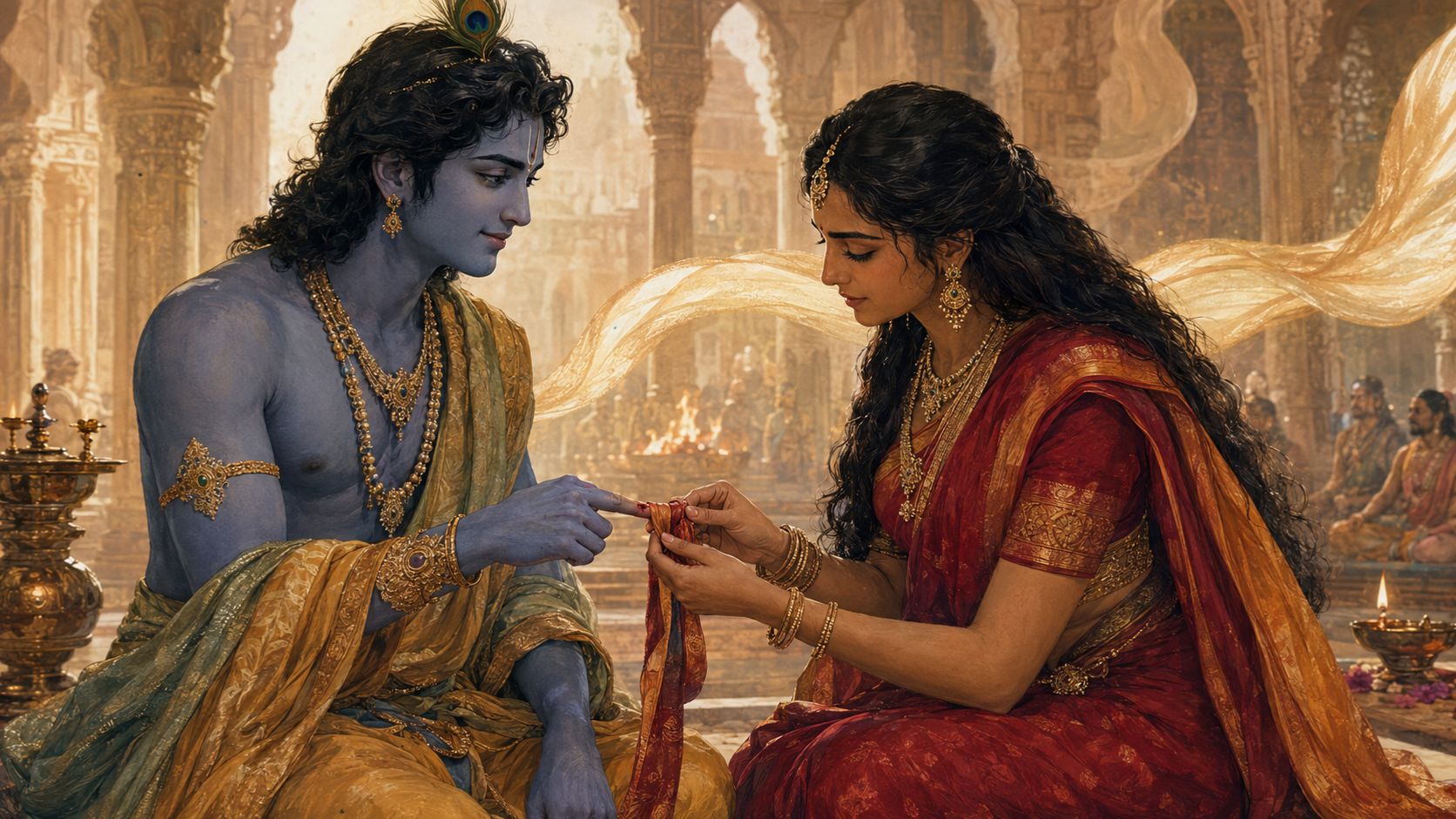
The full moon of Nija Jyeshtha is Jyeshtha Purnima, and in the southern, western, and Maharashtrian traditions it is observed as Vat Purnima — the festival of Savitri, the wife who walked behind Yamaraja Himself into Yamaloka, out-argued the Lord of Dharma over four boons, and returned with her husband’s life. Women circumambulate the banyan tree (the vata vriksha) with red thread, hear the Savitri Vrat Katha from the Mahabharata, and keep a phalahari fast until moonrise.
📖 Read the full story of Vat Purnima 2026 — The Wife Who Argued Yama Into Returning Her Husband’s Life
Yogini Ekadashi — Friday, July 10
The Krishna Paksha Ekadashi of Nija Jyeshtha is Yogini Ekadashi — the Ekadashi whose Vrat Katha tells the story of Hema Mali, the gardener of Kubera, cursed to live as a leper after a single moment of conjugal distraction caused him to miss the morning’s flower delivery to Bhagavan Shiva. The Padma Purana names this Ekadashi the cleanser of distractions — the Ekadashi for the seeker whose sadhana has been interrupted by an entanglement they cannot themselves end.
Devshayani Ekadashi — Thursday, July 16
The closing of Nija Jyeshtha — the Shukla Paksha Ekadashi at the very edge of the month — is the great pivot of the year: Devshayani Ekadashi, the day Bhagavan Vishnu enters His four-month yoga-nidra on Sheshanaga, and Chaturmas begins.
From this evening until Prabodhini Ekadashi in November, the Vaishnava calendar is held in a long pause: no marriages are performed, no housewarmings undertaken, no new ventures begun. The four months belong to the Lord’s cosmic sleep. Bhagavan Shiva takes over the affairs of the universe in His absence. This is the most contemplative period of the entire Hindu year — the uttarayana turning toward inwardness — and we will be writing extensively on it as it approaches.
What Begins Again
Apart from the festivals, Nija Jyeshtha returns to the calendar what Adhik Maas had paused.
Marriages may again be performed. The shubh muhurta calendars list a return of vivah muhurtas from this morning onward. The upanayana (sacred thread ceremony) may again be conducted. The griha-pravesha (housewarming) is again auspicious. Vehicles may be bought. Property may be registered. New ventures may be inaugurated.
The ordinary auspicious life of the householder, paused for thirty days, resumes today.
A small but important note from the Acharyas: the merit accumulated through Purushottam Maas continues to act in the seeker through Nija Jyeshtha. The light kindled in the inner room during the rare month does not depart with the rare month. It carries forward.
The Acharyas teach that the household that kept the thirty days with sincerity will find Nija Jyeshtha unusually fruitful — that the seeds planted in the soil of Purushottam Maas begin to germinate in the soil of Nija.
A Brief Closing
There is, in the Hindu calendar, a particular sweetness to the morning after a long vrat closes. The discipline of the rare month is behind us. The ordinary rhythm of the seasons returns. But something has been added to the household that was not there before. The deepa lit at dawn in May still glows somewhere in the inner room. The mantra kept on the breath through the month has worn a small groove in the breath. The dana given quietly through thirty days has earned the household something it will be drawing on for many months to come.
This is the gift Purushottam Maas leaves behind. Nija Jyeshtha is where it begins to be spent.
May the festivals of the month that now begins arrive at every threshold of every household that kept the month that just closed.
Om Namo Bhagavate Vasudevaya