There is a saying among the devotees of Mahadeva: other gods must be praised, but Shiva has only to be bathed.
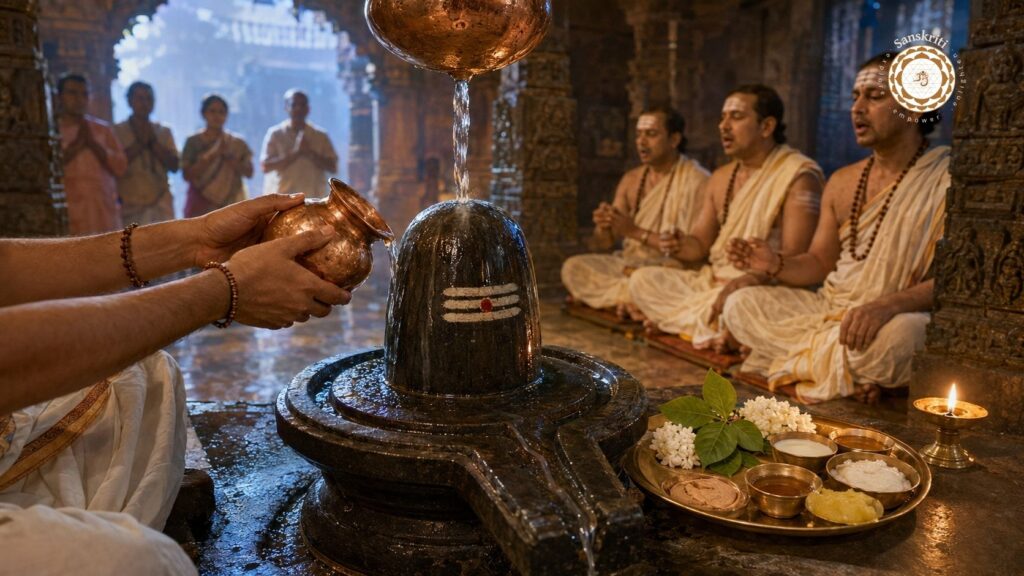
Every deity in the tradition has a worship that pleases Him most. For Vishnu it is the recitation of His thousand names; for the Devi, the Chandi. For Lord Shiva, above every hymn and every offering, there is one act the shastras place first — the abhishekam, the ritual pouring of sacred substances over the Shivalinga. And its highest form, performed to the chanting of the Vedic Rudram, is the Rudrabhishek — held by the Acharyas to be the single fastest way to reach the heart of Mahadeva.
On this second Shravan Somwar of 2026 — Monday, August 10 — temples across Bharata will resound from before dawn with the eleven-fold chant of the Rudram as water, milk, and honey stream over the linga. This is what that ritual is, and why it works as it does.
Why Shiva Is Pleased by Bathing Above All Else
The tradition gives a beautiful reason. Shiva is Bholenath — the innocent Lord, the one most easily pleased. He asks for no gold, no elaborate feast, no flattery. He drank the world’s poison and holds it still in His throat, and the burning of that Halahala is cooled by one thing: the cool flow of water and milk over the linga. To perform abhishekam is therefore not merely to worship Shiva — it is to serve Him, to ease the fire He took on for the sake of the worlds.
This is why the abhishekam is considered so direct. It is not a request laid before a distant throne. It is a hand cooling a burning throat. The Lord who took the poison responds to that gesture more swiftly than to any praise.
“Praise Me if you wish,” Bholenath seems to say, “but if you would truly please Me — pour cool water, and offer Me a single bilva leaf.”
What the Rudram Is
The Rudram — properly the Sri Rudram or Rudra Prashna — is one of the most ancient and sacred hymns in the whole of the Vedas, drawn from the Krishna Yajurveda. It has two parts: the Namakam, whose verses repeat the salutation namo — “salutations to Rudra” in every form, fierce and gentle, in the mountains and the rivers, in the trees and in the humblest of beings — and the Chamakam, which asks that all good things “be granted to me.” Within the Namakam lies the Panchakshari mantra itself, Om Namah Shivaya, and the great Mahamrityunjaya is often joined to the rite.
A full Rudrabhishek is the abhishekam performed while the Rudram is chanted. When the Namakam and Chamakam are recited in the traditional eleven-fold cycle, it becomes a Ekadasa Rudra; multiplied further by qualified priests, it rises to the great Maha Rudra and Ati Rudra yajnas. But the essence is the same at every scale: the sacred word of the Veda flowing together with the sacred stream over the linga.
The Sacred Substances — and What Each Bestows
The abhishekam is performed with a sequence of offerings, each carrying its own meaning and its own traditional fruit. The core sequence is the Panchamrita — the five nectars — followed by pure water.
| Offering | Meaning / traditional fruit |
|---|---|
| Water & Ganga jal | Purity; cooling the throat that holds the poison. The foundation of the rite. |
| Milk | Purity of mind and long life; a peaceful, sattvic heart. |
| Curd (yoghurt) | Prosperity, healthy progeny, and abundance in the home. |
| Honey | Sweetness of speech and freedom from debt and discord. |
| Ghee | Strength, victory, and the removal of obstacles. |
| Sugar / jaggery | Freedom from sorrow; the sweetening of life. |
| Bilva (bael) leaves | The leaf Shiva loves above all — its three lobes the three eyes, or the trident, of the Lord. Offered last, with water. |
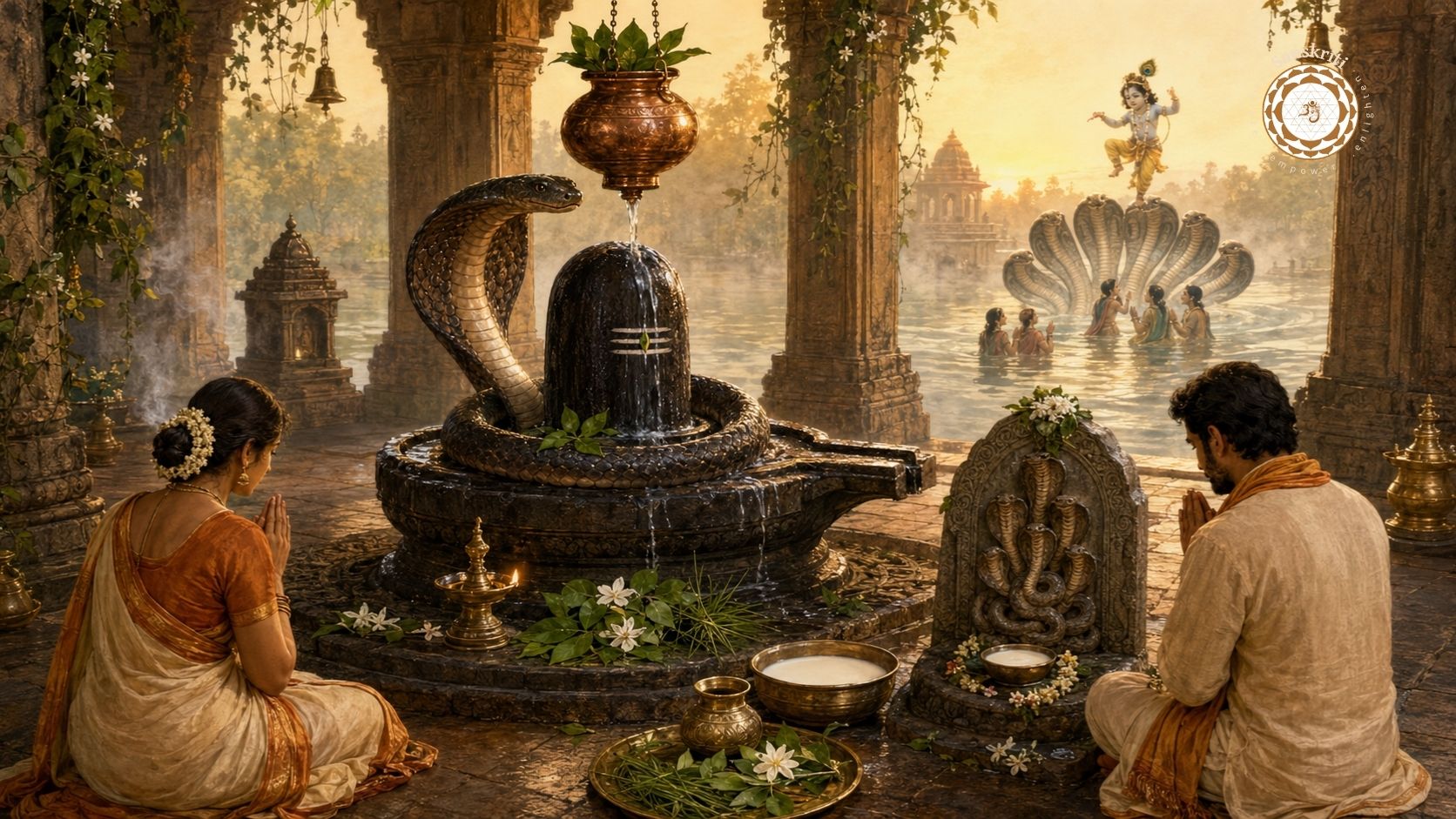
After the Panchamrita, the linga is bathed again in pure water to complete the offering, then adorned with bilva leaves, white flowers, sandal paste, and vibhuti (sacred ash). In many traditions dhatura, aak flowers, and — where customary — bhang are also offered, for these too are dear to the Lord who dwells beyond convention.
How a Simple Rudrabhishek Is Performed at Home
A full Rudrabhishek with the Vedic Rudram is ideally performed by a qualified priest. But a devotee may keep a simple, sincere abhishekam at the household altar — and the tradition is clear that sincerity, not grandeur, is what reaches Bholenath.
- Rise early, bathe, and clean the puja space. Place the Shivalinga (or a clean image of Shiva) in a vessel or on a plate that can catch the flow.
- Light a ghee lamp and incense. Take sankalpa — a quiet statement of intent — with folded hands.
- Begin the flow with pure water, then offer, one by one, milk, curd, honey, ghee, and sugar, returning to water between and at the end. Pour gently and continuously.
- Throughout, chant Om Namah Shivaya steadily; add the Mahamrityunjaya or the Rudram if you know it, or play a recorded recitation.
- Bathe the linga a final time in clean water. Wipe gently, then offer bilva leaves (smooth side down), white flowers, sandal paste, and vibhuti.
- Offer a simple naivedya — fruit or milk — do aarti, and close by asking the Lord’s forgiveness for any error in the rite.
The abhishekam water (the run-off, called charanamrita) is sacred; traditionally it is sprinkled on the head and not stepped over. Bilva leaves and offerings are not thrown in the household waste but returned respectfully to a clean place, a river, or the base of a tree.
The Heart of the Ritual
It is easy to be dazzled by the scale a Rudrabhishek can reach — eleven priests, a hundred and twenty-one recitations, hours of unbroken chant. But the Acharyas return, always, to the same point. The Lord who is worshipped here is the one who wanted nothing from the churning of the ocean and took only the poison. He is moved not by the quantity of milk but by the love in the hand that pours it.
A single leaf of bilva, laid on the linga with a whispered Om Namah Shivaya, is a complete Rudrabhishek if the heart is complete. That is the promise Shravan holds out to every devotee, priest and householder alike: that Mahadeva, of all the deities, is the nearest — that He has only to be bathed, and He answers.
Other gods must be praised. Shiva has only to be bathed. Pour the water, offer the leaf — the Lord who drank the poison is already listening.
Om Namo Bhagavate Rudraya — the opening salutation of the Sri Rudram.