Raksha Bandhan Special · The Mahabharata · Sakhi Bhava · Religion · Spirituality · Mythology
Before Rakhi was a festival of siblings, it was a friendship — the deepest in the whole of the Mahabharata, and it was never once about blood.
Ask most people where Raksha Bandhan comes from, and they will reach for a memory of a torn sari and an endless cloth. They are right — but they are remembering the ending, not the friendship that made the ending inevitable. The bond between Bhagavan Krishna and Draupadi is one of the great relationships of Sanatana Dharma, and it belongs to a category the modern world has almost forgotten how to name: a man and a woman, bound by nothing but choice and devotion, who called each other sakha and sakhi — friend, and friend — and meant it with their whole lives.
They were not husband and wife. They were not brother and sister by birth. Krishna was the cousin of the Pandavas; Draupadi was married to all five. In the tangle of the Kuru genealogy, no formal word quite fits what they were to each other. And that is precisely the point. Their bond is the reason the rakhi, to this day, can be tied to anyone — because the truest raksha in the tradition was between two people whom no family tree had assigned to one another.
Sakha and Sakhi — A Word for What They Were
The Mahabharata uses a particular word for Draupadi’s relationship to Krishna: sakhi. It is the feminine of sakha, the same word Arjuna uses for Krishna, the same relationship at the heart of the Bhagavad Gita — the friend to whom one can say anything, before whom no pretense survives, from whom nothing is finally hidden.
Krishna called her Krishnaa — the feminine of His own name, “the dark one,” her birth-name before she became known as Draupadi (daughter of Drupada) or Panchali (princess of Panchala). It is a small, telling thing. He addressed her by a name that echoed His own. In the whole epic there is no one else, save Arjuna, whom Krishna guards with the same tireless, unasked attention.
She was born of fire — rising unbidden from the flames of her father’s yajna, full-grown, dark and luminous. He was born to end an age. From their first meeting, the epic treats them as two halves of a single purpose.
The Torn Sari at the Rajasuya
The friendship had many chapters, but the tradition fixes on one moment as the seed of Raksha Bandhan.
It was at Yudhishthira’s great Rajasuya Yajna, the sacrifice that proclaimed him emperor. Shishupala, the king of Chedi, could not contain his hatred of Krishna and rose to insult Him before the assembled kings. Krishna had once vowed to His aunt, Shishupala’s mother, to pardon a hundred of her son’s offences. He kept the count in silence. At the hundred-and-first insult, He loosed the Sudarshana Chakra, and Shishupala fell.
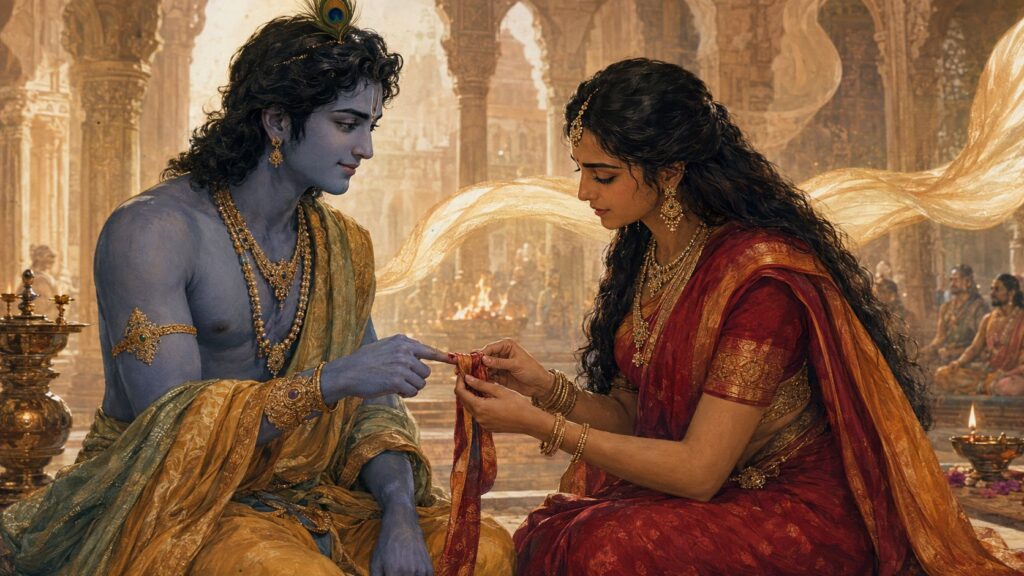
As the discus returned, its edge grazed Krishna’s own finger. Blood welled up. In the great hall, for a heartbeat, everyone hesitated — kings, elders, servants all caught between protocol and alarm. Only one person did not hesitate. Draupadi tore a strip from the border of her sari and wrapped it around the Lord’s bleeding finger, binding the wound before a single attendant had reached Him.
Krishna looked at the cloth of her sari on His hand, and He spoke the words that the whole festival of Raksha Bandhan would one day grow from:
“Sister, you have given a thread of your garment for my wound. I am in your debt now. And a day will come when I shall repay every single thread of it.”
She had asked for nothing. She had not tied a rakhi in any ceremony, on any auspicious tithi. She had simply, instinctively, protected someone she loved. And the Lord, who accepts the smallest sincere act as though it were the greatest sacrifice, turned it into a debt He would honour with the most famous rescue in all of Hindu scripture.
The Endless Cloth
The debt came due in the darkest scene of the Mahabharata — the vastraharan, the attempted disrobing of Draupadi in the gambling hall of Hastinapura.
Yudhishthira, snared in a rigged game of dice by Shakuni, had staked and lost everything: his wealth, his kingdom, his brothers, himself — and finally Draupadi. Dushasana dragged her by the hair into the assembly, and at Duryodhana’s command began to strip the sari from her body before the whole silent court of the Kurus.
Draupadi looked around that hall. Bhishma was there — the grandsire, the greatest warrior of the age. Drona was there. Her own five husbands, the mightiest men alive, sat with their heads bowed, bound by a technicality of the game. Not one of them rose. The men whose entire dharma was the protection of the weak sat frozen while a queen was violated in open court.
And so she stopped calling on any of them. She let go of the sari she had been clutching, raised both her arms, and called out to the one debtor she had — to Dwarka, to Govinda, to the friend whose finger she had once bound with a strip of this very cloth.
“Govinda! Dwarakavasi! Keshava! The Kauravas are laughing as I am shamed. Lord of the Yadavas, protector of the helpless — do you not see?”
What happened next is remembered in every village of Bharata. Dushasana pulled, and the sari did not end. He pulled again, and there was more cloth. He pulled and pulled, faster and faster, until the hall was buried in a rising sea of silk and the mighty Dushasana himself sank to the floor, drenched in sweat and defeated, and still Draupadi stood clothed and unshamed. The strip of cloth she had once given for the Lord’s wound had returned to her as an ocean of cloth for her honour — thread for thread, exactly as He had promised.
Krishna never appeared in the hall. He did not need to. The friend who does not forget His debts was present in the only way that mattered — in the endless cloth that no cruelty could exhaust.
Why This Is the True Root of the Rakhi
Look at what the story quietly overturns.
The men in that hall were bound to Draupadi by every formal tie the world respects — husbands, elders, kinsmen, sworn protectors. And every one of those ties failed her in the moment of need. The one bond that held was the one with no formal name at all: the friendship of a woman who had once, without being asked, wrapped a wound.
This is why the rakhi, unlike almost every other rite in the tradition, is not restricted by blood or gotra or marriage. A sister may tie it to a brother, yes — but also to a cousin, a friend, a soldier she has never met, a stranger who has shown her kindness. The Krishna–Draupadi bond is the scriptural charter for exactly that freedom. It teaches that raksha — real, unbreakable protection — is generated by love and honoured by dharma, not issued automatically by relationship.
What their bond asks of us
- To protect without being asked. Draupadi did not wait for a request; she saw a wound and moved. The finest raksha is the kind offered before it is demanded.
- To remember our debts. Krishna accounted a single strip of cloth a debt of honour. The small kindness done to us is not to be forgotten.
- To understand where true safety lies. When every worldly protector failed, the bond of sincere devotion held. The thread points beyond the human wrist it is tied to, toward the one protection that never fails.
The Friendship After the Fire
Their bond did not end with the gambling hall. Through the thirteen years of exile, through the war, through the desolation that followed it, Krishna remained Draupadi’s confidant — the one to whom she could pour out a grief and a fury the epic lets no one else fully hear. When her five sons were slaughtered in their sleep on the last night of the war, it was Krishna who steadied her. When she raged, He let her rage. When she despaired, He reminded her, without ever diminishing her pain, of the larger dharma turning beneath it all.
That is what a sakha is. Not a protector who solves everything, but a presence that never leaves — that repays the smallest kindness a hundredfold, that answers the cry raised in the worst hour, and that stays, through the fire and after it.
When you tie a rakhi this year, or receive one, remember that you are re-enacting not merely a family custom but the deepest friendship in the Mahabharata: the dark-skinned Lord and the fire-born queen, bound by a torn sari, who taught an entire civilisation that the truest bonds are the ones we choose.
She gave a thread. He returned an ocean. That is the arithmetic of divine friendship — and the real origin of the rakhi.
“To Krishna, son of Vasudeva, to Hari the Supreme Self, destroyer of the sufferings of those who bow to Him — to Govinda, salutations again and again.”