Twelve months turn in the Hindu year, and eleven of them are shared. One belongs, wholly and without rival, to Mahadeva.
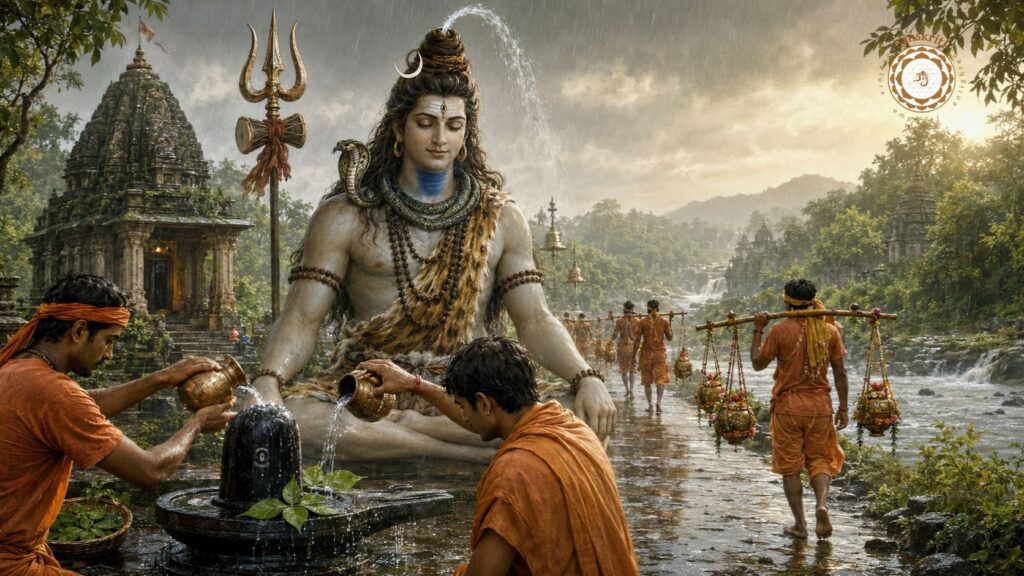
There is a change that comes over Bharata when Shravana arrives. The monsoon has broken; the dry earth has gone green; the rivers run full. And along every road that leads to a Shiva temple, a saffron tide begins to move — barefoot pilgrims in orange, carrying pots of Ganga water slung from decorated poles, walking hundreds of kilometres to pour that water over a Shivalinga. Bells that hung quiet all year ring from before dawn. The whole month tilts toward one presence.
This is Shravan — Sawan in the northern tongue — the holiest month in the entire calendar of Lord Shiva. In 2026 it runs, in the Purnimanta reckoning of North Bharata, from Thursday, July 30 to Thursday, August 27, and it carries within it four Shravan Somwars — the sacred Mondays — falling on August 3, 10, 17, and 24. To understand why devotees give this one month such total devotion, we have to return to the story of the churning of the ocean.
The Month the Ocean Was Churned
The Puranas tell that it was during Shravana that the great Samudra Manthan — the churning of the ocean of milk — took place. The devas and asuras, seeking the nectar of immortality, wound the serpent Vasuki around Mount Mandara and pulled him back and forth to turn the mountain in the sea.
Fourteen treasures rose from the churning. But before the nectar came, something else surfaced — a poison so terrible that the tradition names it Halahala, a venom whose fumes alone could wither all three worlds. It spread across the waters and rose into the sky, and gods and demons alike fled from it in terror. There was no one who could contain it.
There was one who would.
Lord Shiva gathered the world-ending poison into His own hand and drank it — holding it in His throat, refusing to let it pass into the creation He guards. The venom turned His throat blue, and from that hour He is called Nilakantha, the blue-throated one.
To cool the burning of the poison held in His throat, the devas poured water over Him, offered Him the leaves of the bael tree, and kept vigil. And because all of this — the churning, the poison, the drinking, the cooling — is held by tradition to have unfolded in the month of Shravana, the whole month became an offering to the Lord who swallowed death so that the worlds might live.
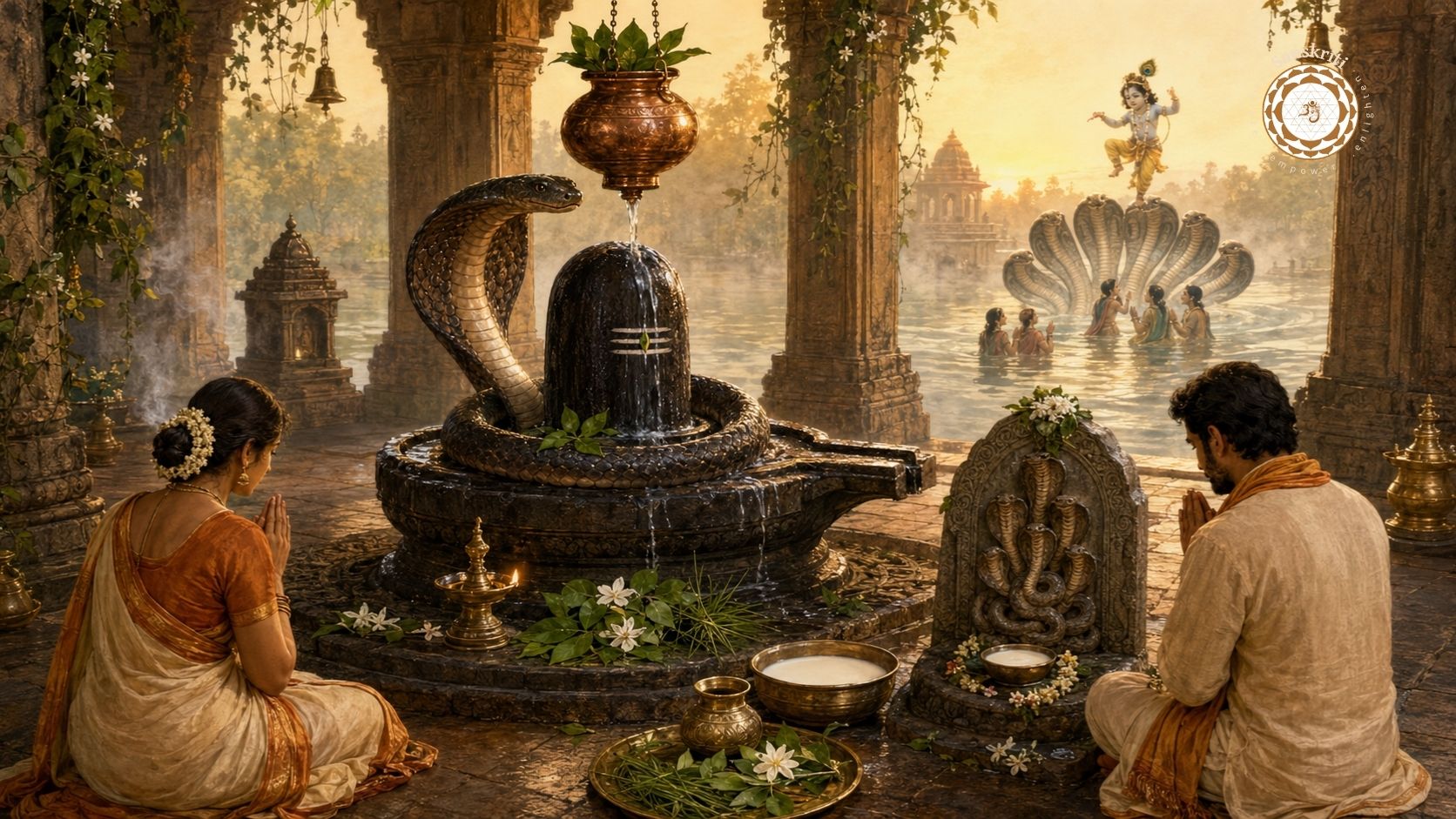
This is why the central act of Shravan worship is the abhishekam — the pouring of water, milk, and Ganga jal over the Shivalinga. Every devotee who pours water over the linga in Sawan is repeating the gesture of the gods: cooling the throat that holds the poison, thanking the Lord who drank it.
Why Monday — the Day of the Moon — Is Shiva’s Day
Every Monday of the year is sacred to Shiva, but the Mondays of Shravan — the Shravan Somwars — are the most powerful of all.
Monday is Somvar, the day of Soma, the Moon. And the Moon has a special place upon Shiva Himself: He wears the crescent Chandra in His matted hair. The story is told that Chandra, cursed to waste away, took refuge in Shiva, who set him upon His own head and stayed the curse — so that the moon now waxes and wanes but never dies. The Lord who rescued the Moon wears him still. To worship Shiva on the Moon’s own day is therefore to approach Him through the very being He sheltered.
The Solah Somwar Vrat — the fast of sixteen consecutive Mondays — is traditionally begun on the first Monday of Shravan, which makes this month the doorway to one of the most beloved vows in all of Shiva bhakti, kept especially by those seeking a good marriage or the well-being of a household.
Shravan 2026 — The Key Dates
Dates as per Purnimanta (North Indian) reckoning, standard Drik Panchang. In the Amanta system of Maharashtra, Gujarat, and the South, Shravan falls roughly a fortnight later. Verify with your local panchang.
| Shravan Begins | Thursday, July 30, 2026 |
|---|---|
| First Shravan Somwar | Monday, August 3, 2026 |
| Second Shravan Somwar | Monday, August 10, 2026 |
| Third Shravan Somwar | Monday, August 17, 2026 (also Nag Panchami) |
| Fourth Shravan Somwar | Monday, August 24, 2026 |
| Shravan Purnima / Raksha Bandhan | Friday, August 28, 2026 |
| Shravan Ends | Thursday, August 27, 2026 |
How to Keep the Sawan Vrat
- Rise early, bathe, and wear clean clothes — white or Shiva’s own colours where possible. Many devotees keep the fast especially on the Mondays.
- Visit a Shiva temple, or worship at the household altar before a Shivalinga or an image of Mahadeva.
- Perform abhishekam: pour water, and where possible milk, honey, curd, ghee, sugar, and Ganga jal over the linga. Offer bilva (bael) leaves — the leaf Shiva loves above all — along with white flowers, dhatura, and bhang where traditional.
- Light a lamp of pure ghee, offer incense, and recite the Panchakshari mantra — Om Namah Shivaya — or the Mahamrityunjaya mantra.
- Keep the fast simple: fruit, milk, and water (phalahari), broken after the evening puja. Avoid grains, onion, and garlic through the day.
- Read or hear the Shiva Purana, the Shiva Chalisa, or the story of the Samudra Manthan.
The Meaning of the Month
The Acharyas point to a quiet lesson hidden in why Shravan belongs to Shiva. Of all the beings present at the churning, only Mahadeva was willing to take the poison into Himself. He asked for none of the fourteen treasures. He drank the one thing no one else would touch, and held it in His throat forever.
This is the nature of the Lord that Shravan honours: the one who takes upon Himself what the world cannot bear, and in doing so makes the nectar possible for everyone else. When the devotee pours a little water over the linga on a Monday morning in Sawan, the gesture is small — a pot, a leaf, a whispered Om Namah Shivaya. But it joins a line of gratitude that stretches back to the gods themselves, cooling the throat of the one who swallowed death.
Eleven months are shared among the many. One belongs to the Lord who drank the poison. That month is Shravan — and it begins now.
Om Namah Shivaya — the five-syllabled mantra, the heart of all Shravan worship.