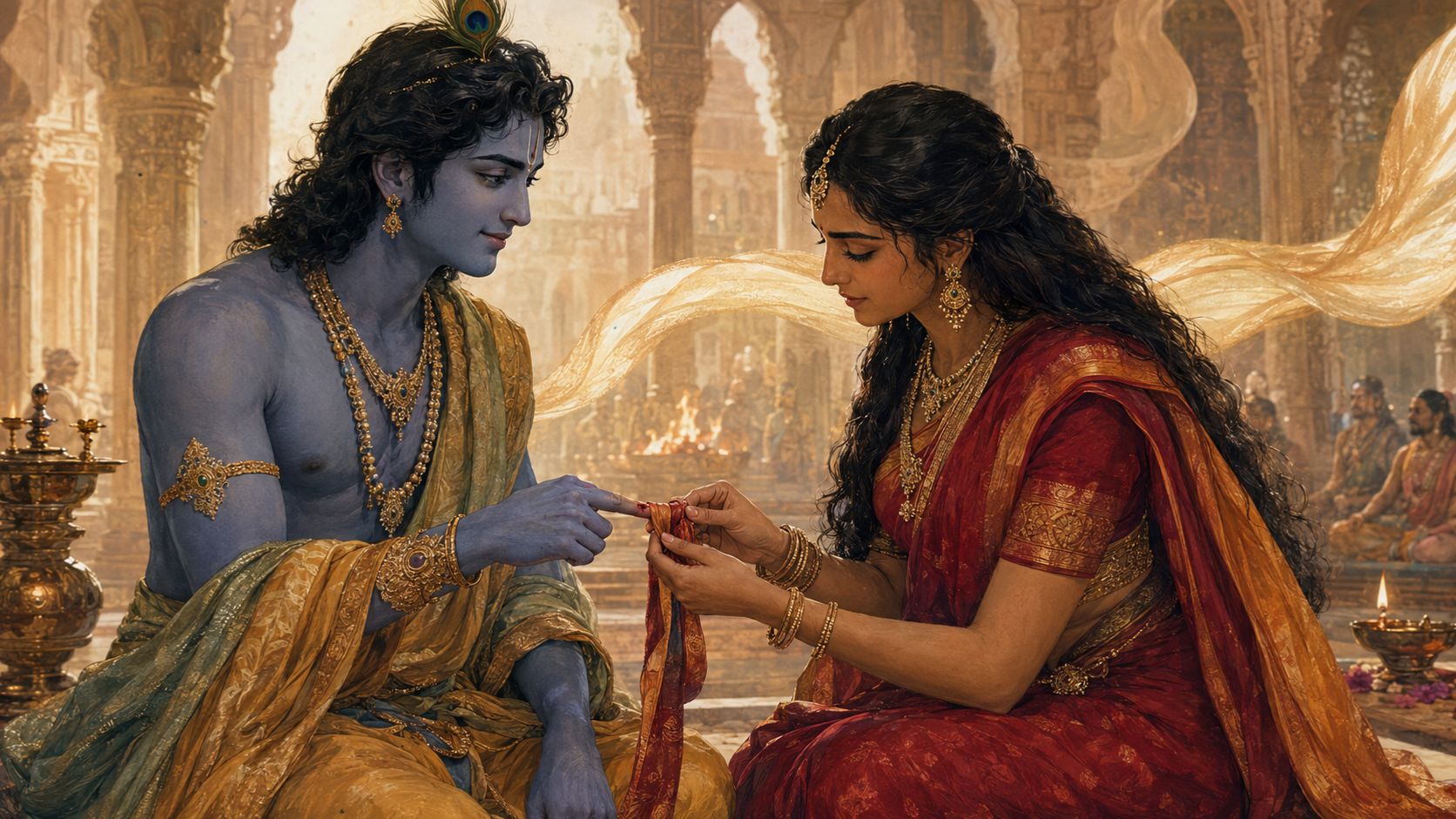
A civilisation that worships what the rest of the world has only ever feared — and understands, in doing so, something the rest of the world has forgotten.
To an outsider it is one of the strangest sights in the whole Hindu year. On the fifth day of bright Shravana, families set out saucers of milk at the mouths of anthills and at the base of old trees, carry offerings to stone serpents coiled at temple thresholds, and fold their palms not away from the snake but toward it. In a world that has spent its whole history trying to kill the serpent, Sanatana Dharma stops once a year to honour it.
In 2026, that day falls on Monday, August 17 — and the date carries a quiet gift, for it is also a Shravan Somwar, one of the sacred Mondays of Lord Shiva. The serpent’s day and Shiva’s day fall together, which is exactly as it should be — for of all the deities of the tradition, none is closer to the Naga than the Lord who wears one around His throat.
Why the Serpent, of All Creatures?
The Western imagination made the serpent the emblem of temptation and evil. Sanatana Dharma looked at the same creature and saw something altogether different: a being that sheds its skin and emerges renewed, that lives between the surface world and the hidden depths of the earth, that holds within its body both deadly venom and, in the tradition’s telling, the guardianship of the world’s deepest treasures and truths.
The Nagas of the Puranas are not mere animals. They are a celestial race — beautiful, intelligent, immensely powerful, dwelling in the jewelled subterranean realm of Patala under their king Vasuki and the great Ananta. They guard the waters, the rains, the fertility of the soil, and the hidden wisdom of the earth. To honour them is to acknowledge a whole order of life the human eye rarely sees but on which human life quietly depends.
And nowhere in the tradition is the serpent a symbol of evil. It is, again and again, a symbol of support — of the vast, patient power that holds everything else up.
The Serpents Who Hold Up the World
Sheshanaga — the couch of Vishnu
Before the worlds are made, the Puranas tell us, Bhagavan Vishnu reclines upon the cosmic ocean of milk, and His couch is a serpent — Shesha, also called Ananta, “the endless one,” His thousand hoods spread like a canopy over the sleeping Lord. When each cycle of creation ends and all the worlds dissolve, it is Shesha who remains, floating on the waters, holding the Lord until it is time to begin again. The name is exact: shesha means “the remainder” — that which is left when everything else is gone.
Vasuki — the churning-rope of the gods
When the devas and asuras churned the ocean of milk to draw out the nectar of immortality, they needed a rope vast enough to turn Mount Mandara. They took Vasuki, king of serpents, and wound him around the mountain. For ages the gods and demons pulled him back and forth, until the friction wrung from his mouth the terrible poison Halahala that threatened to consume all creation — the poison that Lord Shiva then drank to save the worlds, holding it in His throat until it turned Him blue-throated, Nilakantha. The serpent, in that story, is the very instrument by which immortality is won.
The garland of Shiva
And Shiva Himself wears the serpent Vasuki coiled about His neck as an ornament — not a captive, but a devotee given the highest place, resting against the throat that holds the world’s poison. Where others see a thing to fear, the Great Lord sees a companion fit to wear as a garland. On a Shravan Monday that falls on Nag Panchami, this is the image to hold: the serpent at rest on the neck of God.
Krishna and Kaliya — Subduing, Not Destroying
The most beloved serpent story of all shows the tradition’s whole attitude in miniature.
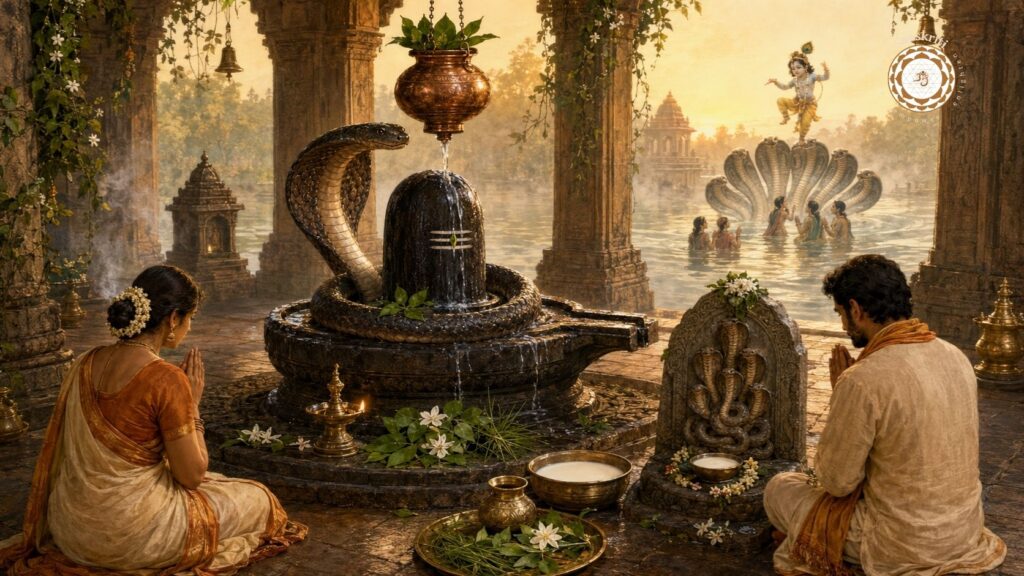
The great serpent Kaliya had poisoned a deep pool of the Yamuna until its waters ran black and no bird could fly over it and live. The child Krishna leapt into the pool, and Kaliya wound his coils about Him. The cowherds wailed on the bank. Then Krishna began to grow, and grow, until the serpent could no longer hold Him — and He rose up and danced upon Kaliya’s many hoods, His small feet beating down each rearing head in turn.
But mark the ending. Krishna did not kill Kaliya. When the serpent’s wives, the Nagapatnis, bowed and begged for their husband’s life, the Lord relented at once. He commanded Kaliya only to leave the Yamuna and return to the ocean — and, the Bhagavata adds, He blessed him: the mark of the Lord’s own feet upon Kaliya’s hoods would henceforth protect the serpent from every enemy.
He subdued the venom and spared the serpent. This is the way of dharma — not the extermination of what is dangerous, but its correction and its blessing.
Astika and the Origin of the Day
The festival’s own charter-story is the tale of the sage Astika, told in the Adi Parva of the Mahabharata.
King Janamejaya, grieving his father Parikshit — who had died of a Naga’s bite — resolved to destroy the entire serpent race. He began a terrible Sarpa Satra, a serpent-sacrifice, whose mantras dragged the Nagas one by one through the air and into the sacrificial fire. The race of serpents was near extinction. Then a young brahmana approached the sacrifice — Astika, whose mother was herself a Naga and whose father was a great rishi. So perfect was his praise of the king that Janamejaya offered him any boon. Astika asked for one thing only: that the sacrifice be stopped and the serpents spared.
Bound by his word, the king relented. The surviving Nagas were saved. And the day on which they were spared, the tradition holds, was the Shukla Panchami of Shravana — the day we keep as Nag Panchami. It is, at its root, a festival of reconciliation: the day the war between man and serpent was called off.
Nag Panchami 2026 — Date and Timings
All timings as per standard Drik Panchang reckoning (IST). Verify with your local panchang for regional variation.
| Panchami Tithi Begins | approx. 04:52 PM, Sunday, August 16, 2026 |
|---|---|
| Panchami Tithi Ends | approx. 05:00 PM, Monday, August 17, 2026 |
| Nag Panchami | Monday, August 17, 2026 (also a Shravan Somwar) |
| Puja Muhurat | approx. 06:04 AM to 08:39 AM |
How to Observe Nag Panchami
- Rise early, bathe, and keep a light vrat (fast) through the day if you are able. Many observe a phalahari fast broken after the evening puja.
- At the household altar, place an image or a small clay or silver figure of the Naga, or draw a serpent with sandal paste, turmeric, and rice-flour beside the deity.
- Offer milk, water, haldi, kumkum, flowers, and durva grass. Milk is the traditional offering — a gesture of feeding and appeasing the Naga rather than fearing it.
- Where there is a Naga stone or a serpent shrine near a temple or peepal tree, offer milk and light a lamp there. In many regions, this is also a day to visit a Shiva temple — fitting, in 2026, since the day is also a Shravan Monday.
- Recite the names of the great serpents and read the story of Astika or the Kaliya-mardana from the Bhagavata.
- Traditionally, no digging of the earth, ploughing, or cutting is done on this day, out of respect for the serpents who dwell within the soil.
A word of care: the deepest form of this worship honours the Naga as a divine principle. Live snakes are not to be captured, disturbed, or force-fed milk — that harms the very creature the day exists to protect. The reverence is best offered to the image, the shrine, and the earth, and expressed as a vow to protect serpent life, not to trouble it.
What the Serpent Teaches
There is a reason the tradition places the serpent everywhere its deepest truths are told. The Kundalini, the spiritual energy that lies dormant at the base of the spine and rises, when awakened, through the centres of the subtle body, is imagined as a coiled serpent — kundalini means “she who is coiled.” The serpent that sheds its skin is the emblem of the soul that sheds body after body and is never itself destroyed. The serpent that holds up Vishnu is the patient, unseen power on which all created things rest.
To worship the Naga is to make peace with the very things the untrained mind fears most — death, the depths, the hidden, the dangerous — and to recognise that these too are held within the divine order, that these too can be honoured, blessed, and turned toward the good.
The world learned to kill the serpent. Sanatana Dharma learned to bow to it — and in bowing, understood that nothing in creation is beyond the reach of grace.
The traditional invocation of the nine great Nagas — Ananta, Vasuki, Shesha, Padmanabha, Kambala, Shankhapala, Dhritarashtra, Takshaka, and Kaliya — recited on Nag Panchami for protection and blessing.