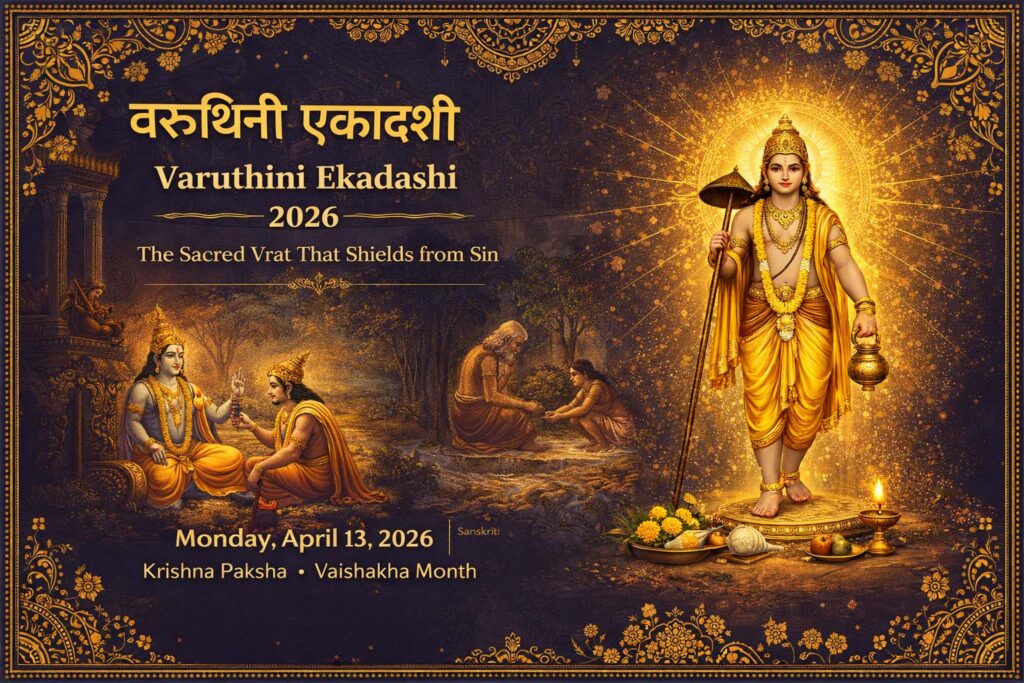
Varuthini Ekadashi 2026 — The Sacred Vrat That Shields from Sin
Observed on Monday, April 13, 2026 | Krishna Paksha Ekadashi, Vaishakha Month
Among the twenty-four Ekadashi vrats observed through the year, Varuthini Ekadashi holds a uniquely protective power. The very name “Varuthini” is derived from the Sanskrit root meaning “that which shields” or “that which protects.” Falling on the Krishna Paksha (waning moon) Ekadashi of the Vaishakha month, this sacred fast is described in the Bhavishya Purana as capable of dissolving the accumulated karmic burden of countless lifetimes and guiding the devoted soul toward Moksha — final liberation from the cycle of birth and death.
As Lord Krishna himself explained to Dharmaraja Yudhishthira, the merit earned by observing Varuthini Ekadashi with sincerity and devotion equals the merit of donating a thousand cows or performing tapasya for ten thousand years.
The Deity: Lord Vamana — The Fifth Avatara of Bhagavan Vishnu
Varuthini Ekadashi is dedicated to Lord Vamana, the fifth avatara of Bhagavan Vishnu. In this divine form, the Supreme Lord appeared as a young Brahmachari dwarf who approached the mighty Asura king Bali during a great yajna. Lord Vamana asked for a humble gift — just three paces of land. When granted, He expanded to His cosmic Trivikrama form, covering the entire Earth with one step, the heavens with another, and with the third step, pressed Bali into the netherworld, restoring the cosmic order of Dharma.
On Varuthini Ekadashi, devotees worship Lord Vamana or Bhagavan Vishnu with yellow flowers, Tulsi leaves, incense, and a ghee lamp, invoking His protective grace.
The Vrat Katha: The Redemption of Dhrishthabuddhi
The sacred account of Varuthini Ekadashi, as narrated in the Bhavishya Purana, tells the story of a man named Dhrishthabuddhi, born in the city of Bhadravati as the son of a wealthy and righteous merchant named Dhanapala.
While Dhanapala lived a life of Dharma — distributing food grains, offering alms, and uplifting the poor — his son Dhrishthabuddhi walked the opposite path. He squandered his father’s wealth on gambling, intoxication, and the company of those who had strayed from Dharmic living. In time, his actions brought such shame upon the family that the king banished him from the kingdom.
Cast into the wilderness, Dhrishthabuddhi survived by committing further adharma — stealing, hunting, and harming innocent creatures. His karmic debt grew heavier with each passing day.
One day, by the grace of the Divine, he came upon Rishi Kaundinya, who was performing his sacred ablutions at a forest stream. A few drops of that sanctified water fell upon Dhrishthabuddhi, and in that moment, something within him stirred. The contact with the sacred water awakened a dormant spark of conscience.
Falling at the feet of the Rishi, Dhrishthabuddhi confessed his sins and begged for a path to redemption. Rishi Kaundinya, moved by compassion, instructed him to observe the Varuthini Ekadashi vrat with complete devotion and surrender to Bhagavan Vishnu.
Dhrishthabuddhi followed the Rishi’s guidance with full faith. Through the power of his sincere vrat, his accumulated sins — described as vast as mountains — were burned away entirely. When his time on Earth came to an end, celestial beings arrived to escort him to Vaikuntha, the eternal abode of Bhagavan Vishnu.
The teaching is clear: no soul is beyond redemption when it turns toward the Divine with genuine devotion.
Sacred Mantra
The primary mantra to chant during the Varuthini Ekadashi vrat is:
ॐ नमो भगवते वासुदेवाय
Om Namo Bhagavate Vasudevaya
Meaning: “I bow to Bhagavan Vasudeva (Vishnu/Krishna), the Supreme Being who dwells in all.”
This twelve-syllable Dvadashakshari Mantra is one of the most powerful Vaishnava mantras. Devotees are also encouraged to recite the Vishnu Sahasranama (the thousand names of Bhagavan Vishnu) during the night vigil.
Varuthini Ekadashi 2026 — Timings
- Ekadashi Tithi Begins: 1:16 AM on Monday, April 13, 2026
- Ekadashi Tithi Ends: 1:08 AM on Tuesday, April 14, 2026
- Parana (Fast-Breaking) Window: 6:54 AM to 8:31 AM on April 14, 2026
Complete Puja Vidhi — How to Observe Varuthini Ekadashi
The Day Before (Dashami — April 12)
- Eat a simple, sattvic meal in the evening. Avoid heavy foods, honey, and lentils.
- Pluck fresh Tulsi leaves for the next day’s puja. (Note: Tulsi leaves should never be plucked on Ekadashi itself.)
- Set your intention (sankalpa) for the vrat before sleeping.
Ekadashi Day (April 13)
- Brahma Muhurta: Wake before sunrise. Take a purifying bath, adding sesame seeds to the water if possible.
- Sankalpa: Stand before your puja space and formally take the vow of observing the Varuthini Ekadashi vrat for the pleasure of Bhagavan Vishnu and the purification of your Atma.
- Puja Setup: Place an idol or image of Lord Vamana or Bhagavan Vishnu on a clean altar. Light a ghee lamp and incense.
- Offerings: Offer yellow flowers, Tulsi leaves, seasonal fruits, panchamrit, and bhog to the deity.
- Chanting: Recite Om Namo Bhagavate Vasudevaya 108 times. Read or listen to the Varuthini Ekadashi Vrat Katha.
- Fasting: Observe a complete Nirjala (waterless) fast if health permits. Otherwise, consume only fruits, nuts, and milk (phalahari vrat). Avoid all grains, pulses, spinach, honey, and betel leaves.
- Night Vigil (Jagaran): Stay awake through the night, singing bhajans, reciting the Vishnu Sahasranama, and meditating on the lotus feet of Bhagavan Vishnu.
Dwadashi Day — Parana (April 14)
- Bathe early and offer morning prayers.
- Offer food to a Brahmin or donate to those in need — charity on this day is considered extraordinarily meritorious.
- Break your fast (parana) between 6:54 AM and 8:31 AM with a simple, non-grain meal.
Important Guidelines
- Do not use bell-metal (kansa) utensils during the vrat.
- Avoid daytime sleep, gossip, and speaking ill of others.
- Practise silence or speak only of Dharmic matters.
- Those unable to fast fully may observe a partial (phalahari) vrat — the intention and devotion matter most.
The Spiritual Teaching of Varuthini Ekadashi
Varuthini Ekadashi carries a profound message that echoes across all Dharmic traditions: no karmic debt is so great that it cannot be dissolved through sincere devotion and surrender.
The account of Dhrishthabuddhi is not merely a story of one man’s redemption — it is a mirror held up to every soul. Each of us carries the weight of past actions, some conscious, some forgotten. Varuthini Ekadashi offers a sacred window — a day when the protective shield of Bhagavan Vishnu’s grace is most accessible, when the act of fasting and prayer can dissolve accumulated karmic residue that might otherwise take lifetimes to exhaust.
But the vrat is not merely about abstaining from food. It is about abstaining from the tendencies that bind us — anger, greed, arrogance, and attachment. The true fast is of the mind. When the body is still and the mind is turned inward toward the Divine, the Atma is purified and the path to Moksha becomes clear.
As the Bhavishya Purana teaches: the merit of Varuthini Ekadashi protects the devotee like an impenetrable shield — from the consequences of past adharma, from the pull of worldly delusion, and from the fear of what lies beyond this life.
May the observance of this sacred vrat bring you Bhagavan Vishnu’s eternal protection and guide you ever closer to the light of liberation.
Om Namo Bhagavate Vasudevaya 🙏
Sanskriti Magazine — Sharing Indian Heritage, Achievements, Practices and Values with the world.