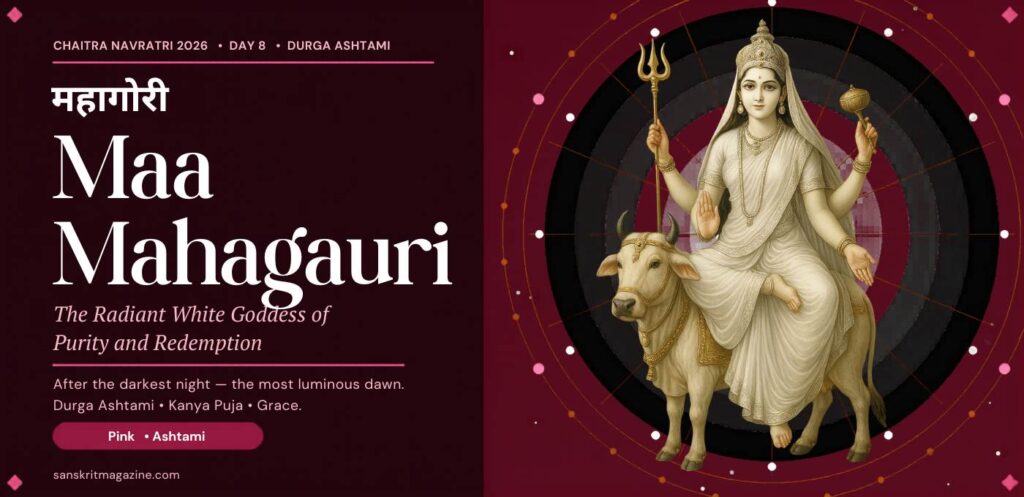
Maa Mahagauri
The Radiant White Goddess of Purity and Redemption
After the night of Kalaratri, morning comes.
Not gently — not as a slow softening of darkness — but in a blaze of absolute, snow-white radiance that leaves no corner of the soul untouched. This is the gift of Day 8. This is Maa Mahagauri — the Great White One, the goddess of luminous purity, who emerges on the morning after the darkest night with a brightness that renders everything dark behind her.
Durga Ashtami — the eighth day of Navratri — is one of the most sacred days in the Hindu calendar. It is the day on which devotees perform havan (sacred fire ceremony), on which the full power of nine days of accumulated prayer reaches its culmination, and on which young girls are worshipped as living manifestations of the Goddess herself in the practice of Kanya Puja. On this day, in this goddess, the entire arc of Navratri finds its penultimate expression: after every form of the divine — the mountain, the ascetic, the warrior, the creator, the mother, the righteous destroyer, the liberating darkness — comes the one who simply says: you are forgiven, you are pure, you are free.
The Story of Mahagauri: How Darkness Became Light
The story of Mahagauri is, at its heart, a story about transformation — about what happens when the darkest phase of a journey is not the end but the turning point.
Parvati had performed her tapas — thousands of years of austerity that had darkened her golden skin to the colour of the forest, to the deep brown of the earth, to the dark intensity that the sages compared to a rain-cloud. She had become Kali in appearance — dark, intense, stripped of every ornament of beauty. And in this state, Shiva — who loved her in every form but who also had a habit of gentle teasing — called her Kali and Shyama (dark one) with a playful smile.
Parvati, stung by the teasing, withdrew to perform further tapas — this time specifically to regain her luminous golden form. Brahma appeared and told her: the form she sought was already hers. The tapas had purified her to the point where the divine luminosity that had always been within her could now shine through without obstruction.
But it was Shiva who completed the transformation. He bathed her in the sacred waters of the river Ganga — and as the Ganga's waters flowed over her, she emerged Mahagauri: luminously, impossibly white. White like the full moon. White like the purest snow of the Himalayas. White like the inside of a white lotus. Maha (महा) — great, supreme, absolute. Gauri (गौरी) — fair, white, luminous.
The Sacred Iconography of Maa Mahagauri
Pure White Complexion
Mahagauri's complexion is described as white like a conch shell, white like the moon, white like jasmine. The texts pile image upon image to convey a whiteness that is not the white of absence, not the white of a blank page, but the white of pure, complete, total luminosity — the white of a being who has been through every shade of darkness and emerged with every shadow burned away.
White Garments and White Ornaments
She wears entirely white garments and white ornaments. In a tradition where red, gold, and saffron are the dominant colours of puja and celebration, this all-white presentation is deliberately extraordinary. White is Sattva at its purest — the quality of pure consciousness, unclouded by passion or inertia. She wears the colour of liberation itself.
The Damaru and Trishul
She holds a damaru (Shiva's small hourglass drum — the primordial sound of creation) in one upper hand and a trishul in the other. Her lower hands are in Abhaya and Varada mudra. The damaru in her hands is significant: it is Shiva's instrument, and she holds it as his equal and partner — not as a subsidiary, but as the goddess who stands at Shiva's level, carrying his symbol as a statement of their complete, mutual, non-hierarchical love.
The Bull Mount
Like Shailputri on Day 1, Mahagauri rides a white bull — the circle of Navratri completing itself. We began at the mountain on a bull, rooted in the earth of dharma. We end (before the final summation of Day 9) on a bull, but now the bull is white — purified, elevated, carrying not the nascent mountain daughter but the fully realised, completely liberated, absolutely radiant divine feminine in her triumphant form.
- Form: Parvati after Shiva's purification — luminously white, fully liberated
- Vehicle: White bull — purified dharma; the full circle from Day 1
- Hands: Damaru, trishul, Abhaya mudra, Varada mudra
- Complexion: Luminously white — pure as conch, moon, and jasmine
- Colour worn today: Pink — compassion, grace, love in its softest expression
- Planet governed: Rahu — karmic shadows, sudden transformation, liberation from illusion
- Bhog (offering): Coconut, halwa-puri-chana (full Ashtami bhog)
- Chakra: Muladhara — full circle; the root now purified and luminous
Mahagauri and Rahu: The Governance of Illusion's Destroyer
Maa Mahagauri governs Rahu — the shadow planet, the north node of the moon, the planet of karmic illusions, obsessions, sudden upheavals, and the hunger that cannot be satisfied by ordinary means. Rahu in Vedic astrology represents the parts of our karma that we carry as shadows — the unresolved desires and fears that come from previous lifetimes, that make us act in ways we don't fully understand, that keep pulling us toward certain patterns no matter how hard we consciously resist.
That Mahagauri — the goddess of pure, instant, unconditional redemption — governs Rahu is one of the most beautiful assignments in the entire Navdurga system. The only thing that can truly neutralise Rahu's shadow is not more effort, not more strategy, not working harder at the karmic debt — but the grace of the divine that washes away even the deepest shadow, just as Ganga water washed away Parvati's darkness and revealed the luminosity that had always been there.
श्वेते वृषेसमारूढा श्वेताम्बरधरा शुचिः ।
महागौरी शुभं दद्यान्महादेवप्रमोददा ॥
Shwete Vrishesamarudha Shwetaambaradharaashuchi
Mahagauri Shubham Dadyaan Mahaadev Pramod Adaa
"Seated on a white bull, dressed in white garments, pure and auspicious — may Mahagauri, who gives joy to Mahadeva, bestow blessings upon me."
Durga Ashtami: The Most Sacred Day of Navratri
Of the nine days of Navratri, Ashtami — the eighth — is considered by many traditions to be the most powerful for worship and for receiving the Goddess's blessings. This is the day of the full havan, the day of Kanya Puja, and the day on which the accumulated energy of eight days of prayer and fasting reaches its peak before the final completion of Day 9.
Ashtami Havan: The Sacred Fire Ceremony
The Ashtami havan is performed in the morning, after the daily puja but before breaking the fast. A fire is built in a copper or clay havan kund (fire pit). Sacred items are offered into the fire with the chanting of mantras: ghee, samagri (a mixture of aromatic herbs, seeds, and sacred substances), sesame seeds, barley, and specific items associated with the goddess of the day. Each offering into the fire is accompanied by "Swaha" — the invocation that carries the offering to the divine.
If performing a home havan is not practical, simply lighting a ghee lamp and offering camphor (kapur) while chanting the Mahagauri mantra carries the same spiritual intention and is entirely valid.
Kanya Puja: Worshipping the Goddess in the Living Girl
Kanya Puja is one of the most moving and theologically profound practices in the Hindu tradition — and Ashtami is its primary day. Nine young girls, ideally between the ages of two and ten years old, are invited to the home. Their feet are washed by the host. They are seated on the puja platform, offered the full Ashtami bhog (halwa, puri, chana), given new clothes or a gift, and worshipped with flowers, kumkum, and prayer — because each one is recognised as a living manifestation of one of the nine forms of Navdurga.
The theological statement of Kanya Puja is radical and beautiful: the divine feminine does not live only in stone or bronze or paint. She lives in the girl next door. She is present in every female child, in all her ordinariness and all her extraordinary potential. To worship the kanya is to practice the seeing that the tradition teaches as the highest: brahman-drishti — the vision that sees the divine in everything and everyone.
- Sooji Halwa: 1 cup semolina (or kuttu atta for vrat), roasted in 3 tbsp ghee until golden. Add 2 cups hot water, 4 tbsp sugar, cardamom. Stir until thick and fragrant.
- Kuttu Puri: Buckwheat flour dough, rolled thin and deep-fried in ghee or oil until puffed and golden.
- Kala Chana (Black Chickpeas): Soaked overnight, boiled with salt, cumin, and a pinch of hing. Dressed with a tempering of ghee, whole spices, and fresh coriander.
This trio — halwa, puri, chana — is the complete traditional Kanya Bhog, served to the nine girls before anyone else eats on Ashtami morning.
Why Pink? The Significance of Today's Navratri Colour
Pink is the colour of Day 8 — and it carries a perfectly calibrated message after the royal blue of Kalaratri's night. Pink is red softened by white: the passion and courage of the warrior (red) now tempered and gentled by the pure luminosity of Mahagauri (white). It is the colour of the dawn after the deepest night. It is the colour of compassion — not the fierce compassion of the warrior, but the soft, unconditional compassion of one who sees your darkness and loves you anyway.
Pink is the colour of the lotus in certain traditions, of the first light of sunrise, of the newborn — of life as it emerges, tender and luminous and impossibly delicate, from every kind of darkness. Wearing pink today is a declaration: I have come through the night. I am still here. And I am ready to be luminous.
The Deeper Teaching: The Possibility of Instant Redemption
Mahagauri's teaching is perhaps the most needed in our age of endless self-improvement, of productivity systems and optimisation culture, of the relentless pressure to be better, do more, earn more grace through more effort. She stands against all of this with a single, luminous, absolute truth: you can be forgiven completely, instantly, not because you have earned it, but because you have sincerely asked.
This is the doctrine of grace — the principle that runs through every great spiritual tradition: that at a certain point, the accumulated weight of karma and sin and mistake cannot be addressed by more effort, by working harder at the problem, by adding more austerity to what has already been done. At that point, only grace works. Only the completely unearned, unconditional, love-sourced yes of the divine can reach into the deepest places and dissolve what has been there for lifetimes.
Mahagauri is the embodiment of that yes. She asks only one thing: sincerity. Not perfection, not a flawless record, not proof that you have already fixed yourself. Just the sincere turning of the heart toward the light. Just the honest acknowledgment: I want to be free. That is enough for Mahagauri. That has always been enough.
🙏 Jai Maa Mahagauri! Happy Durga Ashtami! Wear pink today. Perform Kanya Puja if possible — offer halwa, puri, chana to nine young girls and bow to the goddess in each one. Chant ॐ देवी महागौर्यै नमः 108 times. And today, give yourself permission to be forgiven — for all of it, whatever it is. That is Mahagauri's greatest gift, freely given, always available. 🕊️
Published by Sanskriti Magazine — India's largest digital platform for Hindu heritage, culture, and spirituality.
Read more at sanskritimagazine.com · Follow us on Instagram & Facebook: @indian_sanskriti
The final day tomorrow: Day 9 — Maa Siddhidatri, the bestower of all Siddhis, and Ram Navami. The journey completes. 🙏