Akshaya Tritiya 2026 — The Day That Never Diminishes
Observed on Sunday, April 19, 2026 | Shukla Paksha Tritiya, Vaishakha Month
There are days in the Hindu calendar that carry the weight of eternity. Akshaya Tritiya is one of them. The word “Akshaya” means “that which never diminishes, that which is imperishable” — and on this tithi, the Shastras declare that any act of dharma, dana, japa, or homa performed with sincerity yields results that never decay. The merit is eternal. The blessings are without end.
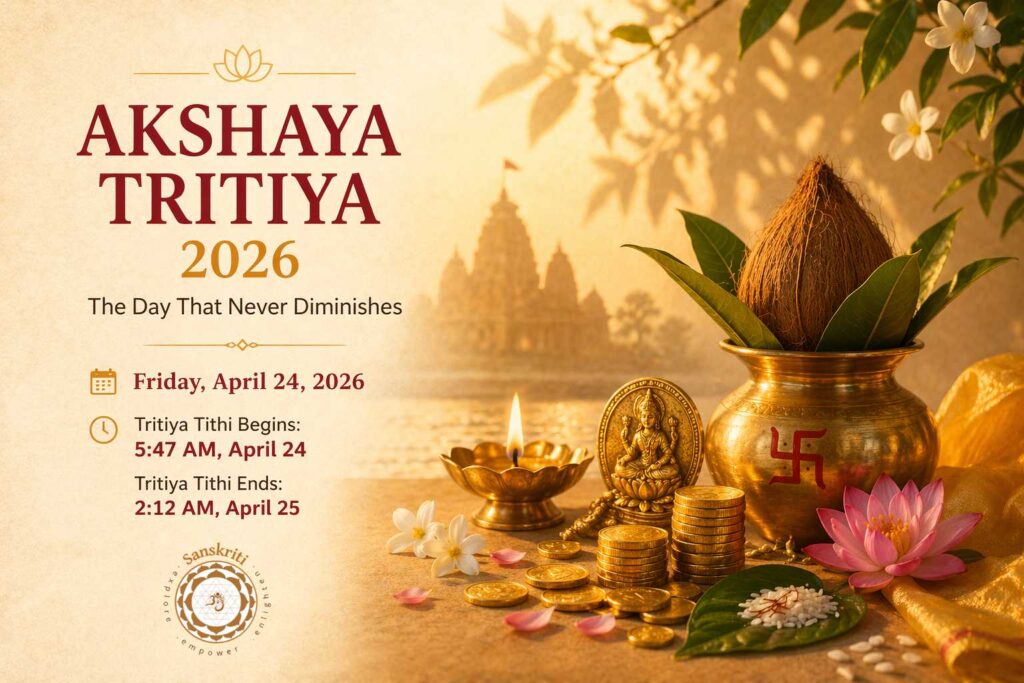
Falling on Sunday, April 19, 2026, Akshaya Tritiya is one of the most auspicious days in the entire Vedic calendar — a day so inherently sacred that it requires no separate muhurta. The tithi itself is the muhurta. Every moment of this day is charged with the power of the imperishable.
Akshaya Tritiya 2026 — Timings
- Date: Sunday, April 19, 2026
- Tritiya Tithi Begins: 10:49 AM on April 19, 2026
- Tritiya Tithi Ends: 7:27 AM on April 20, 2026
- Puja Muhurat: 10:49 AM to 12:20 PM (1 hour 32 minutes) — the peak window for puja, dana, and japa
Five Sacred Events of Akshaya Tritiya
The Puranas associate Akshaya Tritiya with five extraordinary events — each one a marker of divine grace flowing into the world without limit. Together, they reveal why this tithi carries such immense spiritual potency.
1. The Appearance of Bhagavan Parashurama
Akshaya Tritiya is celebrated as the jayanti of Bhagavan Parashurama, the sixth avatara of Bhagavan Vishnu. Born to Rishi Jamadagni and Devi Renuka, Parashurama appeared on this tithi wielding the divine parashu (axe) given to Him by Bhagavan Shiva. He is the Chiranjeevi — the immortal one — who still walks the earth, and whose tapasya and valour restored Dharma when the Kshatriya order had strayed from righteousness. His appearance on Akshaya Tritiya symbolises the truth that Dharma, once established by the Divine, is imperishable.
2. The Beginning of Treta Yuga
According to the Bhagavata Purana and other Puranic texts, Akshaya Tritiya marks the very beginning of Treta Yuga — the second of the four great cosmic ages. It was in Treta Yuga that Bhagavan Rama appeared, that the Ramayana unfolded, and that Dharma was upheld through the supreme example of Maryada Purushottama. The commencement of an entire Yuga on this tithi speaks to the boundless creative power that this day holds.
3. Sudama’s Visit to Bhagavan Krishna
One of the most beloved accounts in the Bhagavata Purana is the visit of Sudama (also known as Kuchela) to his childhood friend, Bhagavan Krishna, at Dwaraka. Sudama, a poor Brahmana living in dire poverty, carried nothing but a handful of beaten rice (poha) as an offering. Bhagavan Krishna received His devotee with overflowing love, washed his feet, and accepted the humble offering with supreme delight. When Sudama returned home, he found his modest hut transformed into a magnificent palace — not because he had asked, but because the Lord’s grace flows without limit to those who offer even the smallest thing with a full heart. This event is said to have occurred on Akshaya Tritiya, affirming the teaching that what is given with devotion on this day returns multiplied beyond all measure.
4. Draupadi and the Akshaya Patra
When the Pandavas were sent into exile in the forest, Devi Draupadi faced the impossible task of feeding her husbands, their attendants, and the sages who visited them daily — with nothing. In her anguish, she turned to Bhagavan Krishna, who gifted her the Akshaya Patra — a divine vessel that would produce unlimited food every day until the last person had eaten. The vessel never ran empty. It was given on Akshaya Tritiya, and its very name carries the essence of this tithi: that which never diminishes.
5. The Descent of Maa Ganga
The Puranic tradition also associates Akshaya Tritiya with the sacred descent of Maa Ganga from the celestial realm to Bhuloka (the earthly plane). Through the tapasya of King Bhagiratha and the grace of Bhagavan Shiva, who received the mighty river in His matted locks, the Ganga flowed down to purify the earth and liberate the souls of Bhagiratha’s ancestors. The Ganga’s descent on this tithi reinforces the central teaching of Akshaya Tritiya: divine grace, once it flows, is inexhaustible.
The Deeper Meaning — Beyond Gold-Buying
In recent decades, Akshaya Tritiya has become widely associated with buying gold and making material investments. While there is nothing wrong with this — the Shastras do affirm that wealth acquired on this day is blessed — it is important not to lose sight of the deeper teaching.
The true “gold” of Akshaya Tritiya is not the metal you store in a locker. It is the merit you store in your Atma. The Rishis taught that the most imperishable investments are:
- Dana — charity given without expectation of return
- Japa — the repetition of the Divine Name
- Tapasya — austerity and self-discipline performed with devotion
- Seva — selfless service to the Divine and to all beings
These are the treasures that follow the Atma beyond this life. On Akshaya Tritiya, their power is multiplied manifold. This is the day to invest not only in worldly wealth, but in the eternal wealth of Dharma.
Sacred Mantras for Akshaya Tritiya
The primary mantras to chant on Akshaya Tritiya are dedicated to Bhagavan Vishnu and Bhagavan Parashurama:
ॐ नमो भगवते वासुदेवाय
Om Namo Bhagavate Vasudevaya
“I bow to Bhagavan Vasudeva, the Supreme Being who dwells in all.”
ॐ नमो भगवते परशुरामाय
Om Namo Bhagavate Parashuramaya
“I bow to Bhagavan Parashurama, the imperishable avatara.”
Devotees may also recite the Vishnu Sahasranama or the Sri Sukta (the Vedic hymn to Devi Lakshmi) during the puja muhurat for maximum spiritual benefit.
Complete Puja Vidhi — How to Observe Akshaya Tritiya
1. Early Morning Preparation
- Rise before sunrise. Bathe and wear clean, fresh clothes — preferably yellow or white.
- Clean and decorate your puja space. Place fresh flowers, especially yellow flowers and Tulsi leaves.
- Light a ghee lamp and incense.
2. Sankalpa (Sacred Resolve)
- Stand or sit before your puja altar. Take water in your right palm and formally declare your intention to observe the Akshaya Tritiya puja for the pleasure of Bhagavan Vishnu and the purification and prosperity of your family.
- Release the water into a plate or on the ground as you state your sankalpa.
3. Puja (During the Muhurat: 10:49 AM to 12:20 PM)
- Place an idol or image of Bhagavan Vishnu (or Bhagavan Parashurama, or Bhagavan Krishna with Sudama) on the altar.
- Perform Shodashopachara Puja (the sixteen-step worship) if possible, or a simplified puja with panchamrit abhisheka, yellow flower garlands, Tulsi leaves, fruits, and sweets.
- Chant Om Namo Bhagavate Vasudevaya 108 times.
- Recite the Vishnu Sahasranama or Sri Sukta.
- Offer bhog (naivedya) of kheer, fruits, and sweets to the deity.
4. Dana (Charity) — The Heart of Akshaya Tritiya
- Dana on this day is considered among the most meritorious acts of the entire year. Traditional offerings include:
- Water, buttermilk, and cooling drinks (especially significant in the rising summer heat)
- Grains, rice, and pulses
- Cloth, umbrellas, and hand fans
- Fruits and sweets
- Gold or silver coins (even small amounts carry immense merit on this day)
- Food to the hungry and offerings to Brahmanas
5. Satvik Fasting (Optional)
- While Akshaya Tritiya is not a strict fasting day like Ekadashi, many devotees observe a satvik fast — eating only fruits, milk, and simple preparations — to heighten the spiritual benefit of the day.
- Those who wish to eat a full meal should ensure it is prepared with pure, satvik ingredients and offered first to the deity.
6. Evening Aarti and Meditation
- Perform evening aarti before your puja altar.
- Spend time in silent meditation, reflecting on the imperishable nature of Dharma and the blessings of the Divine.
- Read or listen to the account of Sudama and Bhagavan Krishna from the Bhagavata Purana.
The Spiritual Teaching of Akshaya Tritiya
Akshaya Tritiya holds a mirror to the deepest aspiration of every Dharmic seeker: the longing for that which does not perish.
Everything in this world is subject to kshaya — to decay, to diminishment, to dissolution. Wealth fades. Youth passes. Empires crumble. Even the body, which we tend with such care, returns to the five elements. But the Shastras tell us that there is something that does not decay — and that something is the merit earned through Dharma, the love cultivated through Bhakti, and the wisdom gained through Jnana.
On Akshaya Tritiya, the universe itself conspires to support this imperishable investment. The Sudama who offers a handful of beaten rice with love receives a palace. The Draupadi who calls upon the Divine in surrender receives a vessel that never empties. The Bhagiratha who performs tapasya with unshakeable faith brings the Ganga herself down to earth.
The teaching is simple, and it is eternal: give with a full heart, and what returns to you will never diminish.
May this Akshaya Tritiya bring you and your family imperishable blessings — in health, in Dharma, in devotion, and in the grace of Bhagavan Vishnu.
Om Namo Bhagavate Vasudevaya 🙏
Sanskriti Magazine — Sharing Indian Heritage, Achievements, Practices and Values with the world.