Maa Katyayani
The Fierce Warrior Born to Destroy Mahishasura
There are moments in the life of the cosmos — as in the life of every individual — when patience is exhausted, when diplomacy has been tried and found insufficient, when gentleness has been extended to its absolute limit, and what remains is not anger born of weakness or fear, but something far more ancient and more powerful: righteous fury. The fury of the just. The wrath of the wronged. The absolute, world-shaking, inevitable "no" of a universe that has been pushed past the breaking point.
This is the moment that gives birth to Maa Katyayani. On Day 6 of Chaitra Navratri, we worship the most overtly fierce form of Navdurga — the goddess who was conjured not from a single divine source, but from the combined, concentrated rage of every god in the pantheon simultaneously. She is, in the most literal sense, the collective wrath of righteousness made flesh.
And yet — in a paradox that is utterly characteristic of the Hindu tradition — this same ferocious warrior is also the beloved patron goddess of Vrindavan, worshipped by the Gopis in the Bhagavatam for a husband as devoted as Krishna. The destroyer and the devotee. The sword and the prayer. In Katyayani, these are not contradictions. They are the two faces of the same absolute love.
The Birth of Maa Katyayani: When the Gods Surrendered Their Power
The story begins with Mahishasura — the buffalo-headed demon king who had performed such intense tapas that Brahma granted him virtual immortality. His boon stipulated that he could not be killed by any man or god — a boon that he immediately exploited to conquer the three worlds, drive the gods from heaven, and establish his reign of terror across the cosmos.
The gods — Brahma, Vishnu, Shiva, Indra, and all the others — tried everything. They fought him individually. They fought him collectively. They appealed to higher powers. Nothing worked. Mahishasura was invincible against every male being in creation. And he knew it. The boon said "no man or god" — and he had been so consumed by his own arrogance that it never occurred to him to worry about anyone else.
In their desperation, all the gods converged in a single place. And then something extraordinary happened. From each of the gods, a beam of divine light — the concentrated essence of their power and anger — poured outward and merged into a single blazing form. Brahma's light, Vishnu's light, Shiva's light, Indra's light, Agni's light, Vayu's light — all the powers of all the gods, flowing together into one.
From this cosmic convergence, Maa Katyayani emerged — armed with the weapons of every god, mounted on a lion, blazing with a light that outshone the sun and moon combined. Mahishasura looked up from his throne and felt, for the first time in his immortal life, something he had never felt before: fear.
The Battle and the Victory
The battle between Katyayani and Mahishasura is one of the great cosmic duels in Hindu mythology. Mahishasura fought in multiple forms — as a buffalo, as a lion, as a man, as an elephant — shape-shifting in desperation as Katyayani methodically defeated each form. Finally, as he emerged from the buffalo form as a half-man, half-buffalo, Katyayani pinned him beneath her foot and drove her trishul through his chest. The demon king fell. The cosmos erupted in celebration. And the gods, who had given away all their power to create her, found it restored — magnified and purified.
The Sacred Iconography of Maa Katyayani
The Lion Mount
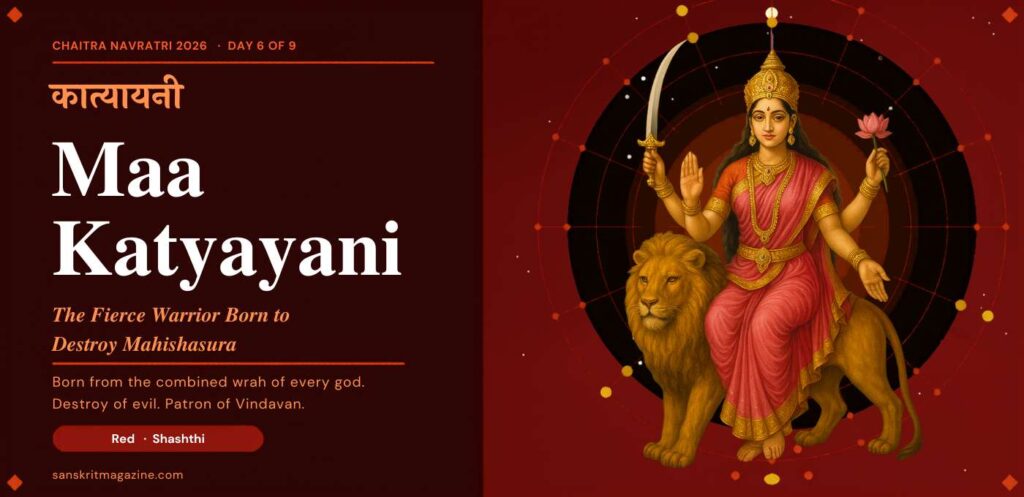
Katyayani rides a lion — the most regal of mounts, the symbol of sovereignty and dharmic authority. The warrior goddess on the lion is one of the most iconic images in Hindu art — found in temples across India, on calendar art, on the facades of government buildings, and in the hearts of devotees across the world.
Four Arms: Sword, Lotus, Abhaya, Varada
Her four arms carry a gleaming sword (the weapon of discrimination — cutting through illusion), a lotus (purity and devotion even in the midst of battle), one hand in Abhaya mudra (fearlessness: "I protect you"), and one hand in Varada mudra (the gesture of giving boons: "I bless you"). This combination is deeply significant: the same hands that wield the sword also bestow grace. Justice and mercy, in a single divine form.
Radiant Golden Complexion
Like Kushmanda, Katyayani is described as having a golden, radiant complexion — the gold of divine fire. She shines like a thousand suns. This luminosity is not merely aesthetic; it represents the purifying, illuminating power of righteous action. She does not bring darkness — she brings a light so intense that darkness has nowhere left to hide.
- Form: The collective divine warrior — born from all the gods' combined energy
- Vehicle: Lion — sovereignty, dharmic authority, courage
- Arms: Four — sword, lotus, Abhaya mudra, Varada mudra
- Named after: Sage Katya / Katyayana, in whose ashram she is said to have manifested
- Colour worn today: Red — fierce love, righteous power, the fire of devotion
- Planet governed: Jupiter (Brihaspati) — wisdom, dharma, expansion, grace
- Bhog (offering): Honey — grants beauty, charisma, and a righteous life partner
- Chakra: Ajna (Third Eye) — clarity, discernment, seeing through illusion
The Gopis of Vrindavan: Katyayani as the Goddess of Love
If Katyayani's birth from divine wrath is one face of her nature, what follows in the Bhagavata Purana is the other — and it is one of the most tender, intimate stories in all of Hindu devotional literature.
In Vrindavan, the young Gopis — the cowherd girls who loved Krishna with a love so pure and total that the sages of the age marveled at it — observed a sacred vow during the month of Margashirsha. They fasted, bathed in the cold Yamuna at dawn, made clay images of Katyayani on the riverbank, and prayed to her for one singular, unambiguous wish: to have Krishna as their husband.
Their prayer, recorded in the Bhagavatam, is one of the most beautiful devotional texts in Sanskrit literature:
The Gopis' Katyayani vrat reveals something beautiful about this goddess: she is as much at home in the heart of the devotee as on the battlefield. The same power that can slay Mahishasura can also grant the deepest wish of a loving heart. Because in the Hindu understanding, righteous love and righteous power are not opposites. They are the same energy, expressed in different circumstances.
To this day, the Katyayani Vrat is observed by young women seeking a devoted, spiritually aligned life partner. It is observed in Vrindavan and across India, particularly during the month of Margashirsha — a living thread connecting modern devotees to the Gopis of five thousand years ago.
Katyayani and Jupiter: The Governance of Brihaspati
Among the Navdurga, Maa Katyayani governs Jupiter (Brihaspati) — the planet of wisdom, dharma, expansion, grace, and auspiciousness. Jupiter is the largest planet in the solar system, and in Vedic astrology it is the Guru — the teacher, the guide, the one who illuminates the path of dharma.
The connection between the fierce warrior and Jupiter's wisdom is illuminating. Katyayani does not merely fight — she fights for dharma, with wisdom, at the right moment. She embodies the Gita's principle of righteous action: acting from duty and wisdom, not from ego or anger alone. This is Brihaspati's highest teaching, and Katyayani is its living demonstration.
चन्द्रहासोज्ज्वलकरा शार्दूलवरवाहना ।
कात्यायनी शुभं दद्याद् देवी दानवघातिनी ॥
Chandrahaasojjvalakara Shaardoolavara Vaahana
Katyayani Shubham Dadyaad Devi Daanavaghatini
"May Katyayani — radiant with her sword, riding the finest lion, destroyer of demons — grant me what is auspicious."
Bhog: Sacred Offering for Maa Katyayani
The traditional bhog for Maa Katyayani is honey (madhu). Offering honey to Katyayani is said to grant the devotee beauty, personal magnetism, and the blessing of a righteous, loving companion in life. Honey is one of the most sacred substances in Hindu ritual — it is pure, it is sweet, it is the product of extraordinary collective effort, and it never spoils. All of these qualities resonate with Katyayani's nature: the purity of righteous action, the sweetness hidden beneath the fierce exterior, and the eternal, imperishable quality of dharma.
Place a small bowl of pure raw honey at the altar of Maa Katyayani. Light a ghee lamp. Offer red flowers (preferably red hibiscus — the hibiscus is sacred to the goddess). After prayer, offer a drop of honey on the tongue of each family member as prasad. You may also add honey to the Panchamrit for today's abhishek (ritual bathing of the idol/image).
Note: Those observing strict Navratri vrat may offer honey without consuming it themselves during the fast.
Why Red? The Significance of Today's Navratri Colour
Red is the colour of Day 6 — and it could not be more perfectly suited to Maa Katyayani. Red is the colour of blood and fire, of courage and passion, of the sacred sindoor that married women wear and the vermilion tilak that warriors wear before battle. It is simultaneously the colour of love and the colour of war — precisely Katyayani's dual nature.
In the Navratri tradition, red also represents the fire of shakti itself — the primordial feminine energy that is at once creative and destructive, nurturing and fierce. When you wear red today, you are not merely following a colour code. You are aligning yourself with the most active, assertive, unapologetically powerful expression of the divine feminine.
The Deeper Teaching: Righteous Anger as Spiritual Power
We live in a culture that is often deeply ambivalent about anger. On one hand, spiritual traditions frequently counsel us to transcend anger, to practise patience, to respond with compassion even to injustice. On the other hand, there are moments — in history, in individual lives — when the failure to act from righteous anger enables harm to continue unchallenged.
Katyayani does not resolve this tension by choosing one side. She holds both simultaneously. She is the goddess who can remain in perfect inner stillness — the tapasvi's equanimity — and simultaneously rise in absolute, unconditional, laser-precise force against what is genuinely wrong. She does not act from personal ego-anger — from wounded pride or frustrated desire. She acts from the deep, clear, impersonal certainty of dharma: this is wrong, and it must be stopped.
This is the teaching she offers on Day 6: that righteous anger, properly understood and properly directed, is not a spiritual failing. It is a spiritual gift. The ability to feel the full force of "this is not right" — and to act on it — is as sacred as any prayer.
🙏 Jai Maa Katyayani! Wear red today. Offer honey and red flowers at your altar. Chant ॐ देवी कात्यायन्यै नमः 108 times. And today, examine: is there something in your life that you have been tolerating, that righteous courage is calling you to address? May her fierce grace give you the sword of clarity and the lotus of compassion — both at once. 🔥
Published by Sanskriti Magazine — India's largest digital platform for Hindu heritage, culture, and spirituality.
Read more at sanskritimagazine.com · Follow us on Instagram & Facebook: @indian_sanskriti
Continue the journey tomorrow: Day 7 — Maa Kalaratri, the darkest and most liberating form of the Goddess.