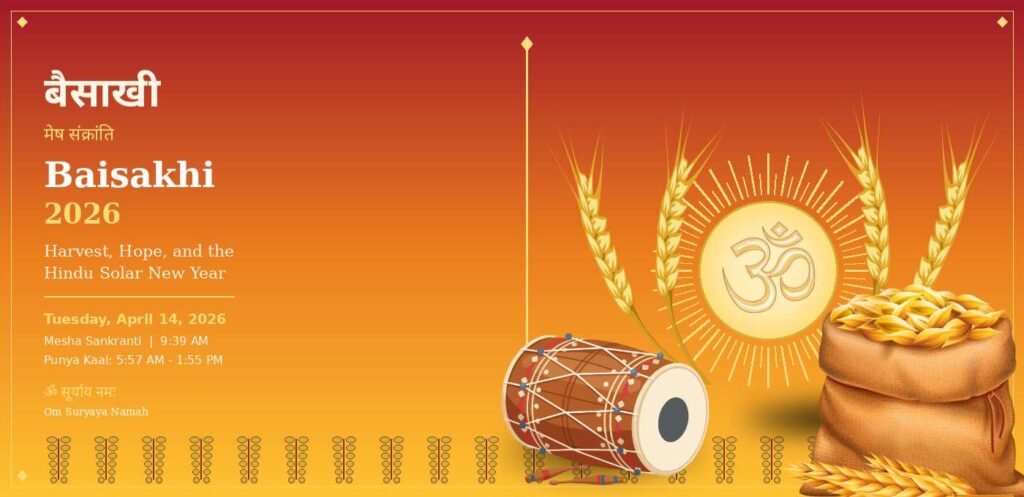
Baisakhi 2026 — Harvest, Hope, and the Hindu Solar New Year
Observed on Tuesday, April 14, 2026 | Mesha Sankranti — the Sun’s entry into Aries
When the Sun steps across the threshold of Mesha Rashi, an entire civilization turns its face toward the light. Baisakhi — also known as Vaisakhi or Mesha Sankranti — is not simply a harvest festival. It is the beginning of the Hindu Solar New Year, a cosmic moment when the wheel of time itself resets, and the whole of Bharata lifts its voice in gratitude, celebration, and renewal.
Across India, this single day is celebrated under many names and in many forms — but the core is one: the Sun has completed another sacred cycle, the earth has yielded her grain, and the soul is invited to begin again.
Baisakhi 2026 — The Sacred Moment
- Date: Tuesday, April 14, 2026
- Mesha Sankranti Moment: 9:39 AM — the exact time the Sun enters Mesha Rashi (Aries)
- Punya Kaal: 5:57 AM to 1:55 PM (7 hours 58 minutes) — the auspicious window for bathing in sacred rivers, charity (dana), and Surya worship
- Maha Punya Kaal: 7:30 AM to 11:47 AM (4 hours 16 minutes) — the peak spiritual window, when the merit of all sacred acts is multiplied manifold
The Science of Sankranti — Why This Day Is Sacred
In Vedic Jyotisha, a Sankranti is the precise moment the Sun transitions from one zodiac sign (rashi) to the next. Of the twelve Sankrantis in a year, Mesha Sankranti holds a unique place — it marks the Sun’s entry into the first rashi of the zodiac, Mesha (Aries), the symbolic beginning of all movement, all manifestation, all new creation.
The Rishis understood what modern science is only now rediscovering: the movement of the Sun through the rashis influences not just the seasons and the harvest, but the subtle pranic currents that flow through all living beings. On a Sankranti day — and especially Mesha Sankranti — these currents are heightened. Any spiritual practice performed in this window, the Punya Kaal, carries manifold merit.
This is why, since time immemorial, Hindus have performed Surya Arghya (offering water to the Sun), bathed in sacred rivers, fed the hungry, and given generously in charity on this day. The results, the Shastras say, return to the giver multiplied a thousandfold.
One Sacred Day, Many Sacred Names — Baisakhi Across Bharata
One of the most beautiful truths of Sanatana Dharma is how the same cosmic event is celebrated with different names, different rituals, and different flavours across our vast land — while remaining entirely one at its heart. Here is how Mesha Sankranti is observed across India on this very day:
Punjab & North India — Baisakhi
In Punjab and Haryana, Baisakhi marks the completion of the Rabi wheat harvest. Fields are golden, granaries are full, and farmers rise to sing, dance Bhangra and Gidda, and offer thanksgiving to the Divine for another season of plenty. It is also the historic day — Baisakhi 1699 — when Guru Gobind Singh Ji established the Khalsa Panth at Anandpur Sahib, a defining moment in the spiritual history of Bharata’s sacred traditions.
Kerala — Vishu
In Kerala, this day is celebrated as Vishu. Families prepare the sacred Vishu Kani — an arrangement of auspicious items (rice, golden konna flowers, a mirror, gold coins, fresh fruits, and an image of Lord Krishna) — which must be the first sight the eyes behold upon waking. It is believed that whatever the eyes see first on Vishu morning sets the tone for the entire year. Elders offer Vishukkaineetam — small gifts of coins — to the young, symbolizing the passing of blessings across generations.
Tamil Nadu — Puthandu
Tamil Nadu celebrates Puthandu, the Tamil New Year. Homes are cleaned and decorated with intricate kolams (rangoli patterns) at the entrance. Families visit temples, offer prayers, and prepare Mangai Pachadi — a traditional dish that combines sweet, sour, bitter, spicy, and tangy flavours, representing the full spectrum of experiences that life will bring in the year ahead. The teaching is profound: embrace every flavour of life with equanimity.
West Bengal — Pohela Boishakh
In Bengal, Pohela Boishakh (the first day of Boishakh) is the Bengali New Year. Traders begin new account books (Haal Khata) after offering prayers to Maa Lakshmi and Lord Ganesha for a prosperous year. The day begins with the beautiful Prabhat Pheri or Mangal Shobhajatra — cultural processions singing the songs of Rabindranath Tagore and welcoming the new year with colour, music, and joy.
Assam — Bohag Bihu (Rongali Bihu)
In Assam, the same cosmic moment is celebrated as Bohag Bihu or Rongali Bihu — the most joyous of the three Bihu festivals. The seven-day celebration features the traditional Bihu dance, offerings to cattle (Goru Bihu), and feasts of pitha and larus.
Odisha — Pana Sankranti (Maha Vishuba Sankranti)
Odisha observes Pana Sankranti, also called Maha Vishuba Sankranti — the Odia New Year. The day’s signature ritual is the preparation and offering of pana, a cooling drink of jaggery, fruit, and spices, distributed freely to quench the summer’s rising heat. This is also the day when the sacred Meru Jatra is observed.
The Rituals of Baisakhi — How to Observe the Day
1. Surya Snana (Sacred Bath at Sunrise)
Rise before sunrise and bathe — ideally in a sacred river (Ganga, Yamuna, Godavari, Narmada, Kaveri). If that is not possible, add a few drops of Ganga jal to your bathing water and invoke the sanctity of the rivers. This purifying act is said to wash away the accumulated residues of the old year. The Punya Kaal begins at 5:57 AM on April 14 — try to complete your snana before this window opens.
2. Surya Arghya (Offering Water to the Sun)
Facing east, offer water to Bhagavan Surya from a copper vessel, chanting:
ॐ सूर्याय नमः
Om Suryaya NamahOr the complete Surya Beej Mantra:
ॐ ह्रां ह्रीं ह्रौं सः सूर्याय नमः
Om Hraam Hreem Hraum Sah Suryaya Namah
3. Dana (Charity)
Charity on Mesha Sankranti is considered among the most meritorious acts of the entire year — especially when performed within the Maha Punya Kaal (7:30 AM to 11:47 AM). Traditional offerings include:
- Water and cooling drinks (especially sattu and pana)
- Seasonal fruits
- Grains, especially newly harvested wheat
- Cloth, umbrellas, and hand fans (for protection from the summer heat)
- Food to the needy and Brahmins
4. Temple Visit and Surya Puja
Visit your local temple, especially a Surya Mandir if available. Light a lamp, offer red flowers, and chant the Aditya Hridayam — the sacred stotra from the Valmiki Ramayana, taught by Rishi Agastya to Lord Rama before His battle with Ravana.
5. New Beginnings and Sankalpa
Baisakhi is a day of sankalpa — of sacred resolve. Take a moment during the Maha Punya Kaal (7:30 AM to 11:47 AM on April 14, 2026) to sit before your family altar and set a clear, dharmic intention for the year ahead. Whatever you resolve in this window, with sincere heart, is said to carry the strength of the rising Sun.
The Harvest and the Heart — The Deeper Meaning
On the surface, Baisakhi is about the golden fields, the heaped granaries, the satisfaction of another successful season. But beneath the visible harvest lies a deeper one.
The Rishis have always taught that the outer agricultural year mirrors the inner spiritual year. Just as the farmer ploughs, sows, tends, and finally harvests — so the sadhaka tills the field of the mind, sows the seeds of sadhana, tends them with patience and surrender, and finally harvests the fruits of bhakti, jnana, and eventually, Moksha.
Baisakhi asks each of us a quiet question: What have I harvested in the year that has passed? And what will I sow in the year that begins today?
The Sun does not pause in its journey. It moves from one rashi to the next, unfailingly, as it has for countless yugas. We too are invited to move forward — with gratitude for what has been given, with humility for what has been received, and with courage for what is yet to come.
A Prayer for the New Solar Year
ॐ आदित्याय विद्महे सहस्रकिरणाय धीमहि
तन्नो सूर्यः प्रचोदयात्Om Adityaya Vidmahe Sahasrakiranaya Dhimahi
Tanno Suryah PrachodayatMeaning: “We meditate upon the Son of Aditi, the thousand-rayed Sun. May that Surya illumine our path.”
May this Baisakhi fill your home with abundance, your heart with gratitude, and your soul with the unshakable light of Bhagavan Surya. May the year ahead bring health, dharma, and divine grace to you and all who are dear to you.
Baisakhi ki lakh lakh wadhaiyan! 🌾🙏
Happy Mesha Sankranti! Happy Hindu Solar New Year!
Sanskriti Magazine — Sharing Indian Heritage, Achievements, Practices and Values with the world.