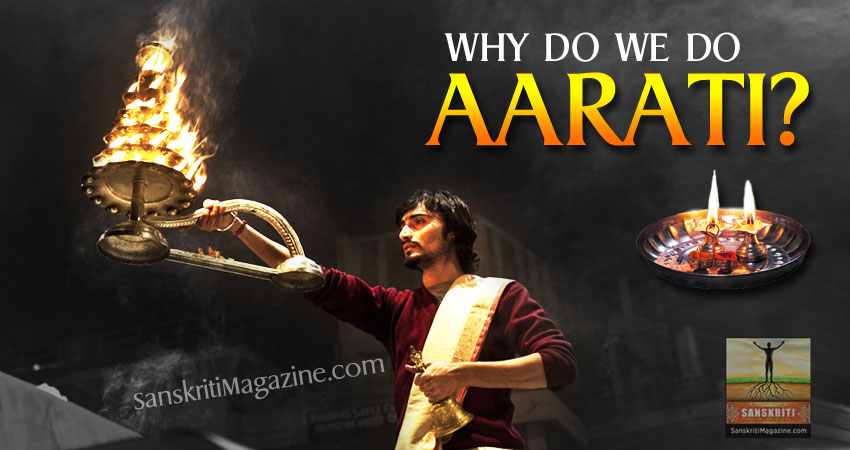
Towards the end of every ritualistic worship (pooja or bhajan) of God or to welcome an honored guest or saint, we perform the aarati. This is always accompanied by the ringing of the bell and sometimes by singing, playing of musical instruments and clapping.
It is one of the sixteen steps (shodasha upachaara) of the pooja ritual. It is referred to as the auspicious light (mangla niraajanam). Holding the lighted lamp in the right hand, we wave in a clockwise circling movement to light the entire form of God.
Each part is revealed individually and also the entire form of God. As the light is waved we either do mental or loud chanting of prayers or simply behold the beautiful form of God, illumined by the lamp. At the end of the aarati we place our hands over the flame and then gently touch our eyes and the top of the head.
We have seen and participated in this ritual from our childhood. Let us find out why we do the aarati?
Having worshipped God with love – performing abhisheka, decorating the image and offering fruits and delicacies, we see the beauty of God in all His glory. Our minds are focused on each limb of God as the lamp lights it up. It is akin to silent open-eyed meditation on His beauty. The singing, clapping, ringing of the bell etc. denote the joy and auspiciousness, which accompanies the vision of God.
Aarati is often performed with camphor. This holds a telling spiritual significance. camphor when lit, burns itself out completely without leaving a trace of it. It represents our inherent tendencies (vaasanas). When lit by the fire of knowledge which illumines God (Truth), our vaasanas thereafter burn themselves out completely, not leaving a trace of ego which creates in us a sense of individuality that keeps us separate from God.
Also while camphor burns to reveal the glory of God, it emits a pleasant perfume even while it sacrifices itself. In our spiritual progress, even as we serve the guru and society, we should willingly sacrifice ourselves and all we have, to spread the “perfume” of love to all. We often wait a long while to see the illumined God but when the aarati is actually performed, our eyes close automatically as if to look within. This is to signify that each of us is a temple of God.
Just as the priest reveals the form of God clearly with the aarati flame, so too the guru reveals to us the divinity within each of us with the help of the “flame” of knowledge (or the light of spiritual knowledge). At the end of the aarati, we place our hands over the flame and then touch our eyes and the top of the head. It means – may the light that illuminated God light up my vision; may my vision be divine and my thoughts noble and beautiful.
The philosophical meaning of aarati extends further. The sun, moon, stars, lightning and fire are the natural sources of light. God is the source of this wonderous phenomenon of the universe. It is due to Him alone that all else exist and shine. As we light up God with the flame of the aarati, we turn our attention to the very source of all light, which symbolizes knowledge and life.
Also the sun is the presiding deity of the intellect, the moon, that of the mind, and fire, that of speech. God is the supreme consciousness that illuminates all of them. Without Him, the intellect cannot think, nor can the mind feel, nor the tongue speaks. God is beyond the mind, intellect and speech. How can this finite equipment illuminate God? Therefore, as we perform the aarati we chant;
Na tatra suryo bhaati na chandra taarakam
Nemaa vidyuto bhaanti kutoyamagnib
Tameva bhaantam anubhaati sarvam
Tasya bhasa sarvam idam vibhaati
He is there where the sun does not shine,
Nor the moon, stars and lightning.
then what to talk of this small flame (in my hand),
Everything (in the universe) shines only after God,
And by His light alone are we all illumined.
~By Swamini Vimalananda Radhika Krishnakumar