When Krishna talks about the body’s digestion system to Arjuna who is loath to go to war, it does seem out of place. But Krishna is drawing Arjuna’s attention to the uniformity and multiplicity existing in every bit of action within and outside the body. ‘There is no escaping Me, Everywhere you glance you will see the play of maya, My power….I am even inside your digestion system,” (Gita 15.14), meaning ‘I am the fire of digestion in bodies of all living entities, and I join with the air of life, outgoing and incoming, to digest the four kinds of foodstuff’.
As with every verse of the Bhagwad Gita, this too lends itself to different interpretations. One commentary focuses on the word ‘food’. Food is not only that what is being taken through mouth. All five senses take in food, through sound, touch, form, taste and smell. Whatever is heard is food for the ear, touched is food for the skin, seen is food for the eyes and smelt is food for the nose. Another says that He is the digestive force of four types of food that is swallowed, chewed, licked and sucked.
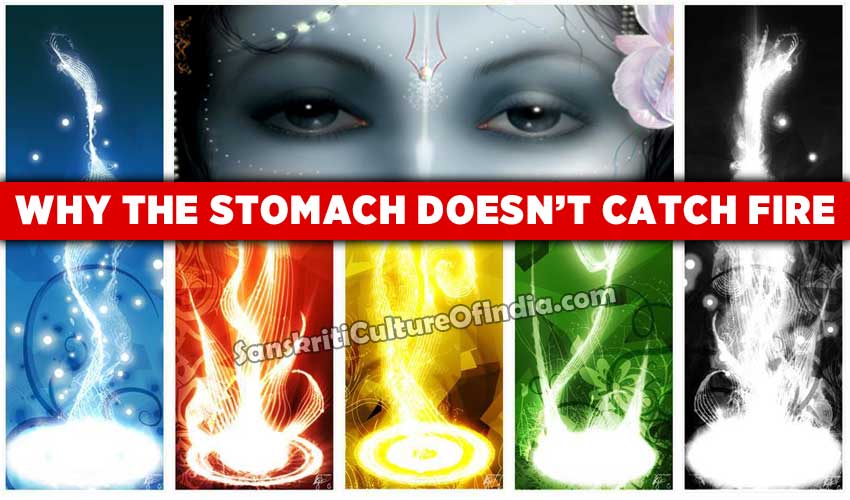
Another interpretation deals with the digestive fire in the stomach being Krishna. Ayurveda says that all five elements — earth, fire, water, air and space — are inside the body just as they exist in the outside world. In a harmonious body fire doesn’t burn, water doesn’t flood it, the earth doesn’t become barren, air cannot blow us away but any disharmony in the five elements indicates that the body needs healing. Krishna says that this fire in body makes its presence felt as hunger. When food is being digested, a conscious person can feel God’s presence and be thankful.
Biologically, the verse applies to all living organisms including micro organisms like bacteria, plants, birds, animals, reptiles and insects. In all living organisms, biochemical functions like respiration, nutrition, and reproduction occur in cells and protoplasm, the biophysical basis of life. Commentators may explain ‘the air of life, outgoing and incoming,’ as oxygen and gas expelled through anus but biologists are unable to understand the reconciliation of these two gases. ‘Apan vayu’ is commonly explained as waste gas expelled through anus (H2S), through nose (CO2) and through skin, that is, perspiration as water vapour with mineral salts. In the Gita (5.27), Krishna refers to prana and apana vayu as gases moving in nose as inhalation (O2) and exhalation (CO2) suspending inward and outward breaths through the nostrils.
In biochemical process like digestion, carbohydrates are reduced to glucose; starches to sugars such as sucrose and finally glucose which then enters blood vessels. Oxygen enters through nose and lungs and finally blood vessels. Circulation of blood is an amazing transport system of body in which glucose coming from stomach and oxygen coming from nose and lungs is carried and delivered to each and every of billions of cells of every living organism as per requirement.
A chemical reaction takes place as glucose is broken down to form carbon dioxide and water and energy is developed. In the process, atoms in gases on either side namely oxygen, carbon and hydrogen in water are equalised. Chemists call this equalising as ‘balancing’ the equation. So, prana apana samayukta occurs in cells of all living organisms. Clearly, Krishna dwells in all living organisms. He is therefore Lord of not just human beings, but all living beings.
~ Swami Pragna Aranya who calls himself Yogi Protoplasm spoke to Seema Burman