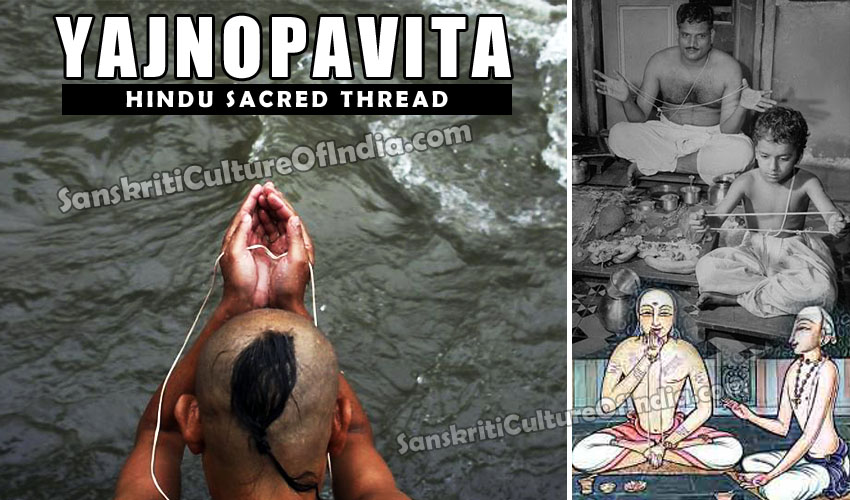
Known as Yajnopavita, the sacred thread is a hand-spun cotton thread worn across the chest and resting on one’s left shoulder (the stavya position of the thread) most commonly by the priestly Hindus. This sacred thread of the Brahmins is made of cotton, that of a Kshatriya of hempen threads and that of a Vaisya of woollen threads.
The sacred thread finds its origins in the Vedic rites, as a garment worn during the rituals. This is perhaps the reason why the first time it is worn (during a Upanayana ceremony), it is attached to a piece of skin (known as krishajina). In today’s Hindu society, the sacred thread symbolizes the ancient history of the custom as well as the caste (Varna) of the person wearing it.
Wearing the Thread the First Time
Wearing of the yajnopavita for the first time involves teaching the young boy (known as vatu or understudy) the sacred Gayatri mantram and providing a three-threaded yajnopavita.
Boy Becomes Man — The Hindu Ordaining Ceremony
Brahmin’s mark this transition with the “Upanayanam Samskara” (the sacred thread ceremony) and is usually performed between the ages of seven and fourteen. If, for some reason, it has not been done during this age period, then it needs to be completed before he gets married. This ceremony is a very ancient one. So long the boy does not wear the janeo or the sacred thread, he could not be reckoned among the “Dvija” (twice born).
The janeo thread is not only worn by the brahmins but also by Kshatriyas and by Vaishyas. If a Brahmin wishes to become learned in the Vedas, he should wear the janeo at the age of 5 years; if a Kshatriya wishes to gain strength, he should wear the thread at 6, and for a Vaishya, if he wishes for success, he should wear the Janeu at the age of 8.
After the man is married, the three-threaded yajnopavita is replaced by a six-threaded one, symbolic of the additional responsibility.
Typically women do not wear the yajnopavita (although they may wear other sacred threads). However, practitioners of Arya Samaj philosophies practice equalities of same sex and perform all rituals for both the sexes.
Meaning of the Three Strands of the Janeu
The janeu thread used by the Brahmins consists of three strands. There are various interpretations of the three strands of the janeo.
These are as follows :
The three strands symbolizes the Hindu trinity-Shiva, Vishnu and Brahma.
Some symbolizes with Mahasarasvati, Mahalakshmi and Mahakali.
Some interpret with past, present and the future.
- The three qualities- sattva, rajas and tamas.
- The three states- wakefulness, dream and deep sleep.
- The three dimensions- Heaven (swarga), Earth (mrityuloka) and nether regions(pataloka).
- The most important of all is-ida, pingala and susumna nadi, through which the kundalini energy manifests as prana and consciousness.
Three debts:
The three strands sometimes symbolize three debts (ऋण, rin) that must never be forgotten:
- the debt to one’s teachers (गुरु ऋण, guru rin), i.e. those who have taught the wearer;
- the debt to one’s parents and ancestors (पितृ ऋण, pitr rin), i.e. those who have nurtured the wearer and made possible his existence;
- the debt to the sages/scholars (ऋषि ऋण, rishi rin), i.e. those who discovered knowledge, both spiritual and secular, over the ages, which now enriches the wearer’s life.
In some versions, the debt to the sages is replaced with debt to God (देव ऋण, dev rin). Upon marriage, sometimes the number of strands increases to six, because the man is expected to assume the debts of his wife as well.
Different Methods of Wearing the Thread
There are different methods of wearing the Sacred Thread at different occasions. For example :
- While performing an auspicious ceremony one should be Upaviti that is, the Sacred Thread should hang from his left shoulder.
- While performing an inauspicious ceremony one should be Prachnaviti, that is, the Sacred Thread should hang from the right shoulder.
- At times he is called Niviti when the Sacred Thread is worn round the neck like a garland.
- The thread should be lifted and the upper part should be put behind ears when a person goes for his daily ablutions or doing impure tasks.
- Both males and females can wear the thread. However, the woman should wear it on the neck. Otherwise, she may wrap it on a naariyal (brown coconut), and place it in worship place.
- After a birth or death in the family, it should be taken out and then a new thread should be worn 15 days after the event.
- Old, or broken thread should be replaced etc.
The Thread Changing Festival :
A full-moon day of the year is observed by those who wear the sacred thread (typically brahmins and followers of Arya Samaj) as a day of spiritual renewal and the thread the ritually replaced by new one.
When on one’s shoulder, it it the person’s responsibility to keep the thread clean (washing every time one takes a bath) and honor it.
Stavyam and Apastavyam :
There are essentially two positions of the thread on a person. The Stavya position, is the default one, is when the thread us hanging from left shoulder. If you study most Hindu idols of worship you will notice this position of the thread.
The opposite position, hanging from the right shoulder is called the exceptional position and is used during funerals and when answering nature’s calls.
~ Dinesh Parikh