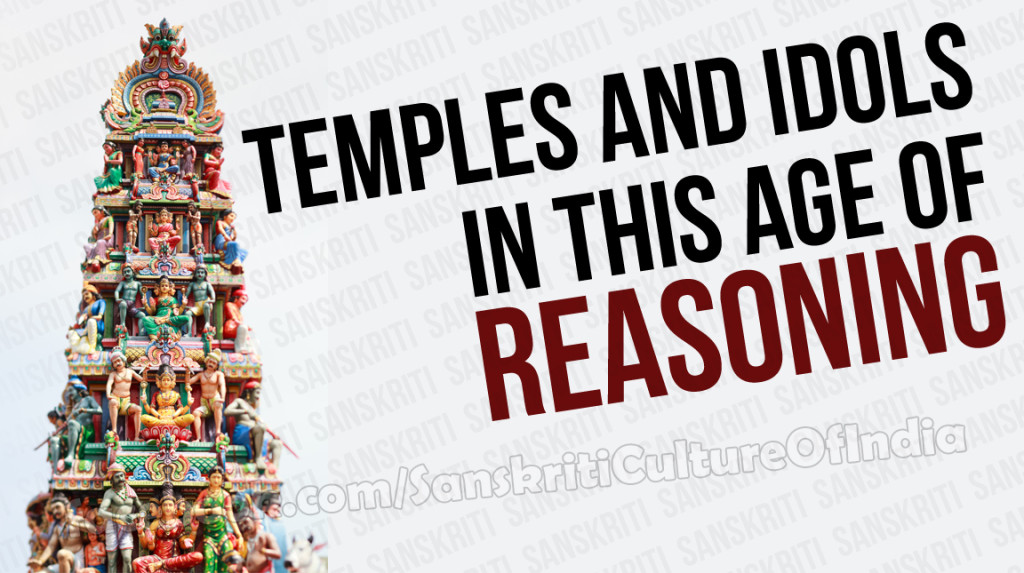
The Indian terms for temple are mandir, ambalam, koil or kovil, deool, devasthaanam, devaalaya etc depending on the regional language. The commonly used word ‘Mandir’ comes from the Sanskrut root ‘Mandaté’, which means to be filled with transcendent emotion, to delight or to shine.
Temples in the age of reasoning
In Sanaatana dharma (Hinduism), GOD or supreme reality is invoked, contemplated upon and worshipped in three abodes depending on the mental capacity of the seeker. In the dharma traditions of India, GOD is worshipped within a) one’s own self; b) at an altar in our homes and c) in a temple or holy place out in the community.
There are numerous instances of saints who have got their complete insight (darshan) of the ‘Absolute Truth’, which have now become holy pilgrimage places. While the enlightened person realises God in all the three abodes, the sceptic struggles to find GOD in any of them. In our age of reasoning, questions like ‘why should I visit a temple’ or ‘why we use idols in temples’ are but natural, to which even the temple goers or pundits fail to give contemporary answers.
Rational answers for practices in dharma can be found in the teachings of Master from the wisdom traditions of India where reasoning has a firm foundation. The wisdom traditions of India particularly Vedanta (end portion of Vedas) allows inquiry into truth. There is no place for blind faith and the questions on dharmic religions are answered in a free atmosphere of investigation.
Why temples?
‘If God is all-pervading but why do we have to worship at temples?”. To this a Vedanta teacher explains, “In a democracy, the government of a country is present at every point within the frontiers of that nation. Yet when I want to invoke the government for permit or for help, I must reach the capital city, approach the right departmental head, and invoke government’s protection or patronage. Though the Lord is all pervading, to invoke Him we need an altar.”He adds, “You know that the essence in the cow is in her milk and it pervades her entire vital body. Yet, if I want to milk the cow, though milk is all pervading, I cannot get it by squeezing her horns or tail. We must go to the udder. Think!”
Why idols or sacred images?
An anecdote from Swami Vivekananda’s life explains the concept of sacred images or idols. Mangal Singh, a Maharaja of Alvaar in western India was once visited by Swami Vivekananda. While talking about religion and faith, the Maharaja said he had no faith in idol worship and that he could not worship wood, stone or earth. Looking around, Swami Vivekananda spotted a picture of the Maharaja on the wall. Taking it down he asked the courtiers to spit upon it. Shocked at the request, they declined to do it.
Swami Vivekananda turning to the Maharaja said, “See, your courtiers declined because the picture has the likeness of “you” and brings “you” to their minds though the picture is not “you”. In the same way, the image in the temple brings to the mind of the devotees their chosen attribute of God. They do not worship the wood, stone or earth of which the deity is made from. The idol remains an idol but the worship goes to the Lord”.
Swami Vivekananda added further,
“A symbol is absolutely indispensable for fixing the mind. The mind wants a prop to lean upon and cannot have a conception of the Absolute in the initial stages. Without the help of some external aid, in the initial stages, the mind cannot be centralized. The people of the whole world, save a few Yogis and Vedantins, are all worshipers of idols. They keep some image or other in the mind.”
Sanatana dharma offers different spiritual tools and diverse approaches to divine life. It starts with God symbolisms which are pitched at the level of the seeker. The more subtle the thought pattern the more abstract is the concept of Godhead. The subtlest mind alone is taken to the formless unmanifest nature of the ultimate truth.
~ Ram Lingam blogs his insights on India and Indian culture at India Sutra