IndianSanskriti
shani-dev

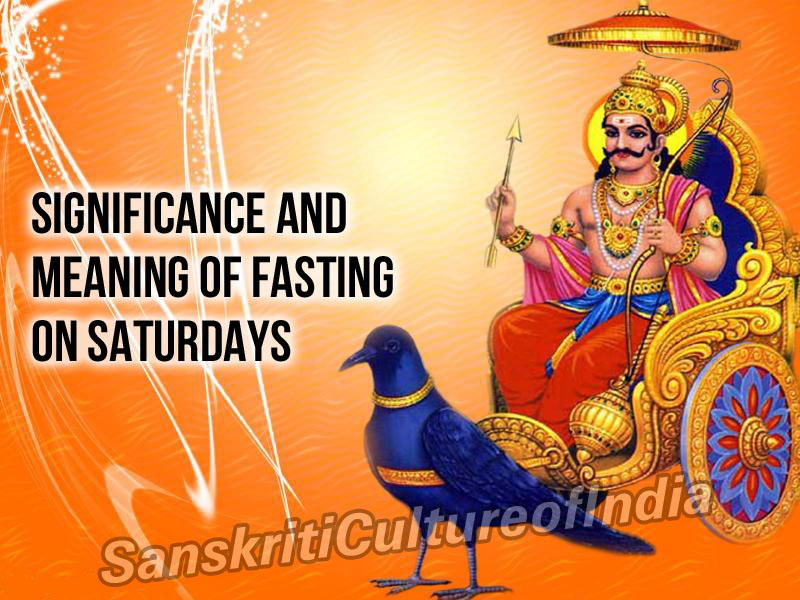
Significance and Meaning of Fasting on Saturdays

God:

Saturday is dedicated to the fearful god Shani, who is one of the Navagrahas – or nine planets. He is represented as a deity carrying bow and arrows and riding a crow or a vulture.

Ritual:

There are temples exclusively dedicated to god Shani and normally they are painted black. The idol too is black in color, and sometimes made of iron. Devotees observing the Shanivar fast usually visit Shani shrines and offer black-colored items like sesame oil, black clothes, and black grams. After the evening prayers, those devotees take a single meal, which is usually cooked sans salt, prepared using sesame til or black gram or other black colored food items.

Some worship the ‘peepal tree’ (the holy Indian fig) and tie thread around its bark. Shani is said to ward off ill effects, illness and troubles. Shani is so dreaded that many Hindus avoid long journeys on Saturday. Fast is observed by many to avoid the adversities and misfortunes on Shanivar. It is also believed that those who have Lord Hanuman’s blessings are protected from Shani’s wrath. So many people flock to Hanuman temple on Saturday.

Folklore:

Legend has it that Lord Hanuman had rescued Shani from Ravana, the demon king of Lanka, at the time when Hanuman set Lanka ablaze as depicted in the epic Ramayana. Lord Shani had then promised that he would not trouble Lord Hanuman devotees.

Color & Gem:

Blue and black are the preferred colors. Blue gems, such as, blue sapphire, black iron rings made of horse-shoe are worn to ward off Shani.

Celestial Body:

The planet Saturn or Shani rules Saturday.

~ Subhamoy Das
You may also like

Search the website

Like us on Facebook

Get daily updates via Email

Enter your email address:

Recent Posts

Purushottam Maas — The Month No Deity Would Claim, and the Lord Who Made It Supreme

Every month of the Hindu calendar has a lord — except the rare thirteenth, the Adhika Maas, born an orphan and shunned as the “impure month.” The Puranas tell how this rejected month went in grief to Bhagavan Vishnu, who claimed it, gave it His own name — Purushottam — and made it the most fruitful month of all. The origin story, the teaching, and what it means for Purushottam Maas 2026 (May 17 – June 14).

Padmini Ekadashi 2026 — The Ekadashi Even the Devas Descend to Keep

Padmini Ekadashi 2026 — The Ekadashi Even the Devas Descend to Keep

The rarest Ekadashi of the entire Hindu calendar is three days away. The Padma Purana preserves a conversation between Bhagavan Krishna and Yudhishthira about a single Ekadashi the great Rishis spend lifetimes waiting for — Padmini. The Vrat Katha of Queen Padmini of Mahishmati, the lotus teaching, and why May 27, 2026 is the morning Vaishnavas across Bharata are preparing for.

Varada Chaturthi 2026 — The Rare Ganesha Day of Purushottam Maas

Varada Chaturthi 2026 — The Rare Ganesha Day of Purushottam Maas

Once every 2.5–3 years — when the rare 13th month of Adhika Maas opens — a thirteenth Vinayaka Chaturthi appears. The Mudgala Purana calls it Varada Chaturthi, the “boon-giving” Chaturthi, and holds it as the most fruit-bearing Ganesha day of the entire calendar. Today, Wednesday May 20, 2026, is that day.

Padmini Ekadashi 2026 — The Rare Ekadashi That Comes Only in Purushottam Maas

Padmini Ekadashi 2026 — The Rare Ekadashi That Comes Only in Purushottam Maas

Padmini Ekadashi 2026 falls on Wednesday, May 27 — the Shukla Paksha Ekadashi of Adhika Maas, the rarest Ekadashi in the entire Hindu calendar (it appears only every 2.5–3 years). The Padma Purana conversation between Bhagavan Krishna and Yudhishthira, the Vrat Katha of Queen Padmini, complete vrat vidhi with jagrana, mantras, and the lotus symbolism that gives the Ekadashi its name.

Ganga Dussehra 2026 — The Day Maa Ganga Came Down to Bhagiratha

Ganga Dussehra falls on Monday, May 25, 2026 — commemorating the day Maa Ganga descended from Vaikuntha to the earth through the millennia-long tapasya of King Bhagiratha. The full account from the Valmiki Ramayana, snan vidhi, dana traditions, mantras, and the teaching of sustained sincerity.

css.php