Amidst the freezing cold weather, with the temperature wobbling between 0-5 degrees Celsius and the dense fog outside, everything seems stagnant in the northern part of India. However, below the apparently frozen surface, you would be amazed to find a palpable wave of activity going on. People, especially in the northern Indian states of Punjab, Haryana and parts of Himachal Pradesh, are busy making preparations for Lohri — the long-awaited bonfire festival — when they can come out of their homes and celebrate the harvesting of the Rabi (winter) crops and give in to relaxing and enjoying the traditional folk songs and dances.
Significance
In Punjab, the breadbasket of India, wheat is the main winter crop, which is sown in October and harvested in March or April. In January, the fields come up with the promise of a golden harvest, and farmers celebrate Lohri during this rest period before the cutting and gathering of crops.
According to the Hindu calendar, Lohri falls in mid-January. The earth, farthest from the sun at this point of time, starts its journey towards the sun, thus ending the coldest month of the year, Paush, and announcing the start of the month of Magh and the auspicious period of Uttarayan. According to theBhagawad Gita, Lord Krishna manifests himself in his full magnificence during this time. The Hindus ‘nullify’ their sins by bathing in the Ganges.
Customs & Legends
In the morning on Lohri day, children go from door to door singing and demanding the Lohri ‘loot’ in the form of money and eatables like til (sesame) seeds, peanuts, jaggery, or sweets like gajak, rewri, etc. They sing in praise of Dulha Bhatti, a Punjabi avatar of Robin Hood who robbed the rich to help the poor, and once helped a miserable village girl out of her misery by getting her married off like his own sister.
The Bonfire Ritual
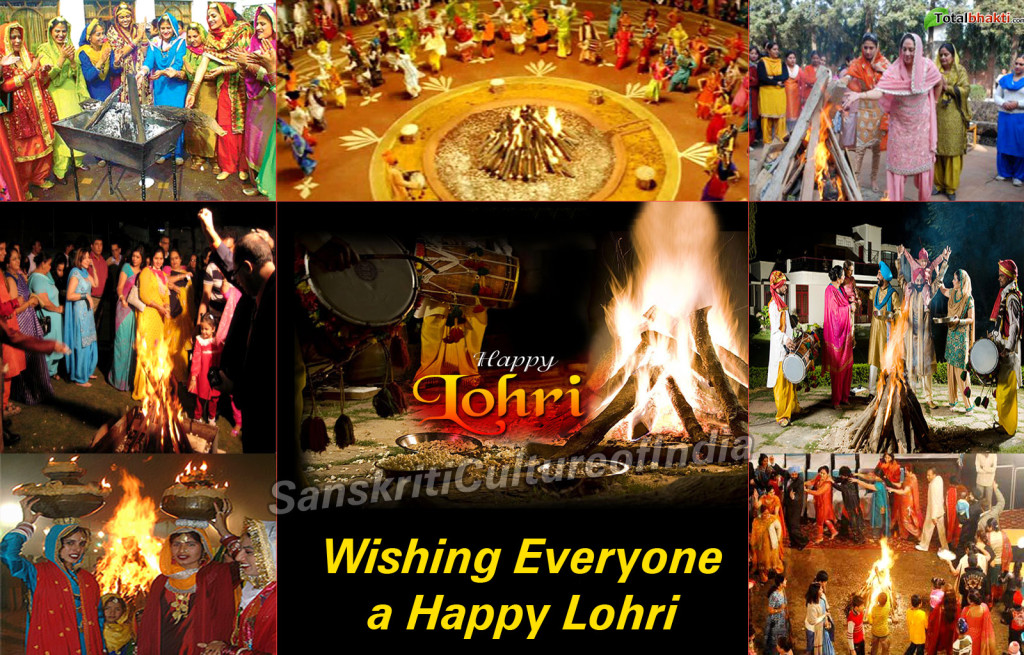
In the evening, with the setting of the sun, huge bonfires are lit in the harvested fields and in the front yards of houses and people gather around the rising flames, circle around (parikrama) the bonfire and throw puffed rice, popcorn and other munchies into the fire, shouting “Aadar aye dilather jaye” (May honor come and poverty vanish!), and sing popular folk songs. This is a sort of prayer to Agni, the fire god, to bless the land with abundance and prosperity. After the parikrama, people meet friends and relatives, exchange greetings and gifts, and distribute prasad (offerings made to god). The prasad comprises five main items: til, gajak, jaggery, peanuts, and popcorn. Winter savories are served around the bonfire with the traditional dinner of makki-di-roti (multi-millet hand-rolled bread) and sarson-da-saag (cooked mustard herbs).
Song & Dance
Bhangra dance by men begins after the offering to the bonfire. Dancing continues till late night with new groups joining in amid the beat of drums. Traditionally, women do not join Bhangra. They hold a separate bonfire in their courtyard orbiting it with the graceful gidda dance.
The ‘Maghi’ Day
The day following Lohri is called ‘Maghi’, signifying the beginning of the month of Magh. According to Hindu beliefs, this is an auspicious day to take a holy dip in the river and give away charity. Sweet dishes (usually kheer) are prepared with sugar cane juice to mark the day.
Exhibition of Exhuberance
Lohri is more than just a festival, especially for the people of Punjab. Punjabis are a fun-loving, sturdy, robust, energetic, enthusiastic and jovial race, and Lohri is symbolic of their love for celebrations and light-hearted flirtations and exhibition of exuberance.
A Celebration of Fertility
Lohri celebrates fertility and the joy of life, and in the event of the birth of a male child or a marriage in the family, it assumes a larger significance wherein the host family arranges for a feast and merry-making with the traditional bhangra dance along with rhythm instruments, like the dhol and the gidda. The first Lohri of a new bride or a newborn baby is considered extremely important.
Thanksgiving & Get-together!
Nowadays, Lohri brings in an opportunity for people in the community to take a break from their busy schedule and get together to share each other’s company. In other parts of India, Lohri almost coincides with the festivals of Pongal, Makar Sankranti, and Uttarayan all of which communicate the same message of oneness and celebrates the spirit of brotherhood, while thanking the Almighty for a bountiful life on earth.