On Guru Purnima, we pause to remember a truth that is easy to forget: no one reaches wisdom alone.
A parent teaches a child how to speak. A schoolteacher opens the first book. An artist learns through years of correction. A seeker receives a mantra, a discipline or a way of seeing life. Behind every body of knowledge stands a living chain of teachers and students who protected it, practised it and passed it forward.
Guru Purnima honours that chain.
Observed on the full moon day of the Hindu month of Ashadha, the festival is dedicated to the guru, the person who leads a seeker from confusion towards clarity. It is also known as Vyasa Purnima, a day of reverence for Maharishi Veda Vyasa and the vast scriptural inheritance associated with him.
In 2026, Guru Purnima falls on Wednesday, July 29.
Guru Purnima 2026 date and tithi timings
For New Delhi and the surrounding region:
- Guru Purnima: Wednesday, July 29, 2026
- Purnima tithi begins: 6:18 PM on Tuesday, July 28, 2026
- Purnima tithi ends: 8:05 PM on Wednesday, July 29, 2026
- Lunar month: Ashadha
- Paksha: Shukla Paksha
- Tithi: Purnima
The observance falls on July 29 because Purnima is present at sunrise on that date. Panchang timings can vary slightly by location, so devotees outside Delhi should check the local calendar followed by their family or sampradaya.
What is Guru Purnima?
Guru Purnima is a day of gratitude towards the people and the parampara, or teaching lineage, through which knowledge reaches us.
The Sanskrit word guru carries a meaning deeper than the modern use of the word “teacher.” A teacher may help us acquire information or master a skill. A guru shapes the disciple’s understanding, conduct and inner life. The guru does not merely provide answers. The guru trains the seeker to see clearly.
Purnima means the full moon day. The full moon has long served as a symbol of fullness, clarity and reflected light. The symbolism is especially fitting: just as the moon reflects the light of the sun, the disciple receives, lives and carries forward the light of knowledge received through the guru.
This is why Guru Purnima is not simply a ceremonial day. It is a day to examine the relationship between knowledge and humility.
Have we remembered those who taught us?
Have we practised what we received?
Have we become worthy links in the chain of knowledge?
Why Guru Purnima is also called Vyasa Purnima
Guru Purnima is traditionally known as Vyasa Purnima in honour of Maharishi Veda Vyasa.
Hindu tradition remembers Vyasa as the great compiler and transmitter of sacred knowledge. He is associated with arranging the Vedic corpus into four divisions: Rigveda, Yajurveda, Samaveda and Atharvaveda. He is also traditionally regarded as the author of the Mahabharata and as a central figure in the preservation of the Puranic tradition.
The name Vyasa itself carries the sense of arranging, compiling or classifying. His importance lies not only in the creation of texts, but in making a vast inheritance of knowledge available to later generations.
This makes Vyasa an enduring symbol of the guru’s work.
A guru receives knowledge from a lineage, understands it, lives it and transmits it in a form that the next generation can receive. Without this careful transmission, even the deepest teaching can disappear.
On Vyasa Purnima, devotees therefore honour not only one revered Rishi, but the entire guru parampara: the unbroken succession of teachers through whom dharma, philosophy, ritual, music, art, medicine, language and spiritual disciplines have survived.
The guru-shishya parampara in Sanatana Dharma
The relationship between guru and shishya, or teacher and disciple, is one of the foundations of Indian civilisation.
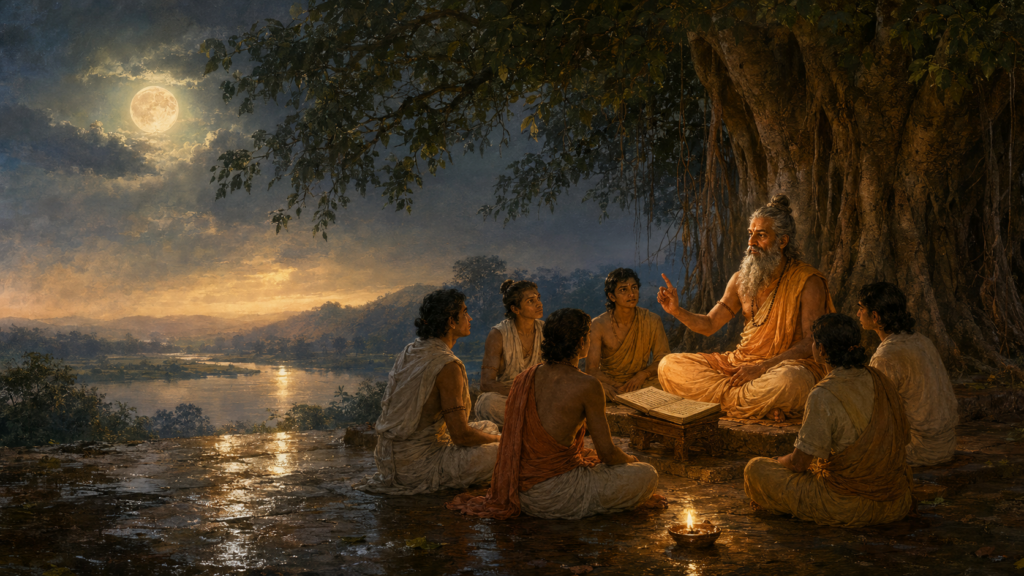
For centuries, many forms of knowledge were passed through direct instruction. A student listened, memorised, questioned, observed and practised under the guidance of a teacher. This method shaped the study of the Vedas and Vedanta, as well as classical music, dance, Ayurveda, yoga, sculpture, temple arts and numerous crafts.
The guru-shishya relationship was never meant to rest on information alone. It required discipline from the student and responsibility from the teacher.
The shishya approached learning with:
- Shraddha, or sincere trust
- Vinaya, or humility
- Seva, or willing service
- Abhyasa, or steady practice
- Jijnasa, or the desire to know
The guru, in turn, carried the duty to teach with discernment, protect the integrity of the knowledge and guide the student according to the student’s readiness.
This is why the tradition values lived knowledge. A teaching becomes meaningful when it changes how a person thinks, acts and responds to life.
What does a guru give the disciple?
A guru may give a mantra, explain a scripture, correct a discipline or guide a seeker through doubt. Yet the deepest gift is often a new way of seeing.
The disciple may arrive with many questions:
- What is my duty?
- What should guide my choices?
- How can I master the restless mind?
- What remains when status, possessions and roles change?
- How should knowledge be lived rather than merely discussed?
The guru does not always remove difficulty. Often, the guru teaches the disciple how to meet difficulty without losing direction.
This distinction matters in the present age. We have access to more information than any earlier generation, yet information does not automatically become wisdom. A search result can offer an explanation. It cannot observe our habits, challenge our pride or insist that we practise what we claim to understand.
The guru’s presence makes knowledge personal, accountable and alive.
Guru Purnima in the wider Indian spiritual tradition
Although Guru Purnima holds a distinct place in Hindu tradition, the Ashadha full moon also carries meaning in other Indian paths.
For many Buddhists, this period recalls the first teaching given by Gautama Buddha at Sarnath after his awakening. At the Deer Park, he taught the five ascetics who had known him earlier and set the Dharma Chakra in motion. Sarnath remains one of Buddhism’s most revered pilgrimage places.
Different communities observe the day according to their own lineage and calendar. The shared cultural thread is reverence for the teacher, the teaching and the disciplined transmission of knowledge.
How Guru Purnima is observed
There is no single ceremony followed by every Hindu family or sampradaya. The form of observance depends on one’s lineage, region and relationship with the guru.
Common practices include:
- Rising early and bathing before prayer
- Cleaning the home altar or place of study
- Remembering Maharishi Veda Vyasa and the guru parampara
- Offering flowers, fruit, incense or a diya
- Performing Guru Paduka Puja where this belongs to the family tradition
- Chanting the guru mantra or reading from a text taught by the guru
- Visiting one’s guru, ashram, temple or place of learning
- Offering guru dakshina
- Taking part in satsang, meditation, bhajan or scripture study
- Serving food, supporting education or helping someone in need
- Beginning or renewing a disciplined period of study
Some devotees observe a fast. Others take simple sattvic food. Fasting is not the only measure of devotion. Children, older adults, pregnant women and people managing medical conditions should adapt the practice to their needs and seek appropriate guidance.
A simple Guru Purnima puja at home
If your family does not follow a prescribed lineage practice, you can keep the observance simple and sincere.
1. Prepare a clean space
Choose a quiet place for prayer or study. Place a clean cloth and, if appropriate, an image of Maharishi Veda Vyasa, your guru, your family’s acharya or the sacred text from which you receive guidance.
2. Light a diya
The flame represents the movement from confusion to clarity. Sit quietly for a few moments before beginning.
3. Remember the lineage
Offer gratitude to the teachers whose names you know and those whose names have been lost to time. Every scripture, art and discipline reached us because someone chose to preserve it.
4. Make a simple offering
Offer flowers, fruit, water or another sattvic item used in your household tradition. The value of the offering lies in the bhava, or inner feeling, with which it is given.
5. Recite a guru prayer
A widely recited verse is:
गुरुर्ब्रह्मा गुरुर्विष्णुः गुरुर्देवो महेश्वरः।
गुरुः साक्षात् परं ब्रह्म तस्मै श्रीगुरवे नमः॥
Gurur Brahma Gurur Vishnuh, Gurur Devo Maheshwarah
Guruh Sakshat Param Brahma, Tasmai Shri Gurave Namah
Meaning: The guru embodies the powers of creation, preservation and dissolution. The guru reveals the Supreme Reality. Salutations to that revered guru.
6. Read and reflect
Read a short passage from the Bhagavad Gita, the Upanishads, the Ramayana, the Mahabharata or a text connected with your teacher’s lineage. Choose one teaching and ask how you can practise it in daily life.
7. Offer guru dakshina or seva
If you can meet your teacher, offer your respects directly. If distance makes that impossible, write a message of gratitude, support the work of the lineage or undertake an act of service.
The most meaningful offering may be a sincere commitment: to study regularly, correct a harmful habit, serve without seeking praise or live one teaching more faithfully.
What is guru dakshina?
Guru dakshina is an offering made by the disciple in gratitude for the knowledge and guidance received.
It may take the form of money, cloth, fruit, support for an ashram or another traditional offering. Yet its meaning is not limited to a material gift.
In many sacred accounts, the real dakshina is effort, discipline or the completion of a duty entrusted by the teacher. A student of music honours the guru through riyaz. A student of scripture honours the guru through study and conduct. A spiritual seeker honours the guru by carrying the teaching into moments of anger, fear and temptation.
The question is not only, “What can I give my teacher?”
It is also, “What have I done with what my teacher gave me?”
How children and families can observe Guru Purnima
Guru Purnima can become a meaningful family tradition without turning into a formal lesson.
Parents can invite children to:
- Name three people who have taught them something important
- Write a note or make a card for a teacher
- Call a grandparent and ask about a lesson they still remember
- Touch the feet of elders where this belongs to the family tradition
- Read a short account of Maharishi Veda Vyasa
- Offer a book to a child who needs one
- Practise a skill with full attention for one hour
- Thank a music, dance, sports or language teacher
This helps children understand that learning is not a product they consume. It is a relationship built through attention, effort and gratitude.
Can parents and schoolteachers be honoured on Guru Purnima?
Yes. Spiritual gurus hold a special place in the tradition, but Guru Purnima also offers a natural moment to thank parents, schoolteachers, mentors and masters of the arts.
Our first teachers are often found at home. They teach language, conduct, memory, prayer and the first sense of right and wrong. Later, other teachers expand that world.
Honouring them does not require elaborate worship. A sincere call, a handwritten note, an act of service or a promise to apply their teaching can carry more meaning than a ceremonial message copied and sent without thought.
The meaning of Guru Purnima in a digital age
Today, answers are available instantly. Guidance is not.
The digital world rewards speed, certainty and constant reaction. The guru-shishya tradition asks for almost the opposite: patience, humility, careful listening and long practice.
This does not make the tradition outdated. It makes it necessary.
Guru Purnima reminds us to ask:
- Who shapes the way I think?
- Is that source worthy of trust?
- Do I seek teachers who only confirm me, or those who correct me?
- Am I collecting information, or becoming more discerning?
- What responsibility comes with the knowledge I have received?
A true teacher does not create dependence. A true teacher strengthens the disciple’s ability to recognise truth, fulfil dharma and act with steadiness.
A day for gratitude and renewal
Guru Purnima is often described as a day to honour the guru. It is equally a day for the disciple to renew the commitment to learn.
Gratitude without practice soon becomes sentiment. Practice without gratitude can become pride.
The full meaning of the day lies in bringing both together.
Remember the teacher.
Return to the teaching.
Resume the discipline.
And when knowledge begins to bear fruit in your life, pass it forward with care.
Frequently asked questions about Guru Purnima 2026
When is Guru Purnima in 2026?
Guru Purnima will be observed on Wednesday, July 29, 2026.
When does the Purnima tithi begin and end?
For New Delhi, Purnima begins at 6:18 PM on July 28 and ends at 8:05 PM on July 29, 2026. Local timings may vary slightly.
Why is Guru Purnima celebrated?
The day honours spiritual teachers, acharyas, mentors and the lineages through which sacred and practical knowledge is transmitted.
Why is it called Vyasa Purnima?
The festival honours Maharishi Veda Vyasa, traditionally remembered for arranging the Vedic corpus and for his association with the Mahabharata and the Puranic tradition.
Is fasting compulsory on Guru Purnima?
No single practice is followed by everyone. Some devotees fast, while others eat simple sattvic food. Follow your family or sampradaya tradition and adapt the observance to your health needs.
What can I offer my guru?
Common offerings include flowers, fruit, cloth, dakshina and support for the guru’s work. Seva, disciplined study and sincere practice are also meaningful offerings.
Can I observe Guru Purnima if I do not have a spiritual guru?
Yes. You can remember Maharishi Veda Vyasa, offer gratitude to your parents and teachers, read a sacred text, support education and renew your commitment to learning.
What should students do on Guru Purnima?
Students can thank their teachers, revise a lesson with attention, begin a disciplined study routine, donate books or help another student learn.