Sanskriti Magazine · Navadurga · Part 7 of 9
At first glance, her form can startle you. Look again, and you find a hand offering reassurance.
This Sharad Navratri, we are looking closely at the nine forms of Maa Durga. Each post pairs devotional history with a question for your daily life. Navadurga worship and regional Durga Puja celebrations share devotion to Maa, while their calendars and customs can differ.
Who is Maa Kalaratri?
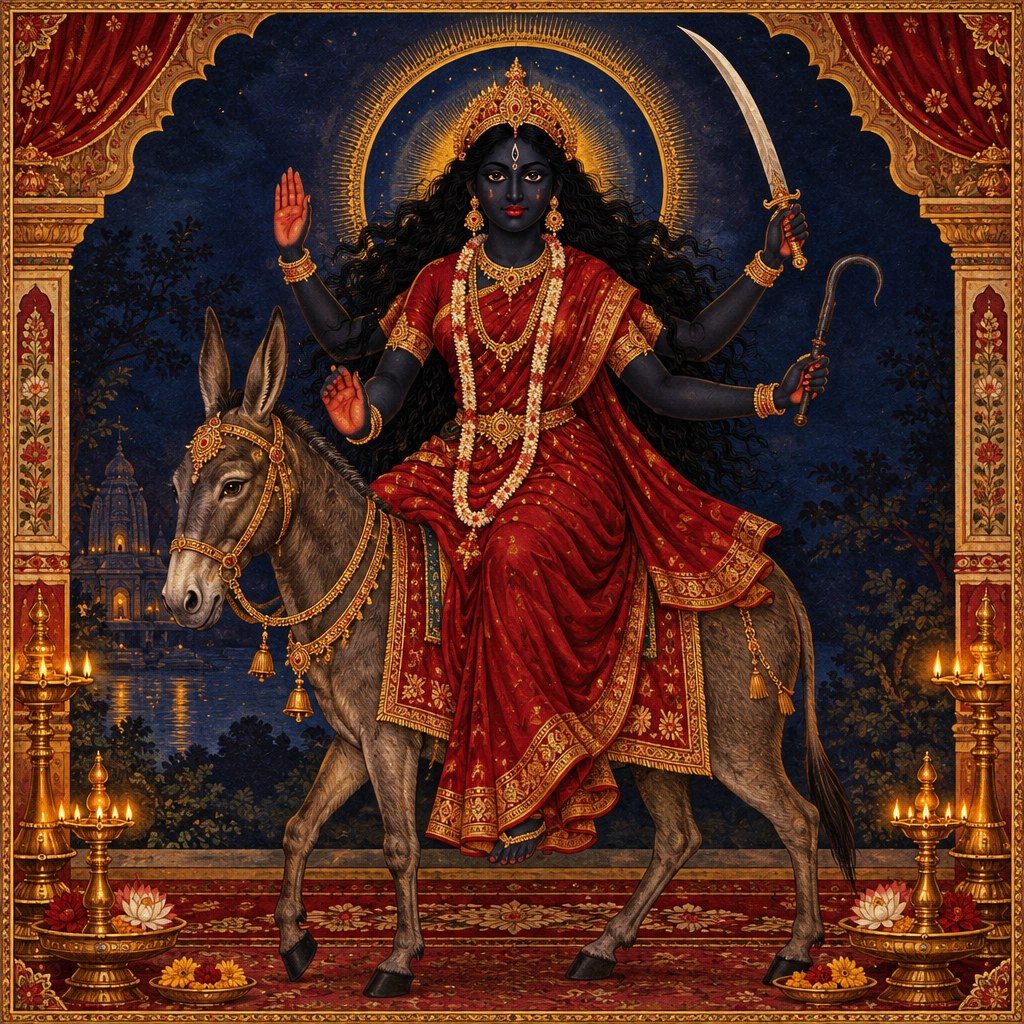
Kalaratri is the seventh Navadurga form. Her dark appearance and fierce imagery express a protective aspect of the Divine Mother. Devotees also know her as Shubhankari, associated with auspiciousness. Fierceness and reassurance belong to the same image. Read the traditional account and iconography.
How to recognise her form
Four arms, a dark complexion, unbound hair, a donkey mount, a sword and an iron hook distinguish her. Two hands offer blessing and reassurance.
Look for these details when you see an image in a home, temple or festival display. Artists and regional traditions may vary. The form is more than a decorative portrait: its identifying details help you follow the devotional account.
A reflection for this Navratri
Kalaratri asks us to look beyond our first reaction. Something that appears difficult may also offer protection: a necessary truth, a firm boundary, or the decision to face a neglected task. Her dark form must not be described as morally lesser than the luminous forms of Devi. Each has a place in the sequence. For today’s reflection, give a vague fear a clear name. Then consider the next step you can actually take.
One practice to carry into your day
- Write the concern in one plain sentence.
- Separate what you know from what you are imagining.
- Choose a practical step or speak with someone you trust.
You can use this as a personal reflection alongside your family’s way of observing the festival. It is not a prescribed ritual or a promise of a particular spiritual result.
A question to share
What changes when you name the fear instead of avoiding it?
Send this reflection to someone you would like to hear from. A specific memory or example can make the conversation more meaningful.
Follow the nine-part series
- 1. Maa Shailaputri
- 2. Maa Brahmacharini
- 3. Maa Chandraghanta
- 4. Maa Kushmanda
- 5. Maa Skandamata
- 6. Maa Katyayani
- 7. Maa Kalaratri
- 8. Maa Mahagauri
- 9. Maa Siddhidatri
Our reading order follows the traditional Navadurga sequence. Part numbers are not publication dates or a universal day-by-day ritual calendar. For local observance dates, check the 2026 Delhi Navratri calendar and your local temple or panchang.
Illustrations in this series are AI-generated devotional art.