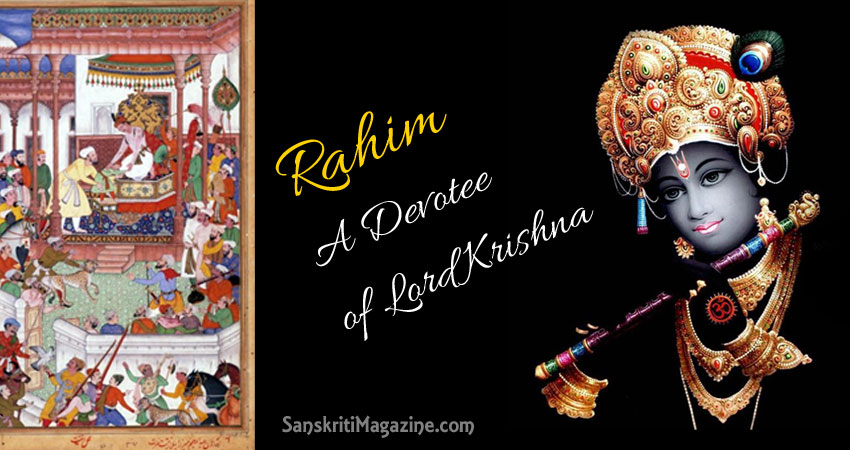
One of the Navaratnas (nine jewels) in Akbar’s court, Abdul Rahim Khan-e-Khana was a great devotee of Lord Krishna. In one of his poem, he says
”Sakhi, I am not able to put out of my mind, the charming eyes which are like petals of lotus flower, the gentle smile, the radiance of the teeth that surpasses lightning in brightness and swiftness and the nectar-immersed talks which are suffused with sweetness of the entire earth. My mind is always occupied with the swinging pearl necklace on His broad chest and the fluttering of the pitamber or yellow garment as he dances. Every day, I expect His return from Vrindavan. The image of the dark-hued Shyam does not leave my mind.”
This is how Abdul Rahim Khan-e-Khana expresses his love and devotion for Lord Krishna in one of his immortal poems. Popularly known as Rahim, he was one of the nine gems or navaratnas in the court of Mughal Emperor Akbar. His father, Bairam Khan, was a great Turkish statesman who took care of Akbar during his early years. After the death of Bairam Khan, Akbar married his widow, so Rahim was also his step-son.
Though his mother tongue was Persian, Rahim was well-versed in Arabic, Turkish, Sanskrit and Hindi and he translated Babar’s memoirs into Persian. He also wrote two important books on astrology: Khet Kautukam and Dwawishd Yogavali. But what made him immortal is his contribution to Hindi literature in the form of couplets called Dohas, which convey, in pithy and melodious language, his deeply held views on different aspects of life. His devotional poems dedicated to Lord Krishna are no less prominent. In these poems, he comes across as an ardent devotee, pining for his Beloved.
Rahim was a great humanitarian and he used to give alms to the poor with immense humility. Once, Tulsidas sent him a couplet enquiring: “Where did you learn to give alms in this manner? As your hands go up, your eyes go down.”
The great devotee of Krishna sent Tulsidas the following answer: “The Giver is someone else, who keeps on giving day and night. The people give me the credit, so my eyes are downcast.”
The last days of his life were far from happy. As he was opposed to Jehangir’s accession to the throne of Delhi, his two sons were beheaded. Jehangir confiscated all his property and he had to face immense difficulties. His somewhat dilapidated tomb is situated in Nizamuddin East, New Delhi.
An illustrious son of India, who promoted what we call Indutva — a syncretic fusion of faith and culture — his message was: “Do not ever snap the thread of love. Once broken, it does not unite; if united, a knot develops.”
By: Vimlesh Kumar