In the first day of our Navratri series, we turn our focus to Goddess Shailputri, the first manifestation of Goddess Durga. Revered on the first day of Navratri, she embodies the purest form of the Goddess, symbolizing nature and purity.
Who is Goddess Shailputri?
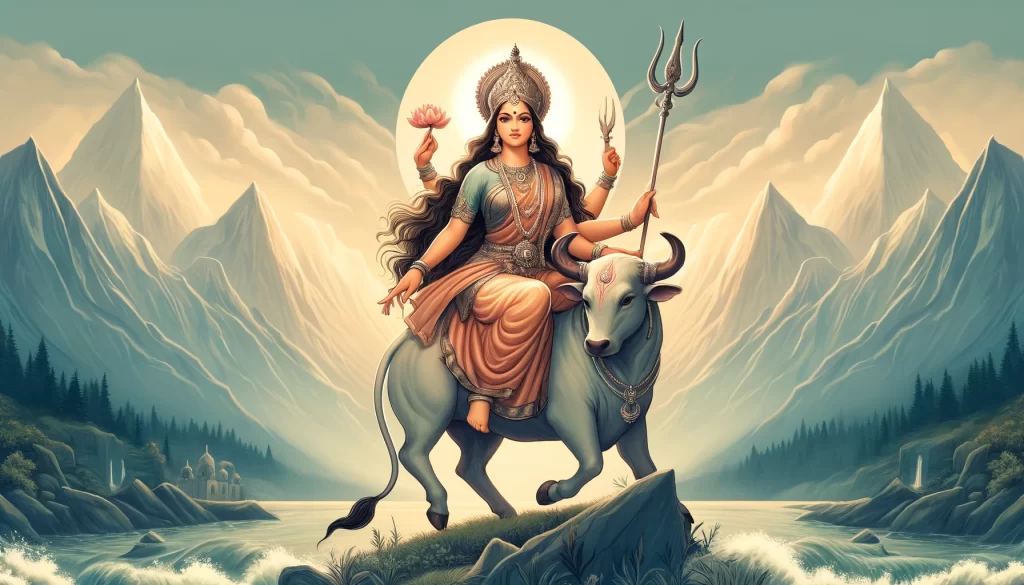
Shailputri, literally meaning ‘daughter of the mountains’, is an incarnation of Goddess Parvati. She is depicted riding a bull, holding a trident in her right hand and a lotus flower in her left. As the consort of Lord Shiva, she epitomizes the harmonious union of Shiva-Shakti.
Symbolism and Significance
Goddess Shailputri represents the grounding and nurturing aspects of nature. Her connection with the mountains signifies strength and endurance, while the lotus in her hand symbolizes purity and devotion. Worshipping her is believed to bring stability and grounding in one’s life.
The Story of Shailputri
According to mythology, in her previous birth, she was Sati, the daughter of King Daksha. After her self-immolation in the fire of yagna, she reincarnated as Shailputri. Her story is one of resilience and rebirth, teaching us the power of transformation and renewal.
Celebrating Goddess Shailputri
On the first day of Navratri, devotees offer prayers to Shailputri to seek her blessings for a life rooted in stability and devotion. The color associated with this day is red, symbolizing action and vigor.
Cultural Relevance and Practices
In various parts of India, this day is marked with special pujas and rituals. Devotees fast, chant mantras, and perform aarti to pay homage to the Goddess.
Contemporary Reflections
In today’s context, Goddess Shailputri inspires us to remain grounded and connected with our roots. She reminds us of the strength and resilience inherent in nature and within ourselves.
Join us tomorrow for Day 2 of our Navratri series as we explore the next form of Goddess Durga, Goddess Brahmacharini. To delve deeper into the enchanting world of Hindu culture and spirituality, don’t forget to visit Sanskriti Magazine for more insights.