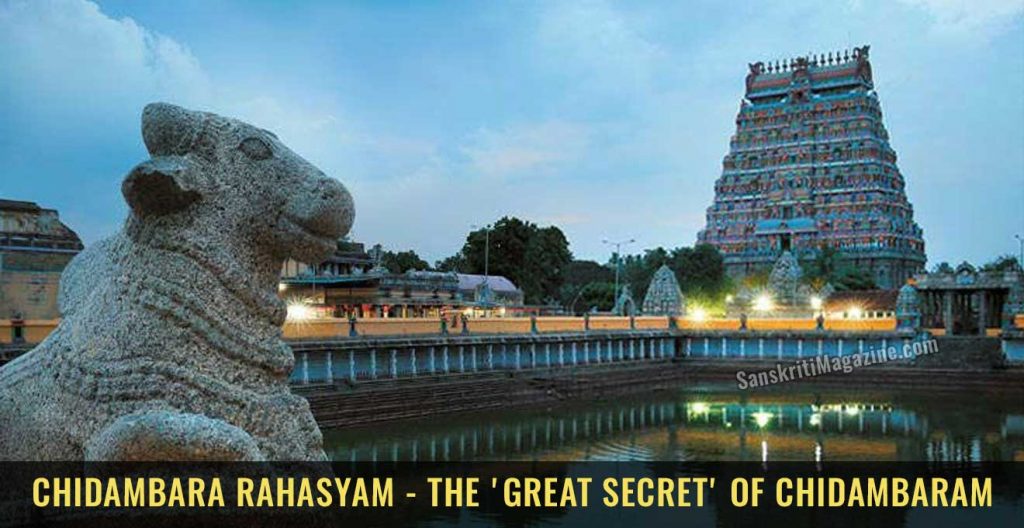
Now, what is here in this City Chidambaram of Brahma (the body) is an abode, a small lotus flower (the heart) within that is the small space. What is within that is to be realized. That, assuredly, is what one should desire to understand. (‘Dahara’ means ‘small’). In that dwelling, since the dwelling is small, that which is include in it is smaller than it — antah (in that dwelling) is akasah, space called Brahman. Brahman is like space because of ‘un-embodiedness’ and because of the similarity in qualities of subtle and all-pervasiveness.
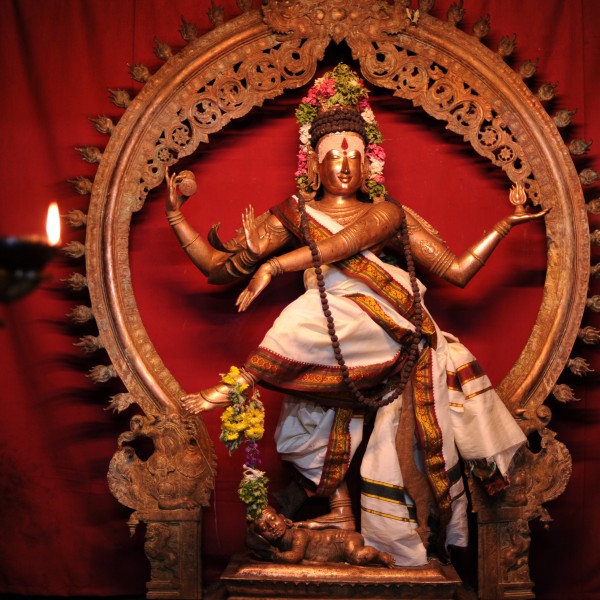
The Kanaka Sabha/Cit Sabha, where Natarajar and Sivakamasundari are manifested, represents the sakala state of Siva. The Cit-Akasa Rahasyam, where the Supreme Siva is enshrined as limitless space, is the nishkala state of Siva. (The sphatika linga, Chndramaulisvaram is the sakala-nishkala ‘formless form’ of Nataraja). Inside the heart is the daharakasa. Inside the daharakasa is the Cit Akasa. The Cit Sabha, in which Natarajar and Sivakamasundari are enshrined, is because the Brahma-taitva (principle or truth of Brahman) is effulgent as Cit in Chidambaram. And the Brhama-tattva shines in the Om-Kara. Cit is the dahara akasa, the small, subtle cavity which enshrines the rahasyam (secret) and is the source of all the effulgence of jnan (knowledge).
The Lord Shiva in his manifestation of formlessness is worshiped in Chidambaram. The Lord is said to continuously dance his dance of bliss ‘Aananda thaandava’ , with his consort ‘Sakthi’ or energy called ‘Sivagami’ and is diagrammatically represented by a ‘Yantra’ on the wall of an empty space in the sanctum sanctorum of the temple. A curtain covers this space , which when drawn reveals strands of golden ‘Vilva’ leaves hung to indicate the Lord’s presence. The curtain is dark in the exterior (indicating ignorance) and bright red in the interior (indicating wisdom and bliss).
Also read : A Foreigner’s account of Chidambaram Temple Festival in 1924, London
During the daily rituals, the Chief priest of the day, himself in a state of Godliness – Shivohambhava- ‘Shiva’- the Lord , ‘hum’ me / us , ‘bhava’- state of mind , withdraws the curtain – indicating withdrawal of ignorance , and reveals the space and the Lord’s presence. The Chidambara Rahasya, is hence that , when in total surrender, one lets God intervene and remove ignorance, one gets to see and experience his presence and bliss.
What is this ‘great secret’ called ‘Chidambara Rahasyam’?
Natarajar represents the Sakala or embodied form of the Lord; the crystal linga, Candramaulisvara, the Sakala-nishkala, or ‘formed-formless form’ of the Lord; and the Rahasya or the Chidambara-yantra, the Lord’s transcendental (nishkala) form.
To the proper right of Natarajar in the sanctum sanctum is a maya-yavanika (a black curtain), behind which are quite a few strings of golden viva leaves hanging in a row. To those who look upon them with earthly eyes and on whom only something in concrete shape can make an impression, It is Chidambaram Rahasyam! It is only a symbol of something infinite — space, akasa. It embodies, according to those who have access to the sanctum sanctum, Sri cakra, Chidambara cakra, Sammelana cakra, Mahatandava cakra, Tiraskarani cakra and Ananda cakra, these constitute the Chidambara Rahasya. This spaces looked upon as the most sacred mulasthana (centre) of the akasa sthana. A great saint has been heard to say that the super-imposition of Sri cakra over Pancakshara cakra produces the configuration of Nataraja. This yantra is regarded as the symbol of ‘space’ and is the Akasa linga which is the Chidambara Rahasyam (‘the great secrat of Chidambaram’).
The Layout inside the Cit Sabha is of considerable interest. The five steps leading to the Cit Sabha represent Brahma, Vishnu, Rudra, Mahesvara and Sadasiva. The door leading into it symbolizes Illusion (avaran or cover thereof). The ninety-six tattvas — Prakrti, Vikrit, etc are in the shape of ninety-six windows. The four ‘golden’ pillars in the middle of the Cit Sabha represent the four Vedas. The twenty-eight wodden pillars around represent the twenty-eight Sivagamas (Kamika, Makuta, etc.). The space encompassed by these is known as Sudha Vidya or Brahma Vidya. The area between the Chidambara Rahasyam and the icon of Natarajar is callled the Pranava Pitham. It is regarded as the saguna manifestation receiving the message through the Pranava Pitham; and the Chidambara Rahasyam is but the symbolism of the Supreme Being, the embodiment of eternal bliss, infinite space and divine knowledge (Jnanananda paramakasa).