IndianSanskriti
Narsimha Dev Gold Currency of Ancient India

Narsimha Dev Gold Currency of Ancient India

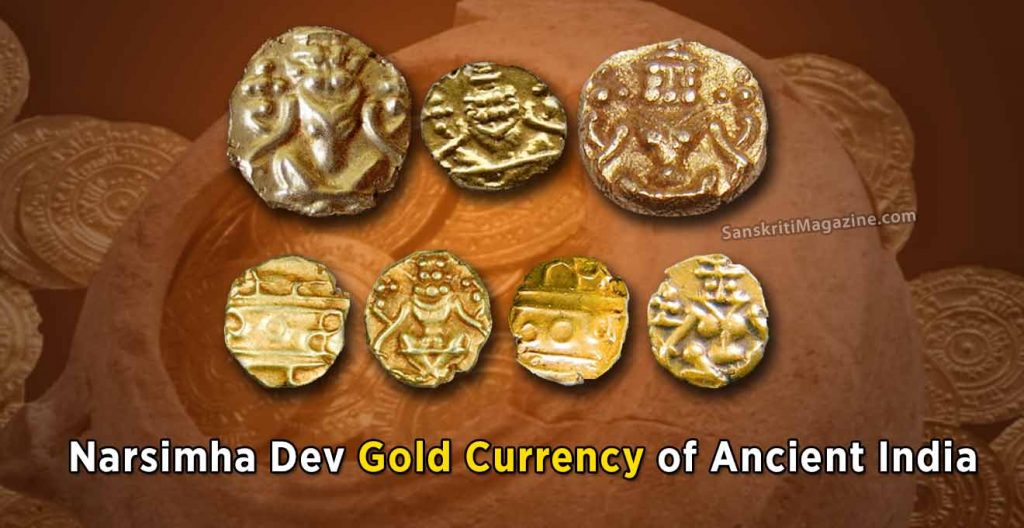
In ancient India, gold fanams were issued by a number of states for use as trade currency. One of these was Mysore, under the reign of King Kantirava Narasa (1638 – 1662 AD). He was the first king of Mysore to issue coins with inscriptions, and these gold coins are still known today as Kantirava fanams. The most beautiful of these bear the image of Lord Narsimha Dev.

Minted in 21 kt. gold, the Narsimha fanams are very small, weighing only about .2 grams and measuring barely 6 mm across. Despite their small size, the artwork is beautiful and there is a wide range of depictions of Lord Narsimha’s beautiful countenance to be found on the coins.

On Kantirava’s Narsimha fanams, the Lord is seen in His yogabhanda mudra, or yoga pose, deep in meditation after Prahlada and the demigods placated His anger. He wears the traditional holy thread janesva around his knees and on some of the Kantirava fanams, a stick is also visible, holding up the Lord’s leg. In His upper hands, the Lord holds chakra and conch, and His lower arms are either resting on His knees, of beside them.

King Kantirava Narasa produced two other fanam series after the Lord Narsimha, depicting Siva-Parvati and Viraraya, the Lord’s lion/boar form. These were engraved in Hoysala style.

The earlier dies, produced during the king’s lifetime, seem to have been made by artists who had superior capability in engraving. Some of the early Kantirava fanams were minted by Sadasiva Nayaka of Ikkeri, an ancient town in Sagara, on the western edge of Karnataka. Coinage minted there is also known as Ikkeri fanams or pagodas. The Ikkeri mint was eventually decomissioned, and later Kantirava fanams were minted by Deevan Purnaiya, during the reign of Krishna Raja Wodeyar-III (1799-1812 A.D.), a later Mysore ruler.

Years later, due to the popularity of the beautiful Narsimha artwork, Kantirava fanams resurfaced yet again, but these were ‘knock-off’ copies. While many authenticated pieces are still in the hands of collectors and available for sale, many of the later coins minted during the British Raj are mixed in. On both types, however, we find the Kantirava legend scripted on the fanam verso.
You may also like

Search the website

Like us on Facebook

Get daily updates via Email

Enter your email address:

Recent Posts

Purushottam Maas — The Month No Deity Would Claim, and the Lord Who Made It Supreme

Every month of the Hindu calendar has a lord — except the rare thirteenth, the Adhika Maas, born an orphan and shunned as the “impure month.” The Puranas tell how this rejected month went in grief to Bhagavan Vishnu, who claimed it, gave it His own name — Purushottam — and made it the most fruitful month of all. The origin story, the teaching, and what it means for Purushottam Maas 2026 (May 17 – June 14).

Padmini Ekadashi 2026 — The Ekadashi Even the Devas Descend to Keep

Padmini Ekadashi 2026 — The Ekadashi Even the Devas Descend to Keep

The rarest Ekadashi of the entire Hindu calendar is three days away. The Padma Purana preserves a conversation between Bhagavan Krishna and Yudhishthira about a single Ekadashi the great Rishis spend lifetimes waiting for — Padmini. The Vrat Katha of Queen Padmini of Mahishmati, the lotus teaching, and why May 27, 2026 is the morning Vaishnavas across Bharata are preparing for.

Varada Chaturthi 2026 — The Rare Ganesha Day of Purushottam Maas

Varada Chaturthi 2026 — The Rare Ganesha Day of Purushottam Maas

Once every 2.5–3 years — when the rare 13th month of Adhika Maas opens — a thirteenth Vinayaka Chaturthi appears. The Mudgala Purana calls it Varada Chaturthi, the “boon-giving” Chaturthi, and holds it as the most fruit-bearing Ganesha day of the entire calendar. Today, Wednesday May 20, 2026, is that day.

Padmini Ekadashi 2026 — The Rare Ekadashi That Comes Only in Purushottam Maas

Padmini Ekadashi 2026 — The Rare Ekadashi That Comes Only in Purushottam Maas

Padmini Ekadashi 2026 falls on Wednesday, May 27 — the Shukla Paksha Ekadashi of Adhika Maas, the rarest Ekadashi in the entire Hindu calendar (it appears only every 2.5–3 years). The Padma Purana conversation between Bhagavan Krishna and Yudhishthira, the Vrat Katha of Queen Padmini, complete vrat vidhi with jagrana, mantras, and the lotus symbolism that gives the Ekadashi its name.

Ganga Dussehra 2026 — The Day Maa Ganga Came Down to Bhagiratha

Ganga Dussehra falls on Monday, May 25, 2026 — commemorating the day Maa Ganga descended from Vaikuntha to the earth through the millennia-long tapasya of King Bhagiratha. The full account from the Valmiki Ramayana, snan vidhi, dana traditions, mantras, and the teaching of sustained sincerity.

css.php