By Pradeep Srivastava
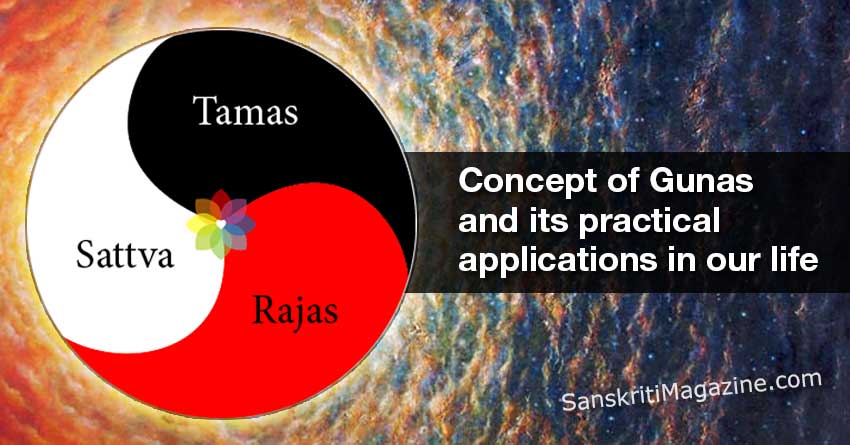
Before we get into the practical applications of the concept of gunas, it would make sense to have a basic understanding of what gunas are. The following excerpt would provide an overview of the gunas.
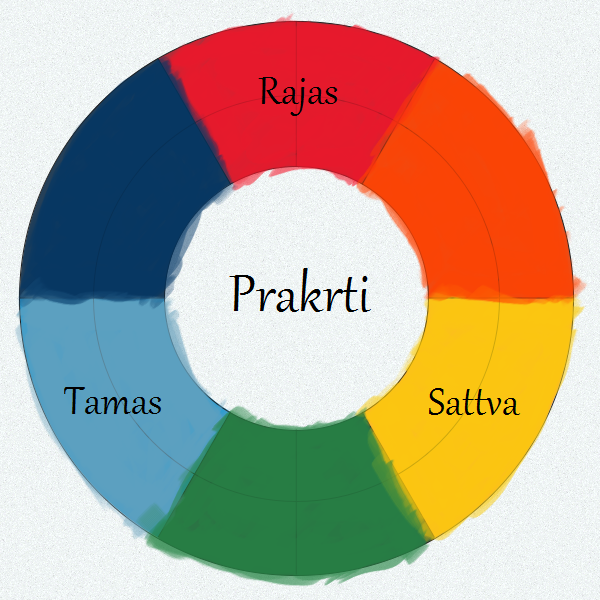
“Guṇa (Sanskrit: गुण) depending on the context means ‘string, thread or strand’, or ‘virtue, merit, excellence’, or ‘quality, peculiarity, attribute, property’. The concept originated in Samkhya philosophy, but now a key concept in various schools of Hindu philosophy. There are three gunas, according to this worldview, that have always been and continue to be present in all things and beings in the world.These three gunas are called: sattva (goodness, constructive, harmonious), rajas (passion, active, confused), and tamas (darkness, destructive, chaotic).
All of these three gunas are present in everyone and everything, it is the proportion that is different, according to Hindu worldview. The interplay of these gunas defines the character of someone or something, of nature and determines the progress of life.
In some contexts, it may mean ‘a subdivision, species, kind, quality’, or an operational principle or tendency of something or someone. In human behavior studies, Guna means personality, innate nature and psychological attributes of an individual.”
There is no single word English language translation for the concept guna. The usual, but approximate translation is “quality”.
As you can see, in the material world, gunas are all-encompassing. Even an atom, which makes up all the objects of the world, has the three gunas manifested in it: sattva in the proton, rajas in the electron, and tamas in the neutron. All the three gunas are present in everyone and everything in varying proportions. Typically, we use gunas to describe characteristics of human beings, but there is no reason that the gunas cannot be used to describe the characteristics of all the entities of the material world, living as well non-living.
Gunas can also be used to characterize all the fundamental operational principles that have been identified by philosophers. However, since I am thoroughly familiar with only Hinduism, I intend to focus only on the philosophy of Hinduism. I have tried to be as thorough as possible, but I suspect that there are infinite applications of the concept of gunas and therefore, no one person can capture all the applications. After I hit the number 18 on these applications, I decided to stop, for 18 is an auspicious number and even Gita stops after 18 chapters. I am sure the reader will get the message that I am trying to convey. I hope that, going forward, others would further expand on the applications of the concept of gunas.
1. Living Being (Experiencer)=Intellect, Mind, and Body
Intellect=Sattva; Mind=Rajas; Body=Tamas
2. Living Being (Experiences)=Thinks, Feels, and Perceives
Thinking=sattva; Feeling=Rajas; Perception=Tamas
3. Living Being (Fields of Experience)=Thoughts, Emotions, and Objects
Thoughts=Sattva; Emotions=Rajas; Objects=Tamas
4. Five Elements=Sky, Air, Fire, Water, and Earth
Sky=Sattva; Air, Fire, Water=Rajas; Earth=Tamas
5. Five Knowledge Sense Organs=Ears, Skin, Eyes, Tongue, and Nose
Ears=Sattva; Skin, Eyes, Tongue=Rajas; Nose=Tamas
6. Five Knowledge Senses=Sound, Touch, Sight, Taste, and Smell
Sound=Sattva; Touch, Sight, Taste=Rajas; Smell=Tamas
7. Five Work Sense Organs=Mouth, Hands, Feet, Reproductive Organ, and Excretory Organ
Mouth=Sattva; Hands, Feet, Reproductive Organ=Rajas; Excretory Organ=Tamas
8. Five Work Senses=Speech, Grasping, Locomotion, Reproduction, and Excretion
Speech=Sattva; Grasping, Locomotion, Reproduction=Rajas; Excretion=Tamas
9. Five Koshas=Annamaya Kosha, Pranamaya Kosha, Manomaya Kosha, Vigyanamaya Kosha, and Anandamaya Kosha
Anandamaya Kosha =Sattva; Vigyanamaya Kosha+Manomaya Kosha + Pranamaya Kosha=Rajas; Annamaya Kosha=Tamas
10. Seven Chakras=Muladhara(Lowest), Svadhisthana, Manipura, Anahata, Vishuddha, Ajna, and Sahaswara(Highest)
Anahata+Vishuddha+Ajna+Sahaswara=Sattva; Svadhisthana+Manipura+Anahata=Rajas; Muladhara=Tamas
11. Antahkarana=Manas, Buddhi, Chitta, and Ahamkara
Buddhi+Chitta=Sattva; Manas=Rajas; Ahamkara=Tamas
12. Four States of Consciousness=Waking, Dreaming, Deap Sleep, and Turiya (the base-consciousness, Brahman, that transcends the other three states of consciousness)
Waking=Sattva; Dreaming=Rajas; Deep Sleep=Tamas
13. Five Pranas=Prana, Apana, Udana, Samana, and Vyana
Prana=Sattva; Udana+Samana+Vyana=Rajas; Apana=Tamas
14. Three Bodies=Causal Body, Subtle Body, and Gross Body
Causal Body=Sattva; Subtle Body=Rajas; Gross Body=Tamas
(Note: Causal Body (Karana Sharira)=Sheath of Bliss (Anandamaya Kosha); Subtle Body (Sukshma Sharira)=Sheath of Intellect (Vigyanama Kosha)+Sheath of Mind (Manomaya Kosha); Sheath of Vitality (Pranamaya Kosha); Gross Body (Sthula Sharira)=Sheath of Food (Annamaya Kosha))
15. Fourteen Worlds (Lokas)=7 Higher Lokas (Bhu, Bhuvar, Svar, Mahas, Janas, Tapas, and Satya) + 7 Lower Lokas (Atala, Vitala, Sutala, Talatala, Mahaatala, Rasaatala, and Patala)
Bhuvar+Svar+Mahas+Janas+Tapas+Satya= Sattva; Bhu=Rajas; Atala+Vitala+Sutala+Talatala+Mahatala+Rasaatala+Patala=Tamas
16. Four Varnas=Brahmans, Kshatriyas, Vaishyas, and Shudras
Brahmans=Sattva; Kshatriyas=Sattva+Rajas; Vaishyas=Rajas+Tamas; Shudras=Tamas
17. Four Ashramas=Brahmacharya, Grihastha, Vanaprastha, and Sannyas
Brahmacharya=Sattva; Grihastha=Rajas+Tamas; Vanaprastha=Sattva+Rajas; Sannyas=Sattva
18. Four Purusharthas=Dharma, Artha, Kama, and Moksha
Dharma=Sattva; Artha=Rajas+Tamas; Kama=Rajas+Tamas; Moksha=Sattva
It is not hard to see how deep, thoughtful, and insightful the philosophy of Hinduism is. I also hope that this write-up would inform the reader about certain core principles of Hinduism and hopefully motivate one to study those principles in detail, especially, in light of the fact that in the era of Internet so much information on every topic is so readily available online, free of charge.