Friday, May 22, 2026 · Ahead of Ganga Dussehra on Monday, May 25 · Religion · Festivals
There are stories in our Itihasa that close with a victory. There are stories that close with a coronation. And then there is the story of King Bhagiratha — which closes with a single, weightless image: the Mother of all rivers stepping out of the sky and onto the matted hair of Mahadeva, lowered from there into the world like a thread of light let down through a window.
That descent — Gangavataran, the coming-down of Ganga — is the moment Ganga Dussehra commemorates. In 2026, it falls on Monday, May 25, the Shukla Paksha Dashami of Adhika Jyeshtha. For ten days before and on the day itself, every ghat of the Ganga from Gangotri to Ganga Sagar fills with devotees, every temple sounds its bells before dawn, and a single name moves quietly across the breath of millions: Maa Ganga.
This is the story of how She came.
The King Who Inherited Sixty Thousand Ashes
The account is preserved in the Bala Kanda of the Valmiki Ramayana, retold in the Bhagavata Purana, and echoed in the Vishnu Purana. It begins many generations before Bhagiratha himself — with his great-great-grandfather, King Sagara of the Ikshvaku dynasty.
Sagara had performed the Ashvamedha — the great horse-sacrifice that would establish his sovereignty over the four directions. The horse, according to the rite, was set free to wander for a year under the protection of the king’s sons. Sagara had sixty thousand sons born of his queen Sumati, and one — Asamanjasa, born of Keshini — and they followed the horse with the pride of a host that no army on earth could check.
But the horse vanished.
Indra, troubled by the king’s growing power, had stolen it and tied it secretly in the patala-loka, beside the meditating sage Maharishi Kapila. The sixty thousand sons, searching with the violence of princes who had never been refused, dug their way down through the very earth itself, tearing open the foundations of the world. When they came at last upon the horse standing beside the sage, they accused Kapila of theft and rushed at him with raised weapons.
The sage opened his eyes.
In the heat of his glance — the gathered tapas of countless years of sadhana — the sixty thousand sons were reduced, in a single instant, to ash. They did not die in war. They did not die in dharma. They died in the violation of a Rishi’s tapasya, and their ashes lay heaped in the patala without rite, without water, without release. Their souls hung suspended — unable to ascend, unable to dissolve — for there was no purifying water in all the three worlds equal to the burden of their fall.
This was the inheritance that came down to Bhagiratha.
The Tapasya of Bhagiratha
Many generations passed. The throne descended from Sagara to Asamanjasa, then to Amshuman, then to Dilipa, and at last to Bhagiratha — a king who, the Ramayana tells us, was given his throne and gave it back. He had no taste for the ordinary work of kingship while the souls of his ancestors waited unrelieved. He left Ayodhya. He left the crown. He climbed into the Himalayas, and he sat down to perform the most sustained tapasya his line had ever known.
The Puranas count it in thousands of years.
He fasted on a single dry leaf in summer, on snow in winter, on air in the months between. He stood with his arms raised through entire seasons. He performed japa of the name of Bhagavan Brahma without break of rhythm or attention. He did not ask for power. He did not ask for sons. He did not ask for victory. He asked for one thing only: that the Ganga, who flowed in Brahma’s kamandalu in Brahmaloka, might be permitted to descend to the earth and touch with her water the ashes of the sixty thousand.
At last, Brahma appeared.
“Your tapasya has reached Me, Bhagiratha. The Ganga shall descend. But hear this — her flow is so great that, falling unchecked from the heavens to the earth, she will shatter the world in two. There is only one in creation whose head can bear her descent. Go to Bhagavan Shiva. Ask Him to receive her on His head.”
Bhagiratha did not pause. He went into the second tapasya — this time for Mahadeva — and the Lord, who is moved by sincerity faster than by any other thing, came after a far shorter wait.
“Bring her down, Bhagiratha. I will hold her.”
The Descent — When Vaikuntha’s River Touched the Earth
The Ganga had her own pride.
She was the river of Vaikuntha, born from the lotus feet of Bhagavan Vishnu Himself, drawn into Brahma’s vessel and carried into Brahmaloka. The Puranas describe her, in her celestial form, as a stream of milk-white light a thousand yojanas wide. When she heard that she was to be lowered to the dust of the earth, and worse — to be received first on the head of a wild, ash-smeared ascetic — she resolved to fall with such force that she would sweep Mahadeva Himself into the patala along with everything she touched.
She fell.
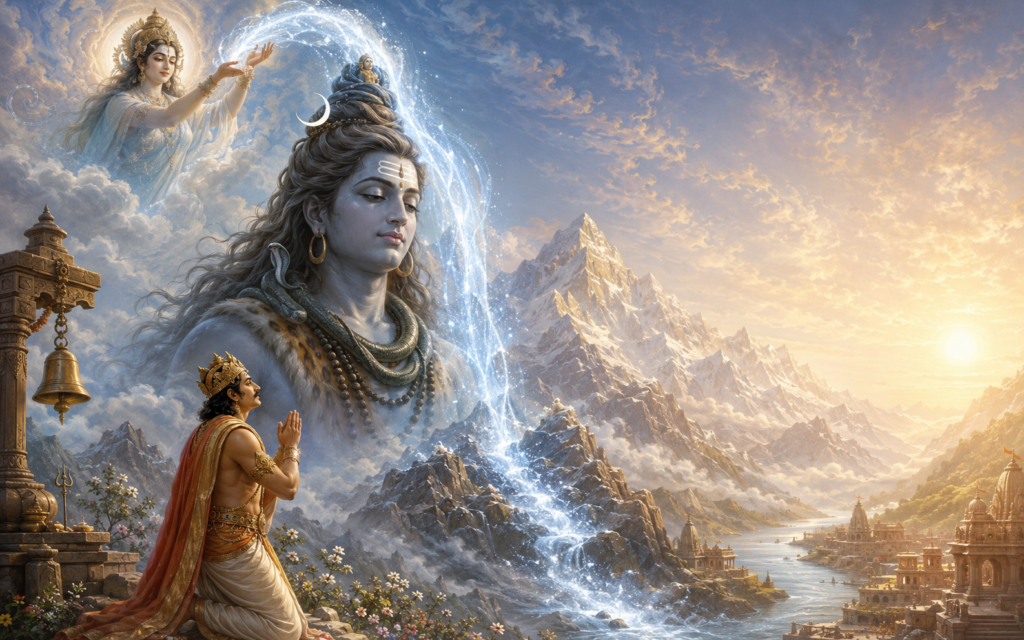
The Valmiki Ramayana describes the moment with extraordinary economy. The whole sky filled with white. The mountains shook. The Devas leaned out of their viman to watch. And Mahadeva — Chandrashekhara, who carries the moon on His head — stood on Mount Kailasa and lifted His face to the falling river.
She struck His matted jata.
And vanished.
For many years she wandered, lost, in the labyrinth of His hair. Her pride dissolved. Her thunder went quiet. She had set out to overpower the Lord and found herself held by Him so completely that she could not find her way out. At last, when she had been gentled enough to enter the world without destroying it, Bhagavan Shiva released a single thread of her flow from a single lock of His jata, and that thread became the Ganga that flows now through the plains of Bharata.
Bhagiratha walked ahead of her on his chariot. She followed. Where his chariot went, her water went. He led her down from the Himalayas, through Haridwar, through Prayagraj, through Kashi, through Ganga Sagar — and at last into the patala, where she touched the ashes of the sixty thousand. The souls rose. The release was given. Sagara’s line was made whole.
This is the descent we honour on Ganga Dussehra.
Ganga Dussehra 2026 — Key Timings
All timings as per Drik Panchang (IST). Please verify with your local panchang for regional variations.
| Dashami Tithi Begins | Early morning, Monday, May 25, 2026 |
|---|---|
| Dashami Tithi Ends | Early morning, Tuesday, May 26, 2026 |
| Snan Muhurta | Brahma Muhurta of May 25 — pre-dawn through sunrise |
| Hasta Nakshatra Window | Coincides with Dashami — most auspicious for Ganga snan and dana |
The combination of Jyeshtha Shukla Dashami with Hasta Nakshatra (and, ideally, Vyatipata yoga) is what gives Ganga Dussehra its name — dasha-hara, “the destroyer of ten” — the ten varieties of paapa accumulated by body, speech, and mind.
How to Observe Ganga Dussehra
The night before: Take a single sattvic meal before sunset. Keep japa of the Ganga mantra (Om Namo Gangayai Vishvarupinyai Narayanyai Namo Namah) on the breath as you fall asleep.
At Brahma Muhurta on May 25: Rise. If you live within reach of the Ganga, the Yamuna, the Narmada, the Godavari, the Kaveri, or any river held sacred in your region, take a snan in her water with the sankalpa of Ganga Dussehra on your tongue. If you cannot reach a river, take a bath at home with a few drops of Ganga jal added to the water — the Puranas are unanimous that sincerity, not geography, is the measure.
The puja: Offer to the river — or to a vessel of Ganga jal placed before you — panchopachara worship: a deepa, dhoop, flowers (white lotus or any white flower), naivedya (fruits and milk), and pranama. Recite the Ganga Stotra of Adi Shankaracharya, even one or two verses, and the dasha-akshara mantra of the Mother.
Through the day: Keep the fast — phalahari is the common form. Avoid sleep during the day. Read the Bhagiratha account from the Bala Kanda of the Valmiki Ramayana, or the Ganga Mahatmya from the Skanda Purana.
Dana: The Puranas attach immense merit to the offering of dasha-vidha dana on this day — ten of any one auspicious thing given to a Brahmana or to a hungry person: ten fruits, ten coins, ten clothes, ten waterpots, ten vessels of food. The number ten is itself the number of paapa that the snan washes away — what is given in tens is multiplied in tens.
In the evening: Light a deepa beside flowing water if you can — a river, a stream, even a vessel — and let it float. The Ganga Aarti at Haridwar’s Har-ki-Pauri and at Kashi’s Dashashwamedh Ghat is broadcast live across the world on this evening; even watching it with sraddha is held to confer the merit of presence.
Mantras for the Day
Om Namo Gangayai Vishvarupinyai Narayanyai Namo Namah
Om Hreem Shreem Gangayai Namah
Recommended recitations: the Ganga Stotra of Adi Shankaracharya (Devi sureshvari bhagavati gange…), the Ganga Sahasranama from the Skanda Purana, and the Bhagiratha Charita from the Bala Kanda.
The Deeper Teaching — The River That Followed a Man
There is something the Puranas keep saying about Ganga that is easy to miss.
She was Vaikuntha’s river. She belonged to the highest realm in creation. She had no need of the earth, no obligation to descend, no debt to pay to any soul that walked the dust below. She came down because one man asked.
She did not come down for the Devas. She did not come down for the Rishis. She did not come down because the earth deserved her. She came down because a king of Ayodhya, generations removed from the sin he was trying to atone for, sat in the snow for thousands of years and would not stop asking.
This is the wisdom Ganga Dussehra leaves with the devotee who watches her flow on the morning of the twenty-fifth: the Divine moves in response to sincerity, not in response to merit. Bhagiratha was not a great Rishi. He was not the inventor of any darshana. He was a king who left his throne and went into the mountains because he could not bear the thought of his ancestors waiting unrelieved. That single, stubborn refusal to rest until the souls of his line were saved was the lever that lifted the river of Vaikuntha out of the sky.
Every japa kept long enough is, in some smaller way, a Bhagiratha tapasya. Every devotee who refuses to give up on a soul they love is calling down their own Ganga.
The Mother does not refuse the call. She never has.