Adhik Jyeshtha Maas, 2026 · May 17 – June 14 · Purushottam Maas · Religion · Festivals
The story of how the most rejected month of the Hindu calendar became the one that bears the name of Bhagavan Vishnu Himself.
Every month of the Hindu calendar has a lord. Chaitra, Vaishakha, Jyeshtha, Ashadha — each of the twelve has a presiding deity, an assigned grace, a place in the great wheel of the year. The festivals know where to fall. The vrats know where to land. The auspicious acts of a lifetime — the marriage, the upanayana, the griha-pravesha, the first feeding of a child — all find their season in one of the twelve.
But the lunar year is shorter than the solar year by roughly eleven days. Left uncorrected, the two would drift apart until the festivals of winter fell in the heat of summer. So once every two and a half to three years, the calendar inserts a thirteenth month to bring the lunar and the solar back into alignment — an extra month, an intercalary month, the Adhika Maas.
And this thirteenth month, the Acharyas tell us, was born an orphan.
The Month That Belonged to No One
When the twelve months were each given their lord and their share of grace, the extra month was left over. It had no presiding deity. It had no festivals of its own. Worse, because it stood outside the ordered reckoning of the year, the tradition came to regard it as inauspicious — a month in which no marriage should be performed, no new house entered, no sacred thread tied, no new venture begun. The very name it earned in common speech was Mala Maas — the impure month, the soiled month, the month the world set aside and waited to pass.
The Puranas give this month a voice. They tell us that the Adhika Maas, seeing every other month honoured and itself shunned, fell into a grief so deep that it could no longer bear to exist. No one invoked it. No one celebrated within it. No one performed a single auspicious act in its keeping. Mothers warned their children away from beginning anything in its days. To the rest of the calendar it was a blemish to be endured.
The month went, in its sorrow, to Bhagavan Vishnu.
The Appeal to the Lord
It came before Him in the form of a being heavy with shame, and it laid its grief at His feet.
“You have given every month a lord. You have given each of the twelve a place in the wheel, a deity to preside, a grace to carry, festivals to hold. To me You have given nothing. The world calls me Mala — the impure one. No marriage is held in my days. No threshold is crossed. No child is named. No yajna is begun. I exist, and yet I am the one month no one wishes to live through. Tell me, Bhagavan — to whom do I belong? Who will claim a month that the whole world has refused?”
The Puranas say that Bhagavan Vishnu listened in silence, and that as He listened, His compassion moved as it always moves — toward exactly the one whom the world has cast aside.
And then He did something He had done for no other month.
He claimed it for Himself.
The Naming
“From this day, you are no longer Mala Maas. You are no longer the impure month, the discarded month, the month that belongs to no one. You belong to Me. And because you belong to Me, I give you My own name.”
The name He gave was Purushottam — the Supreme Being, the Highest of all Persons, one of the most exalted names of Bhagavan Vishnu Himself. The month that no deity would claim now bore the highest name in the Vaishnava tradition.
Nor was the gift only a name. The Lord decreed that the merit of every act of bhakti performed in this month — every japa, every dana, every vrat, every reading of the scriptures, every act of charity — would be multiplied beyond what the same act could earn in any of the twelve ordinary months. What the world had treated as a season to avoid, the Lord made a season of supreme opportunity. The month with no festivals of its own became the month in which the smallest sincere offering carries the greatest fruit.
“The world turned away from you. I have turned toward you. Now those who wish to come close to Me will come to you to do it.”
What the Story Teaches
The Acharyas point to this story whenever a devotee feels passed over, set aside, or left without a place.
The teaching is exact. What the world discards, the Lord makes supreme. The month that was called impure became the month that carries His own name. The season no one wanted became the season most fruitful for the one who seeks Him. The blemish on the calendar became the jewel of it.
This is the consolation Purushottam Maas offers to anyone who has ever felt like the extra one — the unclaimed one, the one without a season of their own. The Lord’s grace does not move first toward what is already honoured. It moves toward what has been refused. The month learned this. And the month was given the highest name there is.
There is a further, quieter teaching the Acharyas add. The reason this month earns such merit is precisely that it holds no festivals to distract the heart. In the twelve ordinary months, the devotee is carried along by the great occasions — the lights of Deepavali, the colours of Holi, the fasts and feasts that arrive on their own schedule. Purushottam Maas has none of these. It is empty of external occasion, and so it returns the devotee to the only thing that was ever the point: the direct, unornamented turning of the heart toward Bhagavan Vishnu. The month with nothing to celebrate becomes the month in which He alone is celebrated.
Purushottam Maas 2026 — A Month Already Underway
This year, Purushottam Maas is Adhik Jyeshtha, running from May 17 to June 14, 2026. We are within it now. It will not return until the calendar opens its thirteenth chamber again, more than two and a half years from now.
Within this single month fall some of the rarest observances of the entire Hindu calendar — the Varada Chaturthi of Bhagavan Ganesha, the rare Padmini Ekadashi and Parama Ekadashi of Bhagavan Vishnu, and the Purushottam Purnima that closes it. Each is fruitful precisely because it falls in the month the Lord made His own.
👉 Adhik Jyeshtha Maas 2026 — The Hidden Month That Belongs to Bhagavan Vishnu
A Closing Word
There is a single sentence the Vaishnava tradition has carried out of this story for a thousand years, and it is worth keeping for the whole of the month:
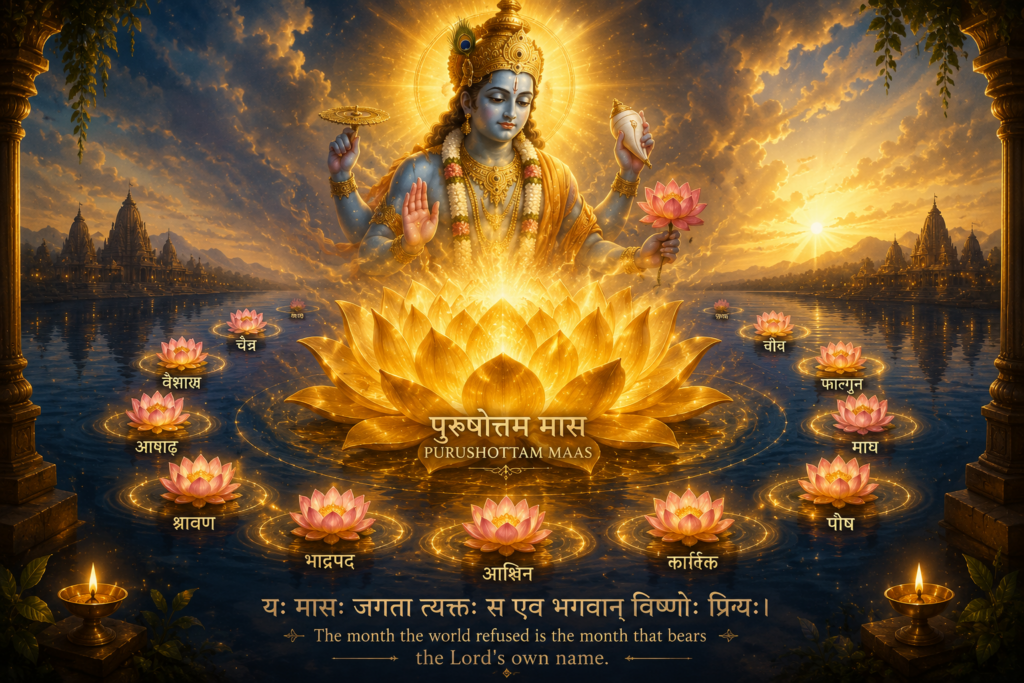
The month the world refused is the month that bears the Lord’s own name.
Whatever in your life feels like the extra one, the unclaimed one, the season without grace — the story of Purushottam Maas says it is exactly there that His hand reaches first.
Om Namo Bhagavate Vasudevaya