Tantrism in some form or other evolved in almost all the countries of the world. But in India it has a specialty forming a significant part of the country’s religious system in points of time and space. The ancient and modern scholars have stated different derivative meanings of the word ‘Tantra’.
According to M.M. Haraprasad Sastri it means shortening of abbreviation like algebraic forms of formula. The word is traced from the term ‘tan’ (to spread) and ‘tatri’ (to explain). Thus the original connotation of the term is scientific.
Tantra is a science of religion and philosophy of science. Tantra is Sadhana. In order to understand Tantra, its antiquity, significance etc in the religious system of India, we have to touch upon the ancient civilisations, when the early men derived the magical power from the natural phenomena.
Tantra is generally categorised into Agama, Nigama and Yamala. The term Agama is explained as that class of tantra which is addressed to Parvati by Lord Siva, whereas Nigama refers to tantra spoken by Parvati to Lord Siva. Yamalas tantra was designed to mean the worship of united deities. Varahi tantra says Agamas deal with seven topics:
- Cosmology
- Destruction
- Worship of God
- Sadhana
- Purascharana
- The six block rites, and
- four-fold meditation
Yamala tantra, on the other hand, deals with cosmology, astronomy, division of castes, yogadharma etc. Agamas are of various types. Shaktisangama tantra records Saiva, Sakha, Ganapatya, Saura, Vaisnava, Mahavira, Pasupata etc. (of eleven types) and Savara (of eleven types). Agamas are Vedic or non-Vedic. It is divided into Tantra, Yamala and Damara. Damaras are of six types:
- Yoga Damara
- Siva Damara
- Durga Damara
- Saraswata Damara
- Brahma Damara, and
- Gandharva Damara
In accordance with the sects the Tantras are classified. Geographical conditions are also responsible in classification of Tantra, viz. Visnukranta, Rathakranta and Asvakranta.
There are three trends of tantras: Dakshina, Vama and Madhyama. Like this tantra has a vast mass of literature covering wide range of heterogenous systems. In the Vamadeva Tantra, Parvati said to Lord Siva “You have explained to me crores of tantras each of which has a special feature of its own.” Each tantra has its philosophy, own system of ritual practice and deity etc. As a matter of fact, the tantras deal with the worship of not only female deities but with various male deities as well. And we have really works known as tantras belonging to various sects like the Saivas, the Vaisnavas, the Ganapatyas, the Sauras etc. It is true that this literature is generally known among the followers of various sects as ‘Agama’ as well. The Tantrikas consider tantra as the fifth Veda. Bhaskar Ray in his book ‘Setubandha’ describes the ‘Chausathi Mahamayavi Tantras’ or ’64 Yogini’ as Veda.
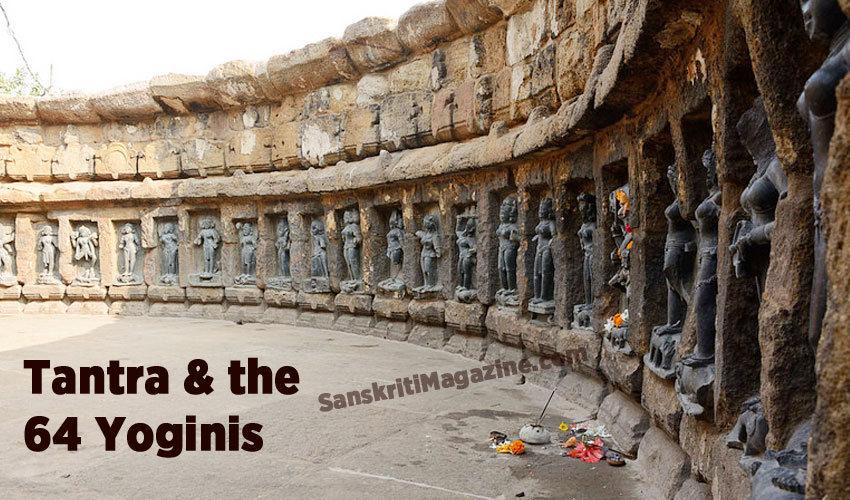
The culture of sixty-four Yoginis was the exuberant expression of extreme form of tantricism in about 8th century A.D. when the occult and esoteric Sadhana reached the highest peak. Origin of sixty-four yoginis is shrouded in mystery. The vedic and post-vedic literature mention the names of some individual yoginis, but never sixty-four manifestations together. Through the process of transformation the cult came into existence and exerted an important niche in the Sakta-tantric pantheon. The puranas and Upa-purans which are the source of different cults are referred to find out the origin of sixty-four yoginis, who are basically the mother-goddesses.
The Markendeya Purana relates that the gods created goddesses from their own Shaktis to assist Durga in killing the demon Raktavirya, the ally of Sumbha, who had the power to multiply himself into demons of the same stature and prowess from the drops of blood oozing out of his wounds and touching the ground. They were yoginis, who drank blood of the demon before felling on the grounds. The same story is recorded in the Mahabhagavata Purana to kill Andhaka demon, who had the power of creating numerous demons from his oozed blood touching the ground. Siva’s pasupata weapon proved futile.
Having no alternative Siva propitiated Nrusimha to come to his rescue. Lord Nrusimha created hundred and eight terrible goddess to help Ambika to kill Andhaka demon. After Andhaka was killed the new goddesses moved in a campaign of destruction in the Universe. To subdue them Nrusimha created thirty-two mothers more powerful than the earlier one. The earlier mothers out of fear took refuge in Nrusimha who asked all the created mothers to look after the living beings of the Universe as mothers. An eminent modern scholar opined that yoginis were originally women or priestesses, who being possessed by the spirit of goddesses became yoginis.
The yoginis have been classified in different texts according to their functions, names and rituals attached to them. The Yoginis are sixty-four in number and are classified as Sahaja, Kulaja and Antyeja. Another text divides yoginis into Ksetraja, Pithaja, Yogaja and Mantraja based on different principles. The first two groups of the second classification have association with the sacred pithas; the yogajas are propitiated with yogic practices and the mantrajas with Mantras. The mother goddesses such as Brahmani, Maheswari, Vaisnavi, Indrani etc. are classified as yoginis.
The yogini kaula of Matsyendranath also refers to the worship of mystic circles made up of 4, 8, 12, 64 and more angles of the centre of which there is Siva, Omnipresent, immovable and undualified. The sixty-four yoginis are most probably so many angles representing the equal number of manifestations of the Shakti embracing Siva. The circle thus forms a ‘Lotus’ reminding us of the famous Tantric Sricakra.
This theory of Matsyendra holds good when we analyse the extant yogini temples. The number of yogini is really perplexing. Various sources have furnished different numbers of yoginis, but ultimately the number sixty-four appears to have been accepted by all the authorities. Of these sixty-four yoginis, the principal seven or eight are known as mother goddesses such as Brahmani, Maheswari, Vaisnavi, Kaumari, Varabi, Indrani and Chamunda, who according to the Puranic stories were created to drink blood of the demons. It is probable that these eight principal mother goddesses who are evidently the yoginis were multiplied into sixty-four.
That the cult of sixty-four yoginis was widely prevalent is evident from several lists of sixty-four yoginis recorded in different texts. The Kalika purana, Skanda purana, Brihadnandikeswara Purana, Cansatha yogini namavali, Chandi purana of Sarala Das, Durgapuja, Brihndla Tantra, Bata Avakasa of Balaram Das and other texts contain list of sixty-four yoginis. Besides, the inscribed images in the sixty-four yogini temple of Bheraghal of M.P. furnish seventy-fine images. Another list enumerates as many as sixty-nine yoginis in eight categories. Another text states sixty-nine yoginis in eight categories, such as Gupta Yoginis, Guptatara Yogini, Sampradaya Yogini, Kulatirna Yogini, Nigarva Yogini, Rahasya Yogini, Atirahasya Yogini.
The sixty-four yoginis are associated with sixty-four kalas, sixty-four Ratibandhas, sixty-four Bhairava, sixty-four Nayika and sixty-four emotion of human being. Name of these sixty-four yoginis are:
| Chhaya | Maya | Narayani | Brahmayani | Bhairavi | Maheswari |
| Rudrayani | Baseli | Tripura | Ugratara | Charchika | Tarini |
| Ambika Kumari | Bhagabati | Nila | Kamala | Santi | Kanti |
| Ghatabari | Chamunda | Chandrakanti | Madhavi | Kachikeswari | Anala |
| Rupa | Barahi | Nagari | Khechari | Bhuchari | Betali |
| Kalinjari | Sankha | Rudrakali | Kalavati | Kankali | Bukuchai |
| Bali | Dohini | Dwarini | Sohini | Sankata Tarini | Kotalai |
| Anuchhaya | Kechamukhi | Samuha | Ullaka | Samasila | Mudha |
| Dakhinai | Gopali | Mohini | Kamasena | Kapali | Uttarayani |
| Trailokya Byapini | Trilochana | Nimai | Dakeswari | Matangi | Ramayani |
| Anadi Shakti | Balakshatrayani | Brahamani | Dharani |
All these names of sixty-four yoginis are described in Chandi Purana of Sarala Das.
~ Dr. Janmejaya Choudhury, Lecturer in History at Sri Jagannath College, Kaipadar in District of Khurda