Grew up in India, where a cultural and linguistic break had occurred. Between my grandparents’ and my parents’ generation there lay an impervious layer of English education that prevented them from being able to reach their roots. As the brilliant Sri Lankan art critic Ananda Kentish Coomaraswamy had written, “It is hard to realize how completely the continuity of Indian life has been severed. A single generation of English education suffices to break the threads of tradition and to create a nondescript and superficial being deprived of all roots—a sort of intellectual pariah who does not belong to the East or the West.”
 What Coomaraswamy’s understanding meant for me was that the literary past of India was locked. I could go back no further than fifty or sixty years. The work of writers who had come before me—who had lived and worked in the places where I am today—was beyond reach. Their ideas of beauty, their feelings for the natural world, their notion of what literature was—all closed.
I therefore knew nothing about the shared origins of Indo-European languages when I first began to study Sanskrit at Oxford. I quickly became completely absorbed in learning of this shared genesis of languages and of its decay, to which no direct record remains.
I would marvel at how the Sanskrit vid, from where we have vidiã, was related to the Latin videre—to see—from where, in turn, we have such words as video and vision;veda, too, of course. Or that kãla—time and death—should be derived from the Sanskrit kãl—to calculate or enumerate—which related to the Latin kalendarium“account book,” and the English calendar. It imparted to me the suggestive notion that at the end of all our calculations comes death. Almost as if kãla did not simply mean time, but had built into it the idea of time’s passage, the counting of our days.
The little knowledge of Sanskrit I’d gained made the walls speak, and nothing was the same again. For me, Sanskrit laid bare the deep tissue of language. Words and names that had once seemed simple dissolved into their elements. Ksitaja, which meant “born of the earth,” could be applied equally to an insect and a worm as well as the horizon, for they are all earth-born. And dvija, twice born, could mean a Brahmin, for he is born, and then born again when initiated; it could mean a bird, who is born once when conceived and then again from an egg; and it could also mean “tooth,” for teeth, it was plain to see, had two lives.
No ancient culture thought harder about language than India; no culture had better means to assess it. Nothing in old India went un-analyzed; no part of speech was just a part of life. No word just slipped into usage and could not be accounted for. This was the land of grammarians. And if today, in that same country, men were without grammar, without means to assess language, it would speak of a decay to be measured against the standards of India’s own past.
That decay lay behind my excitement at discovering my linguistic and cultural roots and glimpsing an underlying wholeness, a dream of unity that we humans can never quite let go of. In India, where recent history has heaped confusion upon confusion, where everything seems shoddy, haphazard and unplanned, the structure of Sanskrit, with its exquisite perfection, is proof that it has not always been that way. Sanskrit is like a little molecule of the Indian genius, intact and saved in amber, for a country whose memory of it has departed.
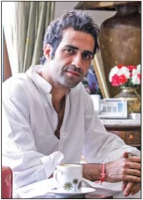
~ Aatish Taseer is a British-born writer, journalist, and contributes to many publications, including Time Magazine, Prospect, Esquire and others.