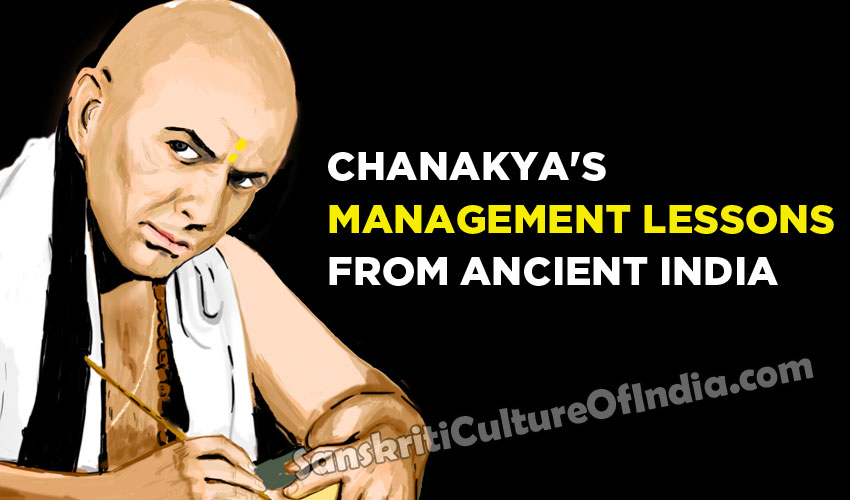
Chanakya, who lived in the 3rd century BC, was a leadership guru par excellence. His ideas on how to identify leaders and groom them to govern a country has been well documented in his book The Arthashastra. This book contains 6000 aphorisms or sutras.
Below are some valuable lessons for business leaders based on Chankya’s ancient management mantra.
Staying at the Top
It is easy to get to the top, but it is very difficult to stay there. Once you are in the leader’s position, the whole dynamics of the game changes. The priority now is to get everything right and maintain your position.
Kautilya was aware of this truth and hence, guides leaders about how to avoid one’s downfall, as well as that of the organization.
He points out: “Control over the senses, which are motivated by training in the sciences, should be secured by giving up lust (kaam), anger (krodha), greed (lobha), pride (mana), arrogance (madh), and overexcitement (harsha).” (1.6.1)
A leader is carefully watched by each person around him. Apart from the external observers, like the media and intelligence agencies, his team members are also watching every move he makes. All his subordinates look to him as their role model. Such a leader should be very careful in his private as well as public life.
As Stephen Covey says in Seven Habits of Highly Effective People, “Private victory leads to public victory.”
A leader’s success is maintained by controlling the senses. For this, Kautilya pointed out the following six negative behaviors that need to be avoided:
Lust (kaam):
Lust is the deep hunger for any object which results from over-attachment. People at the top level are carried away by the lust for power. That is why it is recommended that they should identify the new leaders and train them. Leaders should slowly evolve into mentors guiding the new generation to take over.
Anger (krodha):
Maintaining a cool head is very essential. A short-tempered leader is neither appreciated nor liked by his team members. Such a person is very unpredictable. One should be able tocontrol oneself in all circumstances, most importantly in public.
Greed (lobha):
Gandhiji had rightly said, “There is enough in this world for every person’s need but not enough for one man’s greed.” Satisfaction does not mean complacency. One should be dynamic, yet not get carried away by purely material gains. He should also focus on the social and spiritual contributions he can make.
Pride (mana):
Even when at the top, a leader should be able to initiate more and more projects. However, a feeling that “I am the doer” should not be entertained. He should understand that, after all, his success is because of teamwork. A highly egoistic leader is sure to lose his team members in the long run.
Arrogance (madh):
An arrogant leader will always take the credit for every success, while he blames failures on others. Instead, he should share the results of success with everyone. His motto should be, “It is ‘we’ who have succeeded not ‘I’.”
Over-Excitement (harsha):
A leader should never get over-excited. Expressing extreme happiness or sadness has to be avoided. When the whole world is on fire, it is only the one with a balanced mind who can find a solution.
Radhakrishnan Pillai studied the ancient text the Arthashastra at Chinmaya International Foundation, Kerala, under the guidance of Dr. Gangadharan Nair. Educated in the field of management and consultancy, he later proceeded to do his MA in Sanskrit and a doctorate degree in the Arthashastra. He also started a company Atma Darshan in the field of spiritual tourism.
Pillai spreads the knowledge of Chanakya to millions of people across the globe through his lectures, workshops, training programs, radio shows and articles. Director of SPM Foundationand part of the University of Mumbai team, he designs various leadership programs. He is the recipient of the Sardar Patel International Award, 2009.