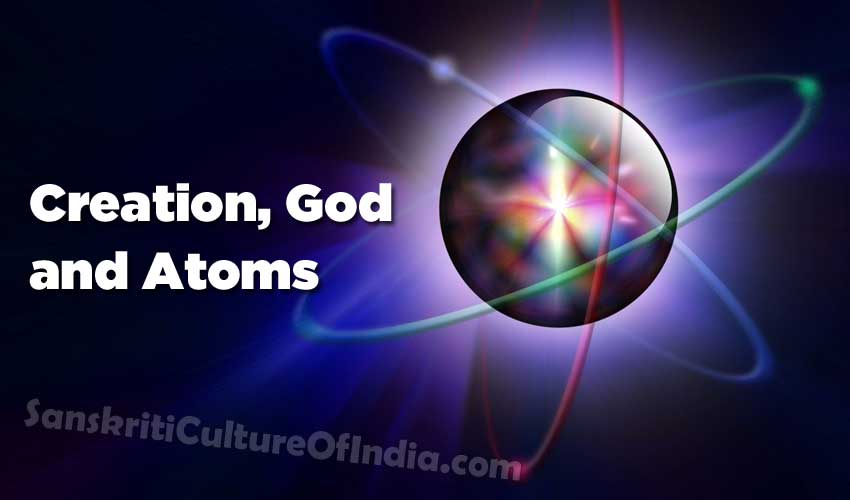
According to the Vaishesika thinkers, all composite objects of the universe are composed of the atoms of earth, water, air and fire.
Hence, the view of the Vaishesika concerning creation is called atomism or paramanuvada. Atomism Postulates the cycle of creation and destruction of the non-eternal or temporary substances of the universe. The eternal categories or substances of universe, namely, soul, space, time, mind, and five physical elements, are neither created nor destroyed.
Creation and God:
The Vaisesika atomism is spiritual. God is the guiding principle controlling the motion of atoms. He creates motion in the material particles in order that the living beings may be rewarded or punished according to their past-tendencies. Creation and destruction of the universe takes place in agreement with the wishes of God. Maheshwar is the ruler and owner of the entire universe all of which He surveys. The cycle of creation and destruction is continuing since eternity.
Creation of atoms:
Creation is the name given to the phenomenon whereby the old order is destroyed and a new one created. Upon God deciding to create the universe, the bodies and external substances appear as the means of rewarding the past tendencies of living beings. In fact, the substances are formed according to the past tendencies of the souls. These past tendencies then start instigating the souls in those directions.
All these are the result of the creator and its four substances which are: effects, the dyad, the triad and its various conjunctions. Atoms combine because of their motion. This motion is due to adrista or past tendencies and the activity of the adrista is inspired by God. The combination or conjunction of two atoms is called dvayanuka. The existence of dyad and the atom is only inferred.
Being microscopic or infinitesimal, the atom and the dyad cannot be perceived. The triad or the trianuka is the smallest particle of matter that can be perceived. It is formed by the conjunction of three dyads. The elements come into existence simultaneously with this conjunction. The elements formed out of these atoms are air, water, earth and fire. Once air is created, it starts flowing in the eternal ether.
Water also mixes with the air and starts flowing. In the same way, earth and fire live in water. The entire universe comes into existence in this way by the mere thought process of God. It is the seed form of the material and fiery atoms. This universe is guided by Brahman or the World Soul, which is the very manifestation of knowledge, detachment and excellence. Brahman guides the creation in such a manner that the individual souls continue to experience pain and pleasure according to their previous actions. All this vast machinery is put into action by the desire of God.
Destruction:
The cycle of creation and destruction has no beginning. The souls get rest and peace in destruction only after they have passed through many births and deaths, continually experiencing pain and pleasure. One creation between two destructions is called ‘kalp’. When, the time is ripe, the World Soul also relinquishes its body like the common souls, and God desires to bring destruction on the universe. The moment Maheshwar so desires, the past tendencies of the soul vanish for some time and their bodies break up into their composite atoms.
Similarly, the physical elements also vanish when the atoms composing them are dispersed. In the residuum are left the atoms of the four elements-five eternal substances and tendencies created by the meritorious or notorious activities of the souls. They form the constitutive elements of the following creation. The Nyaya Vaisesikas are asatkar avadins and their view is also called the arambhavada or paramanu karanavada.
~ Chakravarthy