A lot people are saying India and Hindus should be more tolerant, open minded and should allow this so called pathetic excuse of a “book” to be sold in India. I am not sure how many of you and them have read this book and know what is written by this uneducated, misinformed and biased Jewish American who claims to be an Indologist and teaches at a University.
Now there are petitions out by some muslim groups and “writers” who feel this is impeding freedom of speech and artistic expression of the author. I wonder how they would feel if Satanic Verses (much milder than this one) is put out for sale at every corner!?
Please read some of the highlights from this and decide it for yourself if this should even be allowed to be printed leave alone distributed.
~Sanskriti
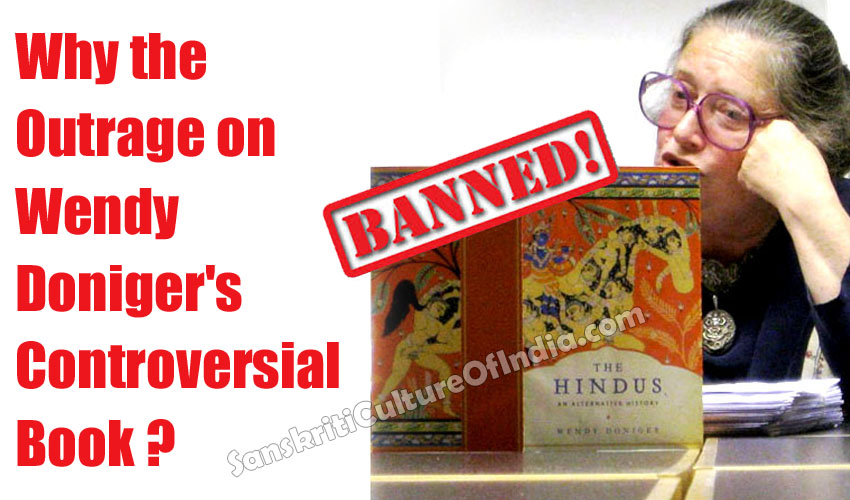
Wendy Doniger’s controversial book ‘The Hindus: An Alternative History’ (Penguin, 2009) has outraged Hindus around the world like never before for allegedly insulting and offending Hindus and Indians. Seventy-three-year-old Doniger is an American Jewish Indologist and has been a professor at the University of Chicago since 1978. Although she is a well-known authority on Hinduism, her bestseller book has been pointed out to have many factual errors and her perspective of things Indian, Vedic, and Hindu has been questioned time and again.
Here are 10 outrageous excerpts from the book that may explain the outspread uproar against the Doniger which ultimately led to the banning of her book in India.Read more about the controversy and join the discussion.
- The Motto of the History of Hinduism:
“Clearly the two—the animals of the terrain and the animals of the mind—are intimately connected, and both are essential to our understanding of Hinduism. If the motto of Watergate was “Follow the money,” the motto of the history of Hinduism could well be “Follow the monkey.” Or, more often, “Follow the horse.” Three animals—horses, dogs, and cows—are particularly charismatic players in the drama of Hinduism.” (Page 39) - The Monkeys and Peoples of India:
“The mosque, whose serene calligraphic and geometric decoration contrasts with the perpetual motion of the figures depicted on the temple, makes a stand against the chaos of India, creating enforced vacuums that India cannot rush into with all its monkeys and peoples and colors and the smells of the bazaar and, at the same time, providing a flattering frame to offset that very chaos. (Page 305) - Rape as a Legitimate Form of Marriage:
“… a form of rape that came to be regarded as a bad, but legitimate, form of marriage: having sex with a sleeping or drugged woman. It appears that a woman’s brother too is someone she might expect to find in her bed, though the Rig Veda severely condemns sibling incest; it is also possible that the brother in question is her husband’s brother, a person who, as we shall see, can have certain traditional, though anxiety-producing, connections with his brother’s wife.” (Page 92) - God Rapes Worshipers:
“Abortion is, together with the killing of a Brahmin, the defining mortal sin in the dharma texts. Here, however, abortion is called for because the god has raped the worshiper, with overtones of the king’s power to possess sexually any woman in his realm. The mythological possibilities encapsulated in the last two lines—“so, in your image, / I’ll bear you a son”—are staggering; the whole mythology of gods fathering human sons (think of the divine lineages of the Mahabharata heroes!) is cast in a different light, for in the end the woman intends to bear the child, not to have an abortion after all.” (Page 369) - Dasharatha was a Sex Addict:
Rama said, “Sita had to enter the purifying fire in front of everyone, because she had lived so long in Ravana’s bedrooms. Had I not purified her, good people would have said of me, ‘That Rama, Dasharatha’s son, is certainly lustful and childish.’ But I knew that she was always true to me.” Then Rama was united with his beloved and experienced the happiness that he deserved. “Dasharatha’s son is certainly lustful” is a key phrase. Rama knows all too well what people said about Dasharatha; when Lakshmana learns that Rama has been exiled, he says, “The king is perverse, old, and addicted to sex, driven by lust.” (Page 153) - Rama, Sita, Sex & Politics:
Rama thinks that sex is putting him in political danger (keeping his allegedly unchaste wife will make the people revolt), but in fact he has it backward: Politics is driving Rama to make a sexual and religious mistake; public concerns make him banish the wife he loves. Rama banishes Sita as Dasharatha has banished Rama. Significantly, the moment when Rama kicks Sita out for the second time comes directly after a long passage in which Rama makes love to Sita passionately, drinking wine with her, for many days on end; the banishment comes as a direct reaction against the sensual indulgence. (Page 153) - The Sultan As an Incarnation of Krishna:
“In Bengal in 1418 a Hindu actually became sultan, Raja Ganesh. His son, converting to Islam, ruled under his father’s direction until 1431. He was succeeded by an Arab Muslim, Ala-ud-din Husain (r. 1493-1519), who revered the Vaishnava saint Chaitanya, in return for which the Hindus regarded the sultan as an incarnation of Lord Krishna. (Page 299) - Humans as Animals:
“As the Hindu idea of nonviolence (ahimsa) that emerged from debates about eating and/or sacrificing animals was soon taken up in debates about warfare, the resulting arguments, which deeply color the narratives of the Mahabharataon all levels, were simultaneously about the treatment of animals, about the treatment of Pariahs symbolized by animals, and about human violence as an inevitable result of the fact that humans are animals and animals are violent.” (Page 170) - Vedas Revered Violence:
“…the Vedic reverence for violence flowered in the slaughters that followed Partition.” (Page 627) - Gandhi Did Not Utter ‘Hey Ram’ While Dying:
“…Gandhi…was killed, apparently with those [Ram Rahim] on his lips*….” “* The words are inscribed on a plaque near the place in Delhi where he was shot. There is much dispute as to whether he said “Ram Ram” or “Ram Rahim” when he died.” (page 446)