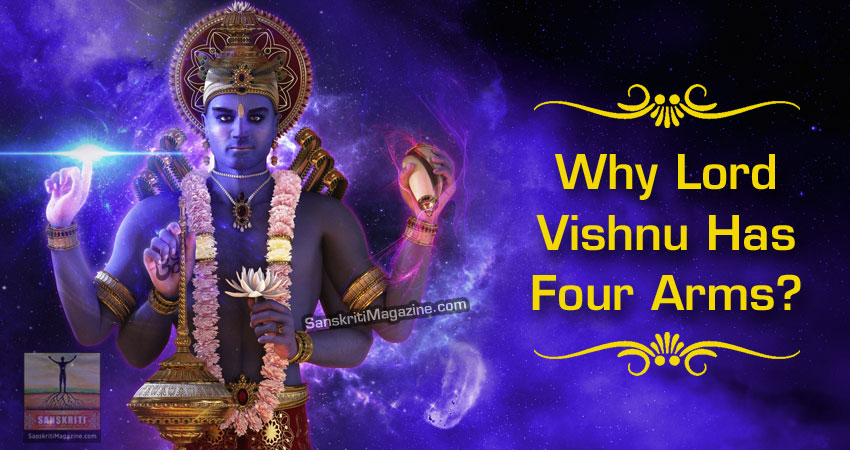
The classical explanation is “Lord Vishnu represents the aspect of perseverance and sustenance of the Supreme Reality. A human body with four arms generally symbolizes Vishnu. The four arms of his indicate his omnipresence and omnipotence. His two front arms show his activity in the physical world and his two back arms signify his activity in the spiritual world.” But I was looking for a more esoteric and cosmic meaning which I want to share with you.
Rishi Kumar Sharma in his book ‘The Ultimate Dialogue’ says; “The Sanskrit word mahima means the ‘dignity, magnitude or majesty’ of an individual…, The word ‘individual’ refers to every single entity in the cosmos which has a manifest identity; that is name, form and function. In its technical usage, mahima means a sphere of radiance emanating from each individual.”
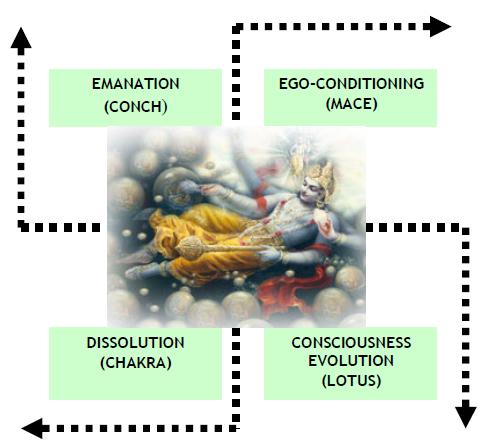 Every manifestation from an atom to the galaxies is endowed with this radiance which is a spherical beam of rays all around it, which makes it visible and gives a specific identity. This 360 degree of radiance can be divided into four quadrants of 90 degrees each. The entire cosmos posses this spherical radiance and each part of the four quadrants is called ‘swastika’. Since all manifestations are of divine origin and are contained within the Divine, Lord Vishnu as the sustainer is represented with four arms.
The four arms thus represent the four dimensional domain of space-time in which all the manifestations of the Divine takes place and the very space-time fabric itself being the implicate order which forms the sustaining potential of the unmanifest Divine.
The swastika has a similar attribute from four different frames of reference which have a common origin and this origin remains same irrespective of the plane of emanation of the four quadrants. Swastika has a 90 degree rotational symmetry and represents the cyclic nature of Divine action.
For me the conch represents emanation (material birth) and the Sudarshan Chakra represents termination (physical dissolution or death). Beyond these is the operation or action of consciousness in the divine realm. We can see this in all the episodes in Puranas, especially the Chakra being used by lord Vishnu to annihilate. The mace representing the action of subjugation or conditioning of the ego and the lotus represents divine wisdom, through which true self realization takes place and these two representations are the operation or action of the consciousness in the manifest realm.
A clear link is to be established between the above iconic representation and the mental model that could elevate one’s consciousness to a higher level.
The Cosmic quadrants are in space-time and are purely in the realm of the manifest or in the domain of the human perception. The Akashic world can not be comprehended as the Gita says in chapter 11 verse 48: “O best of the Kuru warriors, no one before you has ever seen this universal form of Mine, for neither by studying the Vedas, nor by performing sacrifices, nor by charity, nor by pious activities, nor by severe penances can I be seen in this form in the material world.”
The reason we need a deeper interpretation is that though there could be metaphysical dimension from which we arrive at a particular symbolism as has been explained above, but we need a psychic dimension for a specific archetype as this is the route through which the Vedic seers and sages attempt to communicate the unmanifest, to the limited consciousness of common man, through a subconscious path.
The Divine manifestation can be grasped at the deeper psychological level through the understanding of the AQAL (All Quadrant All Lines) model of Ken Wilber, a contemporary American philosopher and psychologist. This model is the more esoteric interpretation of the swastika and the four arms of Lord Vishnu. (see the figure at the top)
The most desired representation which evokes a very meaningful symbolism is Lord Vishnu reclining in the ocean of universal or cosmic consciousness and his four arms in various positions, representing the actions in the manifest consciousness.
~By TIB