In the Vanaparva of Maha Bharata, Yudhisthira, the Dharmaraja, had an encounter with a huge python, who was in fact king Nahusa, one of the forefathers of Yudhisthira. Nahusa, through his good deeds and piety, obtained as his reward, the throne of Heaven but then his downfall started. For he became too proud and forgot the distinction between Dharma and Adharma. He kicked at the head of sage Agastya, and was cursed, which turned him into a python for thousands of years. He had been waiting, in the form of a python, for long time, to be saved by the pious Yudhisthira through a discourse on Dharma.
So one day Nahusa (in python form) got hold of Bhima, and was about to crush him when Yudhisthira appeared in search of his brother. The fabulous power of Bhima, who used to kill endless numbers of demons, elephants, pythons etc., was of no avail. Nahusa was more powerful for he had a noble mission—a discourse on Dharma.
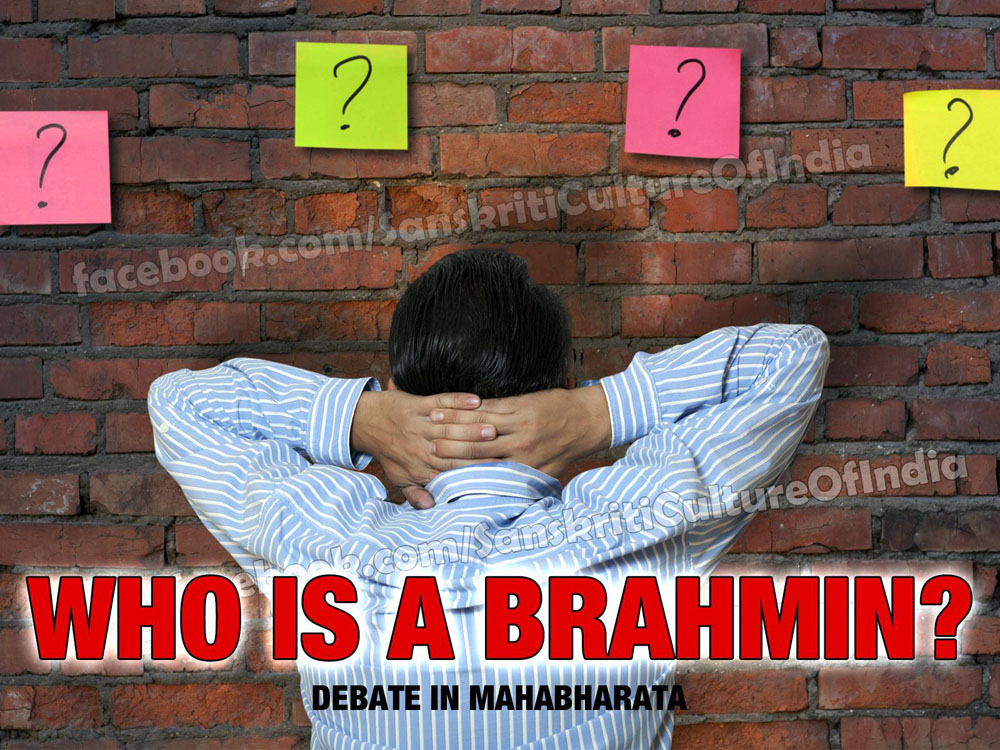
Nahusa said to Yudhisthira, “ I will let your brother go, if you answer my questions on Dharma”. So the discourse started. The first question was; what makes a Brahmin a Brahmin? Yudhisthira listed a number of virtues: truthfulness, generosity, forgiveness, goodness, kindness, self control and compassion—all these qualities together constitute a Brahmin. The list is not very different from the one found in Bhagavad Gita Chapter 18 verse 42.
The python asked, “But this goes against the principle of four varnas/ castes. For even a Shudra may have all these virtues. Virtues cannot be the monopoly of any caste.” Yudhisthira replied in unambiguous language, “Indeed ,if a Shudra is characterised by all these virtues, he is to be defined as a Brahmin. And if a Brahmin lacks them then he is to be regarded as a Shudra.”
The python asked again, “but if Brahminhood is constituted by a number of virtues, then birth (In a Brahmin family) would be in vain, where such virtues are conspicuous by their absence”. Yudhisthira replied, “Indeed. Since through sexual urge (raga) people copulate and produce children, birth is always a dubious criterion in such matters. Therefore, the old sages depend upon good conduct as the indicator of a better person. Even one who is a Brahmin by birth would be a Shudra through poor despicable conduct”. Yudhisthira even referred to the “self originating” (Swayambhuva) Manu as his authority.
**From the book “ The Gita in World Literature”
The Vedas consider all the four Varnas including Shudra as Arya and gives them utmost respect.
It is unfortunate that in this country of ours, where Vedas were the foundation of our culture, we forgot these original lessons of Vedas and got trapped in a variety of misconceptions regarding birth-based caste system and discrimination of people born in certain castes collectively known as Shudras.
The misleading theories of communists and biased indologists have already caused a great damage to our society and have sown seeds of differences. It is unfortunate that so-called Dalits consider themselves outcaste and hence we fail to unite together for prosperity and security. The only solution is to go back to the roots – the Vedas – and rebuild our understanding of our relationships with each other.
We don’t need religion to divide us in separate casts/classes, MONEY DOES IT ANYWAYS!!