IndianSanskriti
Unconditional Obedience A Distortion!

Unconditional Obedience A Distortion!

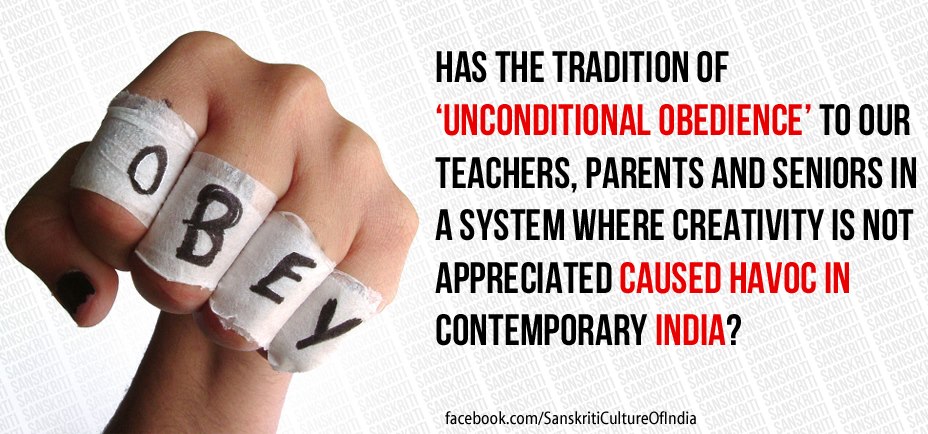
The tradition of ‘Unconditional Obedience’ to our teachers, parents and seniors in a system where creativity is not appreciated has caused havoc in contemporary India. We suffer from ‘Seniority Syndrome’ that is visible in colleges and universities in the form of ragging and in the family, religious space and in governance.Talented people are under-utilised and frustrated because their skill, intelligence and hard work are being ignored, In the name of discipline creativity is suppressed both by seniors, teachers and parents. In the name of culture, they are taught to be subsubservient. Therefore we produce the most sincere and trusted followers, but not leaders. For instance a teacher’s wisdom is regarded as infinite even when it is not.

The Gita provides profound justification for engaging in a just conflict and also talks about how one can settle himself spiritually to be able to decide whether a situation of conflict is justified or not. Interestingly, the same epic that justifies disobeying one’s gurus and elders also carries the story of unconditional obedience by Eklavya who cut his right thumb in deference to the wishes of his guru, Dronacharya, who is held in high regard although he commanded a defeated army. The defeat came not because he was not a skilled warrior but because he supported “un righteousness”. His engagement in the war was not justified. His character was crafty. His demand for Eklavya’s thumb was unjustified. He misused his position to satisfy his ego. Also, who does not admire Eklavya for obeying Dronacharya? The selflessness of Eklavya, his ability to sacrifice and suffer in silence is seen as a virtue. Shouldn’t Eklavya have disobeyed Dronacharya?

There seems to be a contradiction. We admire Eklavya for surrendering to and obeying his guru and we also admire Arjuna, for engaging in war and disobeying his guru. Why did Veda Vyasa not see this contradiction? Or do we fail to understand what he was trying to convey?

The Acharya could not have promoted ‘Unconditional Obedience’ as a virtue. He has clearly said that it is the duty of a warrior to engage in a war if the warrior is faced with an unjustified demand even if the demand comes from one’s own teachers and elders. Then there must be a reason as to why Arjuna and Eklavya are both correct. Until such time as we comprehend the reason, the Eklavya story will remain counter-productive.

Dronacharya was not Eklavya’s guru. Eklavya learnt the art of archery through the process of ‘deification’ by meditating before Dronacharya’s statue. Selfless sacrifice is a matter of faith which leads to spiritual enhancement. The argument, put forward by Krishna, is known to everybody. The path to spiritual enhancement is through karma which means engagement in activities that lead to universal good. Deification and faith on the one hand and knowledge and duty on the other are two separate streams that lead to an individual’s spiritual enhancement. Eklavya followed the former and Arjuna, the latter. The genius of Vyasa is that he presented Dronacharya in real and as a deity. In both cases his pupils have excelled. Eklavya did not surrender to Donacharya the person but to the deity and Arjuna dealt with Dronacharya as a real human being.

We err in assuming that every guru is a deity. Our relationship with the guru is that of Arjuna rather than that of Eklavya. We cannot and should not offer unconditional obedience to any human being, whether teachers, superiors or even our parents.

By: Raj Kachroo
You may also like

Search the website

Like us on Facebook

Get daily updates via Email

Enter your email address:

Recent Posts

Yogini Ekadashi 2026 — The Yaksha Who Missed the Morning Flowers, and the Ekadashi That Undid His Curse

On Friday, July 10, 2026, the rare Krishna Paksha Ekadashi of Nija Ashadha arrives. The Padma Purana tells the story of Hemamali — the Yaksha gardener of Bhagavan Kubera in Alaka, whose single morning of distraction with his wife Vishalakshi cost him his form, his wife, and his celestial city. Cursed to wander the earth of Bharata as a leper for a long time, he was at last shown the way back by Sage Markandeya — a single sincere keeping of Yogini Ekadashi.

Jamai Shashthi 2026 — The Story of Maa Shashthi, the Cat, and the Wife Who Was Forgiven

Jamai Shashthi 2026 — The Story of Maa Shashthi, the Cat, and the Wife Who Was Forgiven

On Saturday, June 20, 2026, Bengali households across Bharata will welcome their married daughters and sons-in-law home for the legendary jamai-aador feast and perform the Shashthi Vrata. But behind the warmth lies a story most Bengalis know by heart and most non-Bengalis have never heard — the wife who stole the hilsa, blamed the cat, lost six sons to Maa Shashthi’s wrath, and was finally forgiven. The Vrat Katha, the vidhi, the mantras, and the deeper teaching.

Vat Purnima 2026 — The Wife Who Argued Yama Into Returning Her Husband’s Life

On Monday, June 29, 2026, women across Maharashtra, Gujarat, and southern Bharata will tie red thread around banyan trees and hear the story of Savitri — the wife who walked behind Yamaraja Himself when He came for her husband, and out-argued the Lord of Dharma into returning Satyavan’s life. The Mahabharata’s Pativrata Mahatmya Parva, the vrat vidhi, and why the banyan witnessed everything.

Nija Jyeshtha 2026 — The Real Jyeshtha Begins, and the Calendar Resumes

Nija Jyeshtha 2026 — The Real Jyeshtha Begins, and the Calendar Resumes

With Adhik Maas now closed on the Somvati Amavasya of June 15, the long-postponed festivals of Jyeshtha return — Vat Purnima (June 29, the Savitri-Yamaraja katha), Jamai Shashthi (June 20, the Bengali festival of Maa Shashthi), Sankashti Chaturthi (June 28), Yogini Ekadashi (July 10), and Devshayani Ekadashi (July 16, opening the four-month Chaturmas of Bhagavan Vishnu’s yoga-nidra). A guide to what the next four weeks hold and what the household that kept Purushottam Maas now carries forward.

css.php