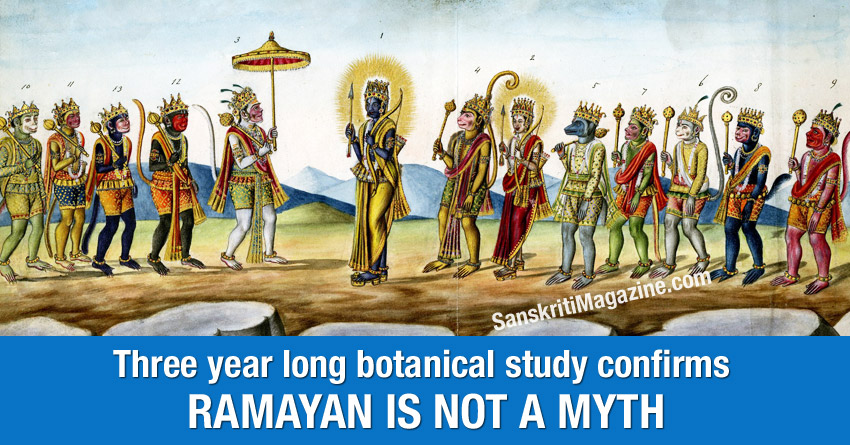
People who belittle Ramayan as a mythology or a mere epic and Lord Ram as a fictitious character should be ready to give up their skepticism. Couple of years ago, two Chennai-based botanists came out with a three-year-long study which establishes that the Ramayan is a true life story authored by Valmiki, incorporating facts, figures, science and environment of the period.
All 182 plants (including flowers, trees, fruits) mentioned in the Ramayan have been found to be true. M Amrithalingam and P Sudhakar, the two botanists working with the CPR Environmental Education Centre, Chennai, said they could confirm the existence of the flora and fauna mentioned by Valmiki in the Ramayan.
“We tracked the route travelled by Lord Ram, Sita and Lakshman from Ayodhya in the north to south as part of their exile to the forest for 14 years. To our surprise, we could identify all the plant species in the Ramayan mentioned by Valmiki along this route,” Amrithalingam told The Pioneer. As a taxonomist, Sudhakar confirmed the plant variety with their Sanskrit and Latin names.
The duo commenced their journey from Ayodhya and reached Chitrakuta’s tropical and deciduous forest. “Valmiki knew his flora, fauna and the geography. What we found was that the same flora and fauna existed in the same places as written in the epic,” pointed out Nanditha Krishna, director, CPREEC, who supervised the project.
According to Krishna, the Ramayan is geographically very correct. “All sites in their route are still identifiable and has continuing traditions. It is not possible for a person to just write something out of his imagination and fit it into local folklore for greater credibility. Valmiki has not erred anywhere while specifying the plant species, flowers and wild animals,” she said.
Sudhakar pointed out that in the Ramayan, Ram, Sita and Lakshman were warned to be cautious while they entered Dandakaranya forests. “This forest had lions and tigers. Now there are no lions in the area. This is because they were killed by poachers over the centuries. But the rocks in the famous Bhimbetka has prehistoric paintings of lion and tigers together which confirm Valmiki’s observation,” he said.
Amrithalingam and Sudhakar journeyed from Dandakaranya to Panchavati and Kishkinda. “We found that Kishkinda has a dry and moist climate which synchronises with what Valmiki has authored,” said Amrithalingam.
Chitrakuta and Dandakaranya regions mentioned in the epic are spread across the modern day Madhya Pradesh, Odisha and Andhra Pradesh, according to Krishna. Panchavati, from where Sita was abducted by Ravan, is situated on the banks of River Godavari on modern Maharashtra. “Diverse types of animal and bird species of this region have been mentioned by Valmiki. These include hamsa (swan), karandava (coot), kraunca (pond heron), Mayura (peacock) and sarasa (crane). These are all visible in the region even today,” said Krishna.
Lord Ram in his conversation with Sita and Lakshman speaks about the significance of plants and trees which they come across during their journey. “Even today we have Sthala Vriksha (trees associated with each location) and plants which are worshipped. Tulsi, banyan, punnaga are some examples to substantiate the theory that Ramayana is not just a story but a chronicle,’ said Krishna.
The research took them to Sri Lanka where too they found the flora and fauna which are all mentioned in the Ramayan. Ravan’s botanical garden was known as Ashoka Vana because of the presence of Ashoka trees. “The evergreen Ashoka Vana could be described as a garden where nature is portrayed in all its glory,” said Amrithalingam.
~ Kumar Chellappan