IndianSanskriti
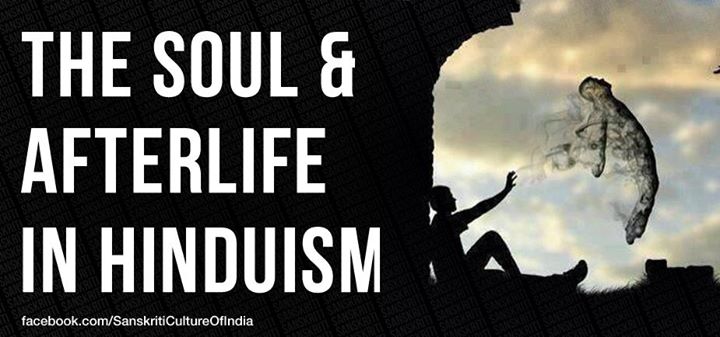
The Soul, Death and Afterlife in Hinduism

The Soul, Death and Afterlife in Hinduism

There is little mourning when a Hindu dies because they believe that once a person is born he or she never dies. Krishna said in the Bhagavad-Gita that “Worn-out garments are shed by the body: worn-out bodies are shed by the dweller within…New bodies are donned by the dweller, like garments.” Death is often viewed in a positive light: as an escape from one life on the road to a better an ultimate moksha (nirvana), shanti (peace) and paramapada (the ultimate place).Atman (the self or spiritual soul) is seen as a kernel that lies at the center of a large onion and is only revealed after the layers around it—associated with the body, passions and mental powers—are removed in a step by step fashion.
The Taittiriya Upanishad defines five layers or sheaths (from the outer to the kernel):
1. the body
2. bio-energy, the equivalent of Chinese qi
3. mental energy
4. intuition and wisdom
5. pure bliss achieved mainly through meditation.These layers can be removed through self actualization and the kernel of eternal bliss can ultimately be realized.

On the subject of death one passage in the Rig Veda reads:

When he goes on the path that lead away the breath of life.
Then he will be led by the will of the gods
May your eye go to the sun, you life’s breath to the wind
Go to the sky or the earth, as is your nature.

The Vedas refer to two paths taken after death:

1. the path of the ancestors, where the deceased travels to a heaven occupied by ancestors and is ultimately reborn;
2. the path of gods, where the deceased enters a realm at the sun and never returns. The latter is the equivalent of reaching nirvana and escaping reincarnation. There is also a reference to a hell-like “pit” where sinners are punished.

At death the sheaths break apart one by one, and go their separate ways revealing the Atman, which departs the body and goes on a path defined by an individual’s karma. In most cases the individual goes to a niche in the cosmos occupied by his ancestors or to one of the 21 heavens and hells of Hindu cosmology and remains there for duration defined by their karma until he or she is ready to be reborn.

You may also like

Search the website

Like us on Facebook

Get daily updates via Email

Enter your email address:

Recent Posts

Adi Shankaracharya Jayanti 2026 — Advaita Vedanta, Om symbol, and four Amnaya Peethas

Adi Shankaracharya — The Monk Who Reunited Bharata

Shankaracharya Jayanti 2026 — the 1238th birth anniversary of Adi Shankaracharya. His extraordinary life, the Digvijaya, the debate with Mandana Mishra, Advaita Vedanta, the four Amnaya Peethas, and his timeless literary legacy.

Akshaya Tritiya 2026 — royal purple hero banner with Akshaya Patra vessel and Devanagari text

Akshaya Tritiya 2026 — The Day That Never Diminishes

Akshaya Tritiya (April 19, 2026) is one of the most auspicious days in the Vedic calendar — when any act of dharma, dana, or japa yields imperishable merit. Discover the five sacred Puranic events, complete puja vidhi, timings, mantras, and the deeper spiritual teaching beyond gold-buying.

Baisakhi 2026 — Mesha Sankranti Hindu Solar New Year hero banner with rising sun, Om symbol and wheat harvest

Baisakhi 2026 — Harvest, Hope, and the Hindu Solar New Year

Baisakhi 2026 falls on Tuesday, April 14 — the day Bhagavan Surya enters Mesha Rashi at 9:39 AM, marking the Hindu Solar New Year. Discover the sacred science of Mesha Sankranti, the Punya Kaal rituals, and how this one cosmic moment is celebrated across Bharata as Vishu, Puthandu, Pohela Boishakh, Bohag Bihu, and Pana Sankranti.

Varuthini Ekadashi 2026 — sacred vrat guide hero banner with Vishnu Chakra mandala

Varuthini Ekadashi 2026 — The Sacred Vrat That Shields from Sin

Varuthini Ekadashi (April 13, 2026) is one of the most powerful Ekadashi vrats — dedicated to Lord Vamana, it dissolves lifetimes of karmic burden and shields the devoted soul with Bhagavan Vishnu’s protective grace. Complete vrat vidhi, timings, mantra, and the sacred Vrat Katha from the Bhavishya Purana.

css.php