IndianSanskriti
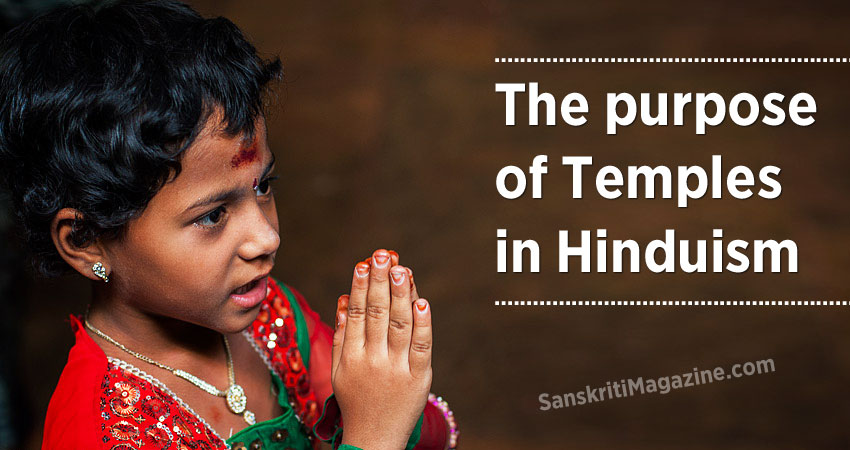
The purpose of temples in Hinduism

The purpose of temples in Hinduism

The very nature of human perception is such that, right now, whatever a human being is involved with, that will be the only truth for him in his experience. Right now, most people are involved with the five sense organs and that seems to be the only truth, nothing else. Sense organs can only perceive that which is physical and because your perception is limited to the five sense organs, everything that you know as life is only the physicality – your body, your mind, your emotion and your life energies are all physical. If you see the physical existence as a fabric, then we can say you are living on the fabric of the physical. You are walking on this cloth and what you are walking on is all that is real. When you look up, there seems to be a vast emptiness above, but even there you only recognize the physical. You look at the stars or the sun or the moon – this is all physical. You don’t perceive that what is not physical, isn’t it?

What you call a temple is like putting a hole in the fabric, creating a space where the physical becomes thin and something beyond becomes visible to you. This science of making the physical less manifest is the science of consecration, so that dimension beyond the physical becomes apparent or visible to you if you are willing. To take the analogy further, it is like the temple is a hole in the fabric of the physical, where you could fall through easily and go beyond.

Today temples may be built just like shopping complexes with concrete and steel, probably for the same purpose, because everything has become commerce. When I talk about temples, I am talking about the way ancient temples were created. In this country, in ancient times, temples were built only for Shiva, nobody else. It was only later that the other temples came up because people started focusing on immediate wellbeing. Using this science, they started creating various other forms, which they could use to benefit themselves in so many different ways in terms of health, wealth, and wellbeing. They created different types of energies and different kinds of deities. If you want money, you create one kind of form or if you are full of fear, you create another kind of form, which will assist with that. These temples came up in the last 1100 or 1200 years, but before that, there were no other temples in the country except Shiva temples.

The word ‘Shiva’ literally means ‘that which is not.’ So the temple was built for ‘that which is not.’ ‘That which is’ is physical manifestation; ‘that which is not’ is that which is beyond the physical. So a temple is a hole through which you enter into a space “which is not.”

~ Sadhguru

You may also like

Search the website

Like us on Facebook

Get daily updates via Email

Enter your email address:

Recent Posts

Jamai Shashthi 2026 — The Story of Maa Shashthi, the Cat, and the Wife Who Was Forgiven

Jamai Shashthi 2026 — The Story of Maa Shashthi, the Cat, and the Wife Who Was Forgiven

On Saturday, June 20, 2026, Bengali households across Bharata will welcome their married daughters and sons-in-law home for the legendary jamai-aador feast and perform the Shashthi Vrata. But behind the warmth lies a story most Bengalis know by heart and most non-Bengalis have never heard — the wife who stole the hilsa, blamed the cat, lost six sons to Maa Shashthi’s wrath, and was finally forgiven. The Vrat Katha, the vidhi, the mantras, and the deeper teaching.

Vat Purnima 2026 — The Wife Who Argued Yama Into Returning Her Husband’s Life

On Monday, June 29, 2026, women across Maharashtra, Gujarat, and southern Bharata will tie red thread around banyan trees and hear the story of Savitri — the wife who walked behind Yamaraja Himself when He came for her husband, and out-argued the Lord of Dharma into returning Satyavan’s life. The Mahabharata’s Pativrata Mahatmya Parva, the vrat vidhi, and why the banyan witnessed everything.

Purushottam Maas — The Month No Deity Would Claim, and the Lord Who Made It Supreme

Every month of the Hindu calendar has a lord — except the rare thirteenth, the Adhika Maas, born an orphan and shunned as the “impure month.” The Puranas tell how this rejected month went in grief to Bhagavan Vishnu, who claimed it, gave it His own name — Purushottam — and made it the most fruitful month of all. The origin story, the teaching, and what it means for Purushottam Maas 2026 (May 17 – June 14).

Padmini Ekadashi 2026 — The Ekadashi Even the Devas Descend to Keep

Padmini Ekadashi 2026 — The Ekadashi Even the Devas Descend to Keep

The rarest Ekadashi of the entire Hindu calendar is three days away. The Padma Purana preserves a conversation between Bhagavan Krishna and Yudhishthira about a single Ekadashi the great Rishis spend lifetimes waiting for — Padmini. The Vrat Katha of Queen Padmini of Mahishmati, the lotus teaching, and why May 27, 2026 is the morning Vaishnavas across Bharata are preparing for.

Varada Chaturthi 2026 — The Rare Ganesha Day of Purushottam Maas

Varada Chaturthi 2026 — The Rare Ganesha Day of Purushottam Maas

Once every 2.5–3 years — when the rare 13th month of Adhika Maas opens — a thirteenth Vinayaka Chaturthi appears. The Mudgala Purana calls it Varada Chaturthi, the “boon-giving” Chaturthi, and holds it as the most fruit-bearing Ganesha day of the entire calendar. Today, Wednesday May 20, 2026, is that day.

css.php