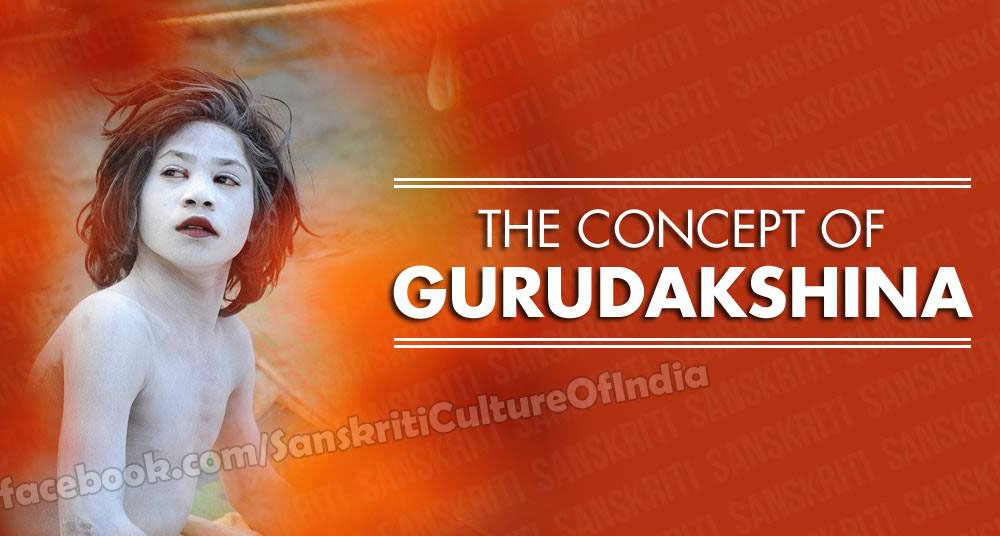
The concept of gurudakshina is very ancient and it is unique to the Indian culture and tradition. If you are absolutely naïve about India, then it’s advisable that you first try to understand the meaning of a guru and the significance of his presence in the lives of those around him. This, in turn, will help you to understand what guru dakshina is. In very simple words, a guru can be described as a teacher, though, as per the Hindu dharma, the role of a guru in the life of his students is much more than just teaching.In modern times, the role of a teacher has just got limited to imparting knowledge of various subjects like Mathematics, Science, English, etc, to pupils. However, in ancient India, a teacher or a guru was a spiritually evolved guide. Along with the knowledge of various subjects, he also taught his students how to live a disciplined and principled life.
A guru was the spiritual guiding force in the life of his students. In fact, as per the ancient Hindu tradition, one had to live life in four stages known as ashrams.Considering that a man can live for a 100 years, each stage was divided into a span of 25 years. The first stage or ashram was Brahmacharya, spanning the first 25 years of a person’s life. During this time, a man lived in the house of his guru. The next stage was Grihastha, which was to be lived as a married man and householder. This was followed by Vanaprastha, which comprised of performing penance in a forest. The final one was Sanyasa, in which a man lived as an ascetic. It’s the life of Brahmacharya that is most closely connected with the concept of gurudakshina.
In ancient times, a student lived the first 25 years in the house of his guru, which was called gurukul. A beautiful thing about gurukul was that all students resided together as equals irrespective of their social standing. The students learnt from the guru and also helped him in his day-to-day life like his own children. It was at the conclusion of this formal education that one was required to repay his guru through a dakshina.The Indian tradition of guru dakshina was meant to serve as a way of showing respect and thanks to the guru. The repayment was not always monetary. At times, a teacher used to simply ask his student to execute an important task. However, the guru often received a valuable gift or donations from the pupil and his family as his gurudakshina. Though the life style of Indians has changed majorly down the years, yet the reverence and respect we pay to our teachers is still as it was a hundred years ago.