IndianSanskriti
The testing of Upamanyu and Aruni

The testing of Upamanyu and Aruni

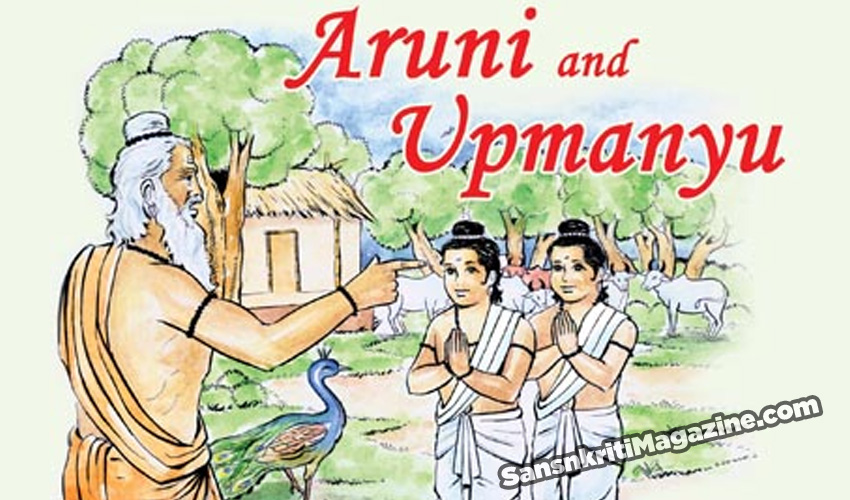
The sage Dhaumya of Mahabharata fame was the high priest of the Pandavas. He had a big ashram and many disciples. Many children were sent there to study. Regular classes were held and most of the children were asked to attend. But there were two who were entrusted with other jobs and did not attend the classes.

These were Upamanyu who was given the charge of the cows and Aruni who looked after the cultivation. The other boys made fun at their apparent dull-headedness, thinking that they were unfit for study, but those two boys were happy and satisfied with their work. They were surrendered to their Guru’s will.

Years passed and still these two boys discharged their duties faithfully. The other boys continued to make fun of them.

Dhaumya was aware of the situation and decided to show their greatness to the rest of the ashramites. He called Upamanyu one day and questioned him, “Upamanyu, what do you eat that you are growing so fat?” “Sir, I eat only what the ashram Mother gives me,” replied the boy. “Well then, do not eat  sight. One evening while bringing in the cows, the blind boy fell into a dry well. The cows reached the ashram without him. Seeing him missing, the Guru went out in search of him calling, “Upamanyu, where are you?”

Upamanyu was thrilled to hear his master’s voice. “Master, here I am. I cannot see anything but I can hear your voice.” “Son, meditate on the twin gods Aswini Kumaras and you will become all right,” told the Guru. Upamanyu did as he was told and immediately the Aswins appeared and restored his sight. He came out of the well and prostrated at his Master’s feet. Dhaumya’s heart overflowed with affection for his obedient disciple and he said, “May your knowledge be perfect in all the Scriptures.” In this way, Upamanyu became a learned scholar without even attending a class. He is an example of implicit faith in the Guru.

Now what about Aruni? Dhaumya once went out to inspect the fields and told Aruni that the water in the fields should not be allowed to escape at any cost. A few days later there was a heavy rain and the bund around the field started to give way. Try as he may, Aruni could not stop the water from flowing out. Finally, in desperation, he laidhis body down in the mud where the bund was weak and in this way he plugged up the leak. The next morning the Guru and his disciples went out into the fields to search for the missing boy, calling his name out loud. Finding him buried in the mud,

the Guru pulled him out and hugged him affectionately. “May all the Scriptures come to you at your beck and call,” was the blessing that the Guru gave Aruni while holding his hand on the boy’s head. It was this Aruni who later became the famous Upanishadic sage Uddalaka.


You may also like

Search the website

Like us on Facebook

Get daily updates via Email

Enter your email address:

Recent Posts

Jamai Shashthi 2026 — The Story of Maa Shashthi, the Cat, and the Wife Who Was Forgiven

Jamai Shashthi 2026 — The Story of Maa Shashthi, the Cat, and the Wife Who Was Forgiven

On Saturday, June 20, 2026, Bengali households across Bharata will welcome their married daughters and sons-in-law home for the legendary jamai-aador feast and perform the Shashthi Vrata. But behind the warmth lies a story most Bengalis know by heart and most non-Bengalis have never heard — the wife who stole the hilsa, blamed the cat, lost six sons to Maa Shashthi’s wrath, and was finally forgiven. The Vrat Katha, the vidhi, the mantras, and the deeper teaching.

Vat Purnima 2026 — The Wife Who Argued Yama Into Returning Her Husband’s Life

On Monday, June 29, 2026, women across Maharashtra, Gujarat, and southern Bharata will tie red thread around banyan trees and hear the story of Savitri — the wife who walked behind Yamaraja Himself when He came for her husband, and out-argued the Lord of Dharma into returning Satyavan’s life. The Mahabharata’s Pativrata Mahatmya Parva, the vrat vidhi, and why the banyan witnessed everything.

Purushottam Maas — The Month No Deity Would Claim, and the Lord Who Made It Supreme

Every month of the Hindu calendar has a lord — except the rare thirteenth, the Adhika Maas, born an orphan and shunned as the “impure month.” The Puranas tell how this rejected month went in grief to Bhagavan Vishnu, who claimed it, gave it His own name — Purushottam — and made it the most fruitful month of all. The origin story, the teaching, and what it means for Purushottam Maas 2026 (May 17 – June 14).

Padmini Ekadashi 2026 — The Ekadashi Even the Devas Descend to Keep

Padmini Ekadashi 2026 — The Ekadashi Even the Devas Descend to Keep

The rarest Ekadashi of the entire Hindu calendar is three days away. The Padma Purana preserves a conversation between Bhagavan Krishna and Yudhishthira about a single Ekadashi the great Rishis spend lifetimes waiting for — Padmini. The Vrat Katha of Queen Padmini of Mahishmati, the lotus teaching, and why May 27, 2026 is the morning Vaishnavas across Bharata are preparing for.

Varada Chaturthi 2026 — The Rare Ganesha Day of Purushottam Maas

Varada Chaturthi 2026 — The Rare Ganesha Day of Purushottam Maas

Once every 2.5–3 years — when the rare 13th month of Adhika Maas opens — a thirteenth Vinayaka Chaturthi appears. The Mudgala Purana calls it Varada Chaturthi, the “boon-giving” Chaturthi, and holds it as the most fruit-bearing Ganesha day of the entire calendar. Today, Wednesday May 20, 2026, is that day.

css.php