In the dawn of the twenty first century, dark clouds in the form of rising fanaticism, Islamofascism, terrorism, mindless violence and criminality are intimidating Humanity. These vicious assaults on civilization have the potential of launching a new catastrophic world war, a war to the finish and it would be wise for India and its eternal culture, Sanatana Dharma to wake up from any delusional ideas of security and peace in the midst of world turmoil.
The circumstances are again ominously reminiscent of that ancient cataclysmic great war, Mahabharata and the world with India, in particular, would do well to learn from the lessons of the magnificent and fateful history of the Kurus. This is the time when an evil, totalitarian terrorist movement like ISIS has raised its ugly head in the Middle East, challenging humanity with medieval barbarism and nihilistic cruelty. It is the responsibility of India along with all civilized nations to participate in the crushing of this monster. Goodness without the will to defend and preserve good values can only degenerate into sickly cowardice.
This is the time for the Youth of India to remember again the great heroes, Krishna and Arjuna and to study their penetrating dialogue in the Kurukshetra war-field. The Gita is not a supporter of passive cowardice and inaction in the face of Evil and Adharma. Lord Krishna strongly supports the cultivation of the, “Warrior Personality”, which is nothing but the building up of spiritual, mental and physical strength that enables one to honorably discharge one’s worldly duties along with the development of Spirit. Thus in the Mahabharatan world view of Krishna and Vyasa, there is no deal that you can strike with Evil. You cannot bury your head in the sand, ostrich-like and wish that the inimical forces will go away by themselves. Au contraire, we have to resist the darkness inside us and out in the world and crush them for the dawn of a better future. In Lord Krishna’s Weltanshauung, even deeply cherished individual principles have to be sacrificed for the larger good of the world, Lokasangraha.
There is a need today for the reaffirmation of a strong Positive ideology which combats the dark nihilistic forces. An ideology based on humanity, strength, valor, willpower, compassion, achievement, development, spirituality and peace. These mighty principles, needed so desperately by the world today, are already residing deep in the Ocean like Mahabharata. It thus becomes the task of all thoughtful men to study this great history for the genesis of a new revolutionary philosophy to combat vicious terrorism on one hand and aimless and rootless materialistic, decadent living on the other.
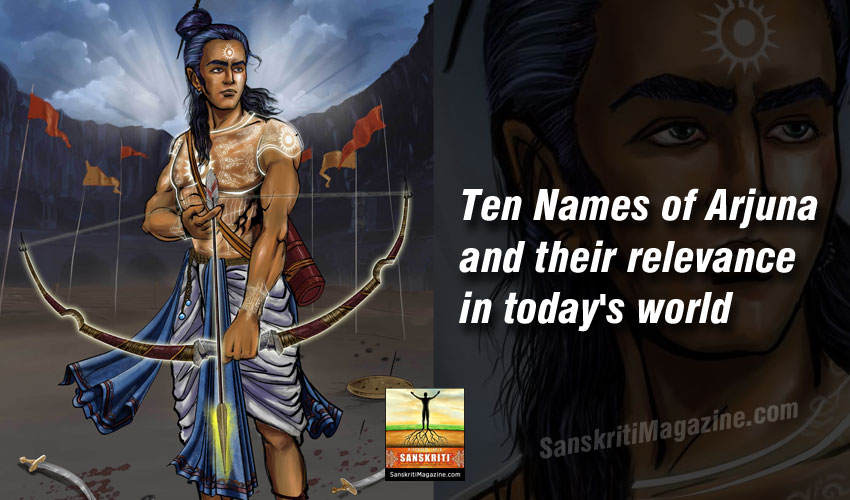
The Ten names of Arjuna, have the potential of building up this warrior and Hero spirit in us. Arjuna is the archetypal hero, eminently worthy of being emulated by the world today for the development of a better class of Men, who are true Karma Yoddhas capable of building a world order based on goodness and strength.
These ten names and their meaning were recounted by Arjuna himself to Prince Uttar of Viraat kingdom. The young prince had become terrified at the sight of the mighty invading Kaurava Army in front of him, ready for War. Panic stricken and losing his courage and willpower, Uttar had fled blindly from the terror inspiring battlefield. Fortunately he had Arjuna in the guise of the charioteer, Brihannala with him. Arjuna catches hold of Uttar and brings him back to his senses, infusing strength, hope and valor into him by his awe inspiring presence and words. This story of the Mahabharata also illustrates starkly that Conquest and mastery of the inner realm inevitably leads to victory over the external forces.
The ten names of Arjuna are:
Dhananjaya: The Conqueror of immense wealth. Here wealth stands for all valuable things, including the most valuable qualities of personality.
Vijaya: Ever victorious in war, the vanquisher of invincible kings.
Shwetavahana: The Warrior with snow white horses, clad in gold plated armor yoked to his Chariot. The snow white horses symbolize purity of character.
Phalguna: The Exterminator of enemies, born under the asterism Uttara Phalguni.
Kiritin: As a resplendent diadem was placed on his head by his father, Lord Indra after the destruction of the “Nivaatakavachas”, a powerful class of netherworld demons. These demons were said to be invincible and undefeated even by Indra and the gods. Exemplifies that the Crown of success adorns the courageous and self-believing man or “Fortune favors the brave!”
Vibhatsu: One who never performs an act unworthy of himself.
Savyasachin: The Warrior who can draw the bowstring using either hand with equal ease, highly and equally skilled with both hands. This name illustrates the value of skill development through hard work.
Jishnu: The irrepressible one, of lofty and unapproachable standard, the tamer of adversaries, the son of Indra. The hero always has high standards and principles in his life.
Krishna: Dark like a mass of rain clouds, the one who attracts everyone.
Arjuna: Bright, possessing a high character and famed for his pure and stainless deeds.
Meditating on the meaning of these Ten names of Arjuna develops character and willpower, which are the essential firepower badly missing in the apathetic and rudderless world of today. A deep study of the lives of the Mahabharata heroes: Bhishma, Karna, Krishna and Arjuna would lead to Self-expansion. Heroic personalities molded by Vyasa’s Great epic would be sorely needed to steer India and the world safely out of the dark and portentous challenges of the new century.
~ Dr. Madhu Guptan, MD, Trainee in Diagnostic Radiology, Medical University Sofia, Bulgaria