Goddess Durga is the mother of the universe and believed to be the power behind the work of creation, preservation, and destruction of the world. Since time immemorial she has been worshipped as the supreme power of the Supreme Being and has been mentioned in many scriptures – Yajur Veda, Vajasaneyi Samhita and Taittareya Brahman.
The Meaning of “Durga”
The word “Durga” in Sanskrit means a fort, or a place which is difficult to overrun. Another meaning of “Durga” is “Durgatinashini,” which literally translates into “the one who eliminates sufferings.” Thus, Hindus believe that goddess Durga protects her devotees from the evils of the world and at the same time removes their miseries.
The Many Forms of Durga
There are many incarnations of Durga: Kali, Bhagvati, Bhavani, Ambika, Lalita, Gauri, Kandalini, Java, Rajeswari, et al. Durga incarnated as the united power of all divine beings, who offered her the required physical attributes and weapons to kill the demon “Mahishasur”. Her nine appellations are Skondamata, Kusumanda, Shailaputri, Kaalratri, Brahmacharini, Maha Gauri, Katyayani, Chandraghanta and Siddhidatri.
Durga’s Many Arms
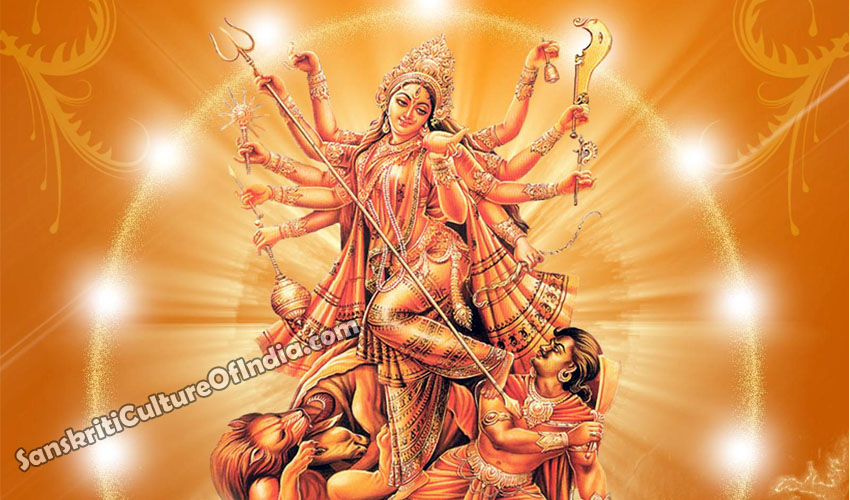
Durga is depicted as having eight or ten hands. These represent eight quadrants or ten directions in Hinduism. This suggests that she protects the devotees from all directions.
Durga’s Three Eyes
Like Shiva, Mother Durga is also referred to as “Triyambake” meaning the three eyed Goddess. The left eye represents desire (the moon), the right eye represents action (the sun), and the central eye knowledge (fire).
Durga’s Vehicle – the Lion
The lion represents power, will and determination. Mother Durga riding the lion symbolises her mastery over all these qualities. This suggests to the devotee that one has to possess all these qualities to get over the demon of ego.
Durga’s Many Weapons
- The conch shell in Durga’s hand symbolizes the ‘Pranava’ or the mystic word ‘Om’, which indicates her holding on to God in the form of sound.
- The bow and arrows represent energy. By holding both the bow and arrows in one hand “Mother Durga” is indicating her control over both aspects of energy – potential and kinetic.
- The thunderbolt signifies firmness. The devotee of Durga must be firm like thunderbolt in one’s convictions. Like the thunderbolt that can break anything against which it strikes, without being affected itself, the devotee needs to attack a challenge without losing his confidence.
- The lotus in Durga’s hand is not in fully bloomed, It symbolizing certainty of success but not finality. The lotus in Sanskrit is called “pankaja” which means born of mud. Thus, lotus stands for the continuous evolution of the spiritual quality of devotees amidst the worldly mud of lust and greed.
- The “Sudarshan-Chakra” or beautiful discus, which spins around the index finger of the Goddess, while not touching it, signifies that the entire world is subservient to the will of Durga and is at her command. She uses this unfailing weapon to destroy evil and produce an environment conducive to the growth of righteousness.
- The sword that Durga holds in one of her hands symbolizes knowledge, which has the sharpness of a sword. Knowledge which is free from all doubts, is symbolized by the shine of the sword.
- Durga’s trident or “trishul” is a symbol of three qualities – Satwa (inactivity), Rajas (activity) and Tamas (non-activity) – and she is remover of all the three types of miseries – physical, mental and spiritual.
Devi Durga stands on a lion in a fearless pose of “Abhay Mudra”, signifying assurance of freedom from fear. The universal mother seems to be saying to all her devotees: “Surrender all actions and duties onto me and I shall release thee from all fears”.
~ Gyan Rajhans