IndianSanskriti
Sri-Hastamalakacharya----Head-of-Dwaraka-Monastery-appointed-by-Adi-Shankara

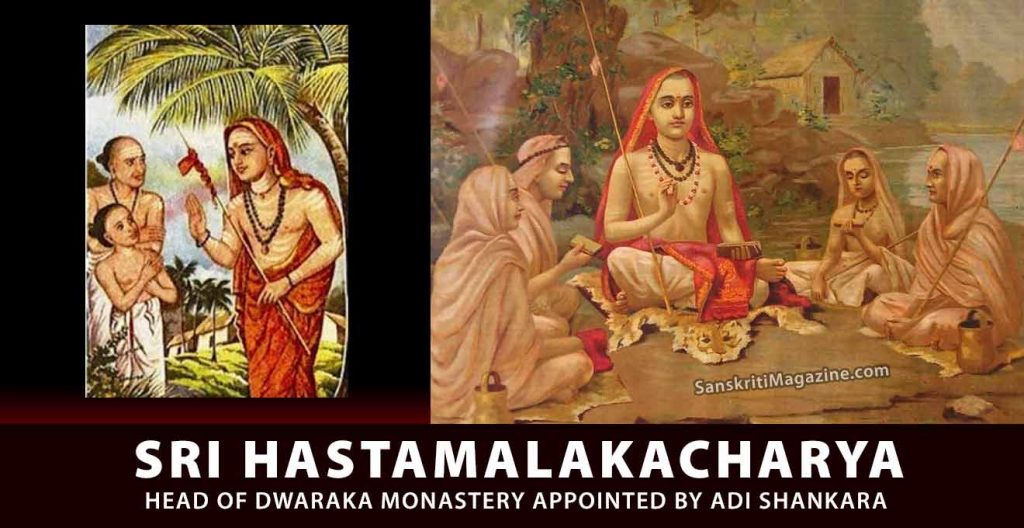
Sri Hastamalakacharya – Head of Dwaraka Monastery appointed by Adi Shankara

In the early part of the 9th century, when Adi Shankaracharya was wandering in the southern part of the India, he happened to pass through a village called Sri Bali (Shivalli, near Udupi in present day India).

In that village there was a pious and learned Brahmin named Prabhakara, he had a 13 year old son who had a pleasant, angel like face; his actions appeared rather strange to the people around. So they thought that the boy was simply an idiot.

The boy was now 13 year old and he never spoke a word. So everyone believed him to be dumb. When Prabhakara (the boy’s father), heard of this sage who would be visiting his village, he went to see Adi Shankara and requested him to come to his house and bless the unfortunate child.

Lord Shankara visited brahmin’s house and saw the child sitting outside quietly. When the boy saw this true sage, he prostrated in front of him.

Lord Shankara knowing the child to be a spiritually advanced soul, asked the boy “My child! why don’t you talk?”

“What about?” The child replied to everyone’s surprise. “It is of no use to speak, ‘that which is’ (referring to God) can’t be grasped through words”

“Tell me, who are you?” questioned Lord Shankara with the intention of letting everyone know about the greatness of the child.

The boy composed 12 Sanskrit verses summarizing the teachings of Vedanta on the nature of ‘SELF’, thus answering Adi Shankara’s question.

Lord Shankara took him as his disciple with his parents’ consent and walked to the next village with his battalion.

Later Adi Shankara established 4 monasteries, and named the boy who was now called ‘Hastamalaka’ as the head of Dwaraka Monastery. Hastamalaka also wrote extensively on spiritual subjects, his own Guru Shankara wrote commenteries on some of the works of Hastamalaka.

Hastamalaka=Hasta (palm)+ Amlaka (gooseberry fruit); Hastamalaka is one who has the knowledge of the Brahman (God) comfortably like a fruit in his palm. The word ‘Karatalamalaka’ also means the same.
You may also like

Search the website

Like us on Facebook

Get daily updates via Email

Enter your email address:

Recent Posts

Adi Shankaracharya Jayanti 2026 — Advaita Vedanta, Om symbol, and four Amnaya Peethas

Adi Shankaracharya — The Monk Who Reunited Bharata

Shankaracharya Jayanti 2026 — the 1238th birth anniversary of Adi Shankaracharya. His extraordinary life, the Digvijaya, the debate with Mandana Mishra, Advaita Vedanta, the four Amnaya Peethas, and his timeless literary legacy.

Akshaya Tritiya 2026 — royal purple hero banner with Akshaya Patra vessel and Devanagari text

Akshaya Tritiya 2026 — The Day That Never Diminishes

Akshaya Tritiya (April 19, 2026) is one of the most auspicious days in the Vedic calendar — when any act of dharma, dana, or japa yields imperishable merit. Discover the five sacred Puranic events, complete puja vidhi, timings, mantras, and the deeper spiritual teaching beyond gold-buying.

Baisakhi 2026 — Mesha Sankranti Hindu Solar New Year hero banner with rising sun, Om symbol and wheat harvest

Baisakhi 2026 — Harvest, Hope, and the Hindu Solar New Year

Baisakhi 2026 falls on Tuesday, April 14 — the day Bhagavan Surya enters Mesha Rashi at 9:39 AM, marking the Hindu Solar New Year. Discover the sacred science of Mesha Sankranti, the Punya Kaal rituals, and how this one cosmic moment is celebrated across Bharata as Vishu, Puthandu, Pohela Boishakh, Bohag Bihu, and Pana Sankranti.

Varuthini Ekadashi 2026 — sacred vrat guide hero banner with Vishnu Chakra mandala

Varuthini Ekadashi 2026 — The Sacred Vrat That Shields from Sin

Varuthini Ekadashi (April 13, 2026) is one of the most powerful Ekadashi vrats — dedicated to Lord Vamana, it dissolves lifetimes of karmic burden and shields the devoted soul with Bhagavan Vishnu’s protective grace. Complete vrat vidhi, timings, mantra, and the sacred Vrat Katha from the Bhavishya Purana.

css.php