The following is a brief adaptation of the story as appears in the Devi-Mahatymam. It is adapted in a way so as to lift the veil of the spiritual symbolism employed in the story:
The Devas, embodying the virtues of such as Self-discipline, Universal Love, Selfless Service and Courage were being routed by the most fearsome demon they had ever beheld, Mahishasura (Egotism). Ego disregards the promptings of the Devas and claims all he sees for his own, living only for sensual pleasure and self-glorification, aided by lesser demons like Greed, Lust, and Anger.
The divine beings ran to the greatest of all the gods, Brahma, Vishnu and Shiva, to plead for help. But when the Big Three realise whom they are up against, they exchanged worried glances. “This job is too much for the Three of us,” they agree. “In a case like this, there is only one recourse.” And sitting down for meditation, the gods concentrate their mental energy on her, the Supreme Goddess. Her response is instantaneous.
At that very moment as Greed and Lust are trampling the world, an extraordinarily beautiful woman rivets their attention seated quietly near a mountaintop. “She’s incredible!” they pant. “Ego must possess her!” And indeed, when Ego hears about her ravishing beauty, he sends his henchmen to her with a proposal.
“Submit to Ego and all the wealth of the world will be yours!” the demons announce to the mysterious woman. “Become his slave and we will serve you forever!”
Smiling shyly, she responds, “Oh my, that’s a very attractive offer. But – silly me – I took a foolish vow when I was a little girl that I would only marry the man who defeats me in battle. I’m afraid I cannot accept your master unless he conquers me.”
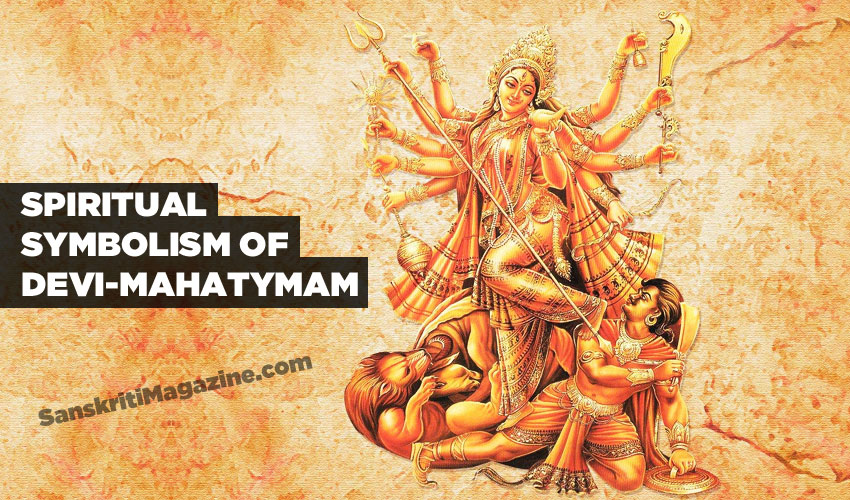
Mahishasura is enraged at this reply and sends his generals with their heavily armed divisions to take the mysterious beauty by force. As the demons reach out to grasp her, however, the delicate maiden begins to grow. An extra eye swells from her forehead, numerous arms sprout from her trunk, and fangs erupt from her howling mouth. Swords, spears, cudgels, and whirling discuses with very sharp edges-every conceivable weapon appears in each of her numberless fists. The tawny rock on which she has been sitting unfurls into an enormous, razor-clawed, ravenous lion.
“I think we bit off more than we can chew,” Fear mutters under his breath as he leads the suicide charge against Durga, the Mother of the Universe.
The enemy the Ego has unwittingly engaged is the Chit Shakti herself – the purifying power of Supreme Consciousness. The Ego has finally confronted the Higher Self-and it is mighty! The Divine Warrioress thwarts her foes with powerful mantras, the sword of discrimination, the bow of determination, and the bludgeon of persistent yogic practice. A fierce and grisly battle ensues in which Egotism expends every means at its disposal to overcome the spiritual force within as it reasserts its innate sovereignty.
The fighting is portrayed in detail, including Mother Durga’s famous battle with Rakta Bija (“Red Drop”): each time a drop of his blood, spilled in battle, touches the earth; it leaps up as a new warrior. The Divine Mother transforms herself into the gruesome Goddess Kali, who swallows every drop of blood before it reaches the ground. To the casual reader this is a grotesque episode, but mediators will instantly recognize the analogy: in the struggle to control one’s thoughts and desires, they seem to replicate magically and maniacally. Only by catching them before they have the opportunity to take root can this endless cycle be stopped.
Eventually, the all-powerful demon Mahisha (Self-Delusion) lurches into battle, transforming himself from one shape into another as he attempts to elude the Universal Mother. Indeed many of us have experienced this shape shifting as for example, brash egotism sublimates itself into spiritual pride. He is in the form of a half-man/half water buffalo when the Divine Force finally overcomes him. Indian religious art is replete with paintings and sculptures of the calm, benign Mother Durga slaying the buffalo demon Mahisha.
At one point the Universal Mother projects millions of goddesses from herself, including Brahmani, the Goddess of Prudently Applied Intelligence, Vaishnavi, Goddess of Wisely Used Material Resources, and Varahi, the Goddess of Desire for Spiritual Perfection. Ego cries out, “This is not fair!” and the Goddess reabsorbs her emanations, leading to the climatic scene in which Ego and Pure Spiritual Awareness stride forth to battle each other -alone. In this final confrontation the great demon Mahishasura is slain.
When the Ego perishes, order is restored to the universe and harmony returns to nature. Indra and the other Gods regain their place in heaven (i.e., the mind and senses, in service of the Divine, resume their functions).
~ V. Subramanyam