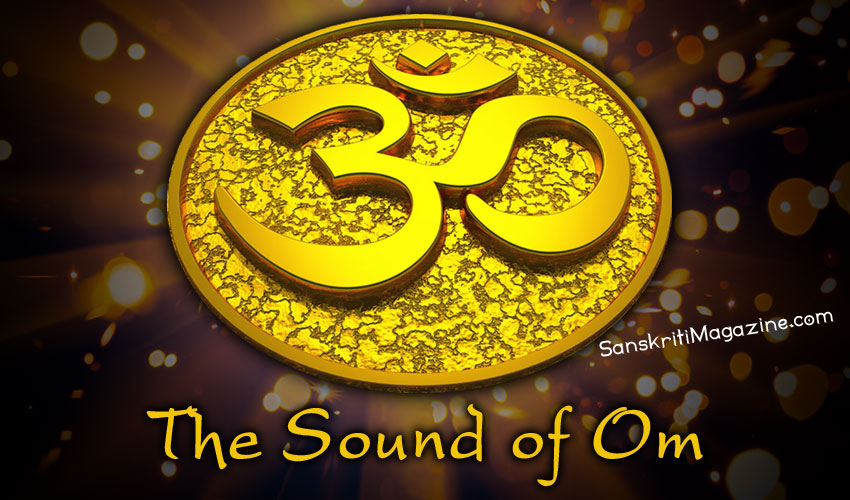
Om is a sacred mono-syllable. Om is the mystic letter. In Om the world rests. Om is the symbol of Brahman. Om is the word of power. Om is the soul of all souls. Om is infinity. Om is eternity. Om is immortality. Om is the source of everything. Om is the womb of all Vedas. Om is the basis of all languages. From Om proceed all sounds. In Om exist all objects. Om is the highest mantra. Om is Soham. Om is Om Tat Sat. Om is a lamp for your feet and a light on your path.
Om is Nada Brahman. Nada is sound. Sound is vibration. Om is the first vibration of sound. Sound is the first manifestation of the Absolute. We know nothing about the nature of the Absolute except that It is. The scriptures have tried to tell us all about creation, how it proceeded from the Absolute. They say: “Brahman was one and non-dual. It thought, ‘Let me become many.’ That caused a vibration, eventually bringing in sound, and that sound was Om, from whence arise all other manifestations.” Thus sound is virtually the comprehensible basis for all creation. Brahman is incomprehensible in Its transcendent aspect. The nearest approach to It is only sound.
All objects are denoted by sounds, and all sounds merge in Omkara. All speech or words terminate in one sound -‘Om’. The humming of bees, the sweet melody of the nightingale, the seven tunes in music, the sound of the mridanga and kettledrum, the lute and the flute, the roaring of the lion, the singing of the lover, the neighing of horses, the hissing of the cobra, the ‘hu, hu’ sound of invalids, the crying of the baby, the clapping of the audience – all are emanations from Omkara only.
The sound produced in the flowing Ganga, the sound heard in the distance from the bustle of the market, the sound produced when the flywheel of an engine is set in motion, the sound caused when it rains – it is all ‘Om’ only. If you split any word, you will find ‘Om’ there. Om is all-pervading like akasha, like Brahman.
Om is the basis of all sounds. Om consists of three letters, A, U, and M. A, U, M cover the whole range of sound-vibrations. The larynx and the palate are the sounding-boards. When you pronounce A, no part of the tongue or palate is touched. When you pronounce U, the sound rolls from the very root to the end of the sounding-board of the mouth. M is the last sound which is produced by closing the two lips. Therefore, all sounds are centred in Om.
All languages originate from Om. The essence of the four Vedas is Om only. One who chants or repeats Om really repeats the sacred books of the whole world. Om is the source or womb for all religions and scriptures. Om, Amen and Ahamin are all one. They present the truth or Brahman, the One Existence. There is no worship without Om. The world exists in Om and dissolves in Om.
Live in Om. Inhale and exhale in Om. Rest peacefully in Om. Take shelter in Om. Sing Om rhythmically. Chant Om loudly. Roar Om forcefully. Repeat Om mentally. Draw strength from Om. Get inspiration from Om. Imbibe bliss from Om. Rely on Om. Reflect on Om. Meditate on Om.
From the teachings of Swami Sivananda Saraswati