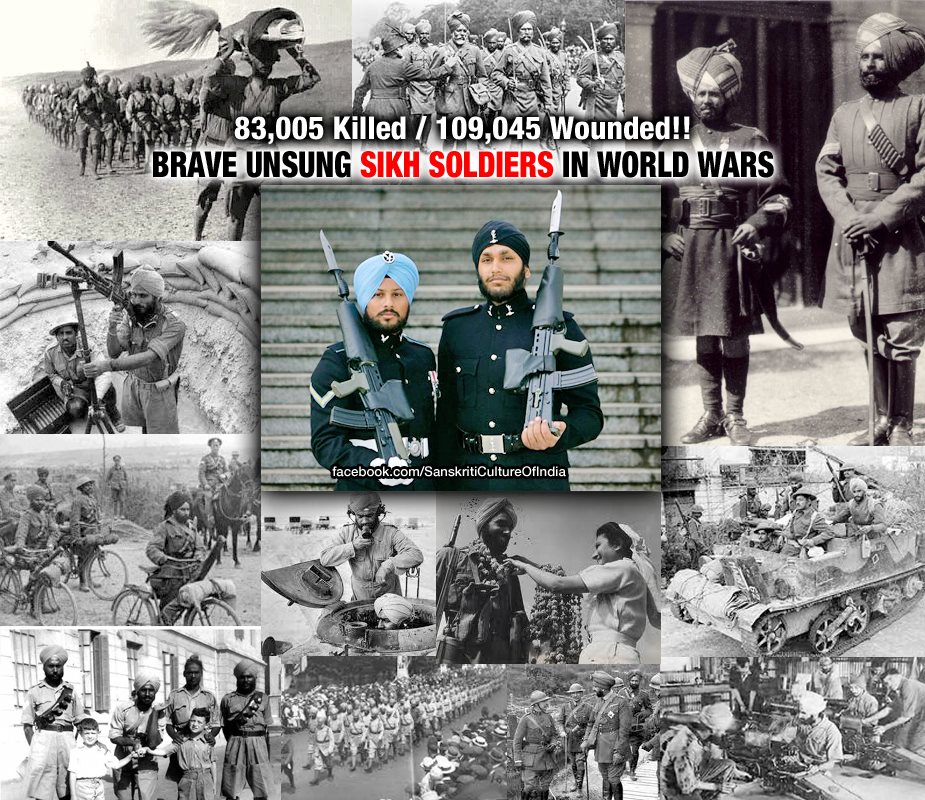
The forces of British India played a major role in both World Wars. Nearly 1,700,000 men and women of the Commonwealth including some 160,000 from the forces of undivided British India died in the 1914-18 and 1939-45 Wars. In the first World War, the strength of the British Indian Army rose to one million and in the 2nd World War with two and half million. During WW-1, it fought in China, France and Belgium ( Flanders ), Mesopotamia against Turkey, Iraq, Iran, Egypt , Palestine, Gallipoli and in East Africa. In 2nd WW, a company of the Royal Indian Army Service Corps was part of the British Expeditionary Force in 1940 campaign which ended in the evacuation from Dunkirk ( France ). Divisions of British Indian Army fought in the Western Desert, in the Middle East, in Eritrea, Ethiopia, they fought in Italy and took part in the liberation of Greece. But against Japan in the east, British Indian Army played its greatest role right through from the reverses of 1942 to the final overwhelming victory of 1945.”In the last two world wars 83,005 turban wearing Sikh soldiers were killed and 109,045 were wounded. They all died or were wounded for the freedom of Britain and the world, and during shell fire, with no other protection but the turban, the symbol of their faith.”
Sir Winston Churchill was very well conversant with the bravery of the Sikhs, who had fought for Britain in the World Wars. Churchill while speaking in the British Parliament said:
“…..It is a matter of regret that due to the obsession of the present times people are distorting the superior religious and social values, but those who wish to preserve them with respect, we should appreciate them as well as help them. Sikhs do need our help for such a cause and we should give it happily. Those who know the Sikh history, know England’s relationship with the Sikhs and are aware of the achievements of the Sikhs, they should persistently support the idea of relaxation to Sikhs to ride a motorbike with their turbans on, because it is their religious privilege.”
Churchill, further added:
“…British people are highly indebted and obliged to Sikhs for a long time. I know that within this century we needed their help twice and they did help us very well. As a result of their timely help, we are today able to live with honour, dignity, and independence. In the war, they fought and died for us, wearing the turbans. At that time we were not adamant that they should wear safety helmets because we knew that they are not going to wear them anyways and we would be deprived of their help. At that time due to our miserable and poor situation, we did not force it on them to wear safety helmets, why should we force it now? Rather, we should now respect their traditions and by granting this legitimate concession, win their applaud.”
A video about Sikh contribution to WW I and II:
http://www.youtube.com/
Brave unsung sikh soldiers in world wars