IndianSanskriti
navgrah

Significance and Meaning of Seven Days of the Week

Each of the seven days in a week has a special significance and is apportioned to one or more Hindu gods or goddesses and there are several folklore associated with the ritual fasting observed on these days.

On the following pages, we look at the seven days, the respective planet & deities associated with the particular days, relevant tales and legends, and the gemstones and colors that are said to be lucky for those days.

Fasting Associated with the Daily Deities

Hindu devotees keep occasional ‘upvaas’or fast corresponding to the fulfillment of a vow or a belief and ‘vratas’ (fasting and observance of religious rituals) that is analogous with material or other gains. Apart from these special occasions, many devotees also fast on a particular day of the week dedicated to a particular god in the Hindu pantheon to appease him/her. Ancient sages used observances like ritual fasts to spread the awareness of different gods. Fasting and other rituals pave the path of the divine for the devotees to realize god, which is considered the sole purpose of human existence.

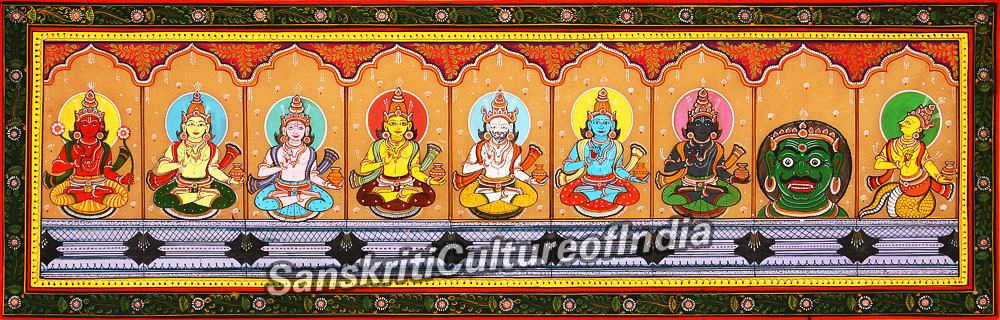
The Navagraha – the 9 Celestial Bodies

Navagraha represents the nine celestial influencers in Vedic Astrology. The seven days are named after the seven celestial bodies of our solar system – the Sun, Moon and the planets. Apart from these, mention should be made here of Rahu and Ketu, the two nodes of the Moon – the north and the south, the points of intersection of the paths of the Moon and the Sun. Lunar eclipses occur when the Moon and the Sun are at Rahu or Ketu. So, Navagraha comprises of:

  1. Surya (Sun)
  2. Chandra (Moon)
  3. Mangala (Mars)
  4. Budha (Mercury)
  5. Brihaspati (Jupiter)
  6. Shukra (Venus)
  7. Shani (Saturn)
  8. Rahu
  9. Ketu

~ Subhamoy Das

You may also like

Search the website

Like us on Facebook

Get daily updates via Email

Enter your email address:

Recent Posts

Yogini Ekadashi 2026 — The Yaksha Who Missed the Morning Flowers, and the Ekadashi That Undid His Curse

On Friday, July 10, 2026, the rare Krishna Paksha Ekadashi of Nija Ashadha arrives. The Padma Purana tells the story of Hemamali — the Yaksha gardener of Bhagavan Kubera in Alaka, whose single morning of distraction with his wife Vishalakshi cost him his form, his wife, and his celestial city. Cursed to wander the earth of Bharata as a leper for a long time, he was at last shown the way back by Sage Markandeya — a single sincere keeping of Yogini Ekadashi.

Jamai Shashthi 2026 — The Story of Maa Shashthi, the Cat, and the Wife Who Was Forgiven

Jamai Shashthi 2026 — The Story of Maa Shashthi, the Cat, and the Wife Who Was Forgiven

On Saturday, June 20, 2026, Bengali households across Bharata will welcome their married daughters and sons-in-law home for the legendary jamai-aador feast and perform the Shashthi Vrata. But behind the warmth lies a story most Bengalis know by heart and most non-Bengalis have never heard — the wife who stole the hilsa, blamed the cat, lost six sons to Maa Shashthi’s wrath, and was finally forgiven. The Vrat Katha, the vidhi, the mantras, and the deeper teaching.

Vat Purnima 2026 — The Wife Who Argued Yama Into Returning Her Husband’s Life

On Monday, June 29, 2026, women across Maharashtra, Gujarat, and southern Bharata will tie red thread around banyan trees and hear the story of Savitri — the wife who walked behind Yamaraja Himself when He came for her husband, and out-argued the Lord of Dharma into returning Satyavan’s life. The Mahabharata’s Pativrata Mahatmya Parva, the vrat vidhi, and why the banyan witnessed everything.

Nija Jyeshtha 2026 — The Real Jyeshtha Begins, and the Calendar Resumes

Nija Jyeshtha 2026 — The Real Jyeshtha Begins, and the Calendar Resumes

With Adhik Maas now closed on the Somvati Amavasya of June 15, the long-postponed festivals of Jyeshtha return — Vat Purnima (June 29, the Savitri-Yamaraja katha), Jamai Shashthi (June 20, the Bengali festival of Maa Shashthi), Sankashti Chaturthi (June 28), Yogini Ekadashi (July 10), and Devshayani Ekadashi (July 16, opening the four-month Chaturmas of Bhagavan Vishnu’s yoga-nidra). A guide to what the next four weeks hold and what the household that kept Purushottam Maas now carries forward.

css.php