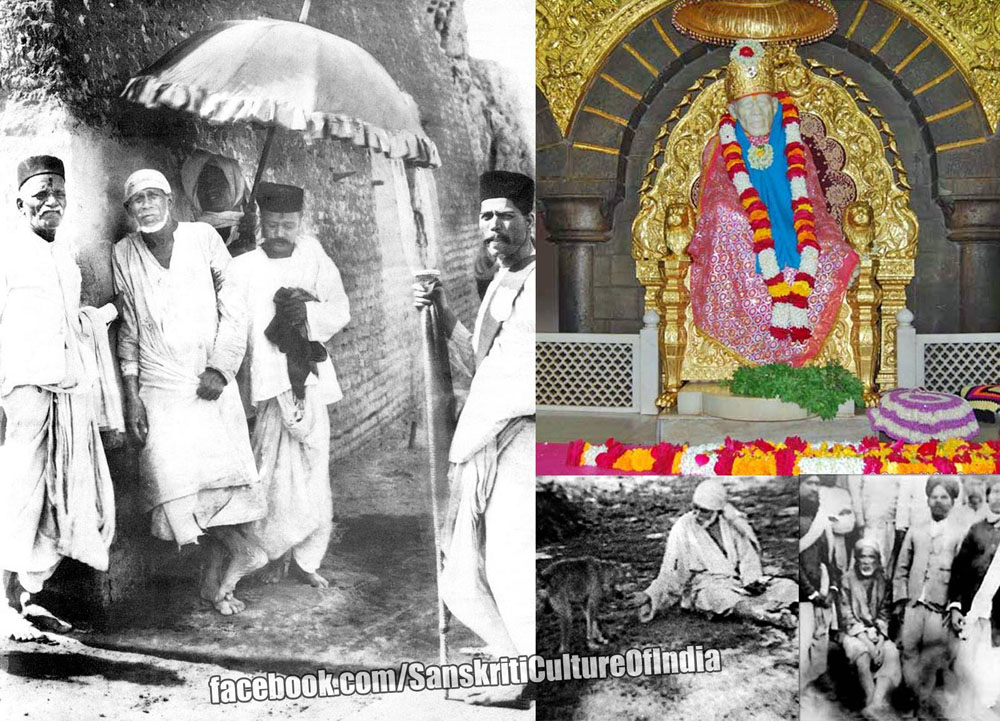
A fakir in a tattered kafni (long robe) who begged for alms till his last day. Who founded no religion or sect, developed no trademark spiritual philosophy or system of practices, started no movement, initiated not a single disciple, left behind no apostles. Who breathed his last eight long decades ago and about whom very few had heard till the 1960s.
In his life and teachings he tried to embrace and reconcile both faiths: Sai Baba lived in a mosque, was buried in a Hindu temple, embraced Hindu and Muslim practices, and taught using words and figures that drew from both traditions. One of his well known epigrams says of God: “Sab ka Malik Ek” (“Everyone has One God.”)
The Sai Baba of Shirdi.
Today, he has millions of devotees in India and other parts of the world.Shirdi, the obscure village in Ahmednagar district of Maharashtra, in India, has become a pilgrimage destination much as Bethlehem, Jerusalem or Varanasi. The number of pilgrims go there average 25,000 a day and can climb to over a hundred thousand on holidays and festival days. They belong to every strata of society and all religions, and include politicians, film stars and rich businessmen. By conservative estimates, there are over 2,000 major Sai temples in different parts of India and 150 abroad in places as far-flung as Canada and Kenya, Singapore and England.
Significantly, all these temples have been constructed and consecrated by local initiative. Indeed, the growing Sai phenomenon is not orchestrated by a central organization, though there is the Sri Sai Baba Sansthan, which manages the affairs at Shirdi.
Sai Baba had the reputation of being clairvoyant, healing the sick, restoring eyesight, affecting events at a distance, appearing in devotees’ dreams, and exercising control over the elements. Biographies of Baba are replete with stories of how he helped his devotees out of problems and crisis. He continues to do so.
A DIVINE LIFE
Though the last decades of his life are well documented, the little that is known about the early life ofSai Baba is disputed. He was born to Brahmin parents in 1838 in a place called Pathri in Marathwada. He was abandoned soon after and adopted by a childless Sufi fakir and his wife. Later he was put in the care of a guru (Venku Shah) where he remained for 12 years. According to another version he studied with a Sufi master Roshan Shah Miyah, in the Aurangabad area where Sufism flourished.
He was first seen in Shirdi around 1858, but had disappeared after a while. Initially, he was discarded as a mad fakir. After staying for a while on the outskirts of the village, under a neem (margosa) tree (where he said his master was buried), he finally made a dilapidated mosque his abode. When people began approaching him with health problems, he gave them some herbal remedies and later udi (sacred ash) from his continuously burning dhuni. In a few years, priest of the Khandoba village temple and others had accepted him.
In 1886 Baba went into samadhi for three days, had a direct experience of union with God, after which his spiritual powers became evident and he started acting as a pir to wandering fakirs.
The first miracle performed at Shirdi was lighting oil lamps in the mosque with water. He also saved the village from a cholera epidemic. As his fame spread, government officials, high-ranking Britishers, politicians including Lokmanya Balgangadhar Tilak, and the wealthy started calling on him. One day, a millionaire came to Sai Baba and said he was going to start a building in Shirdi in his name. But before its completion, Baba fell ill and attained mahasamadhi on October 15, 1918.
The building now contains a silver idol of Baba and is part of what is now called the Samadhi Mandir.
SIMPLE TEACHINGS
What Baba preached was actually quite simple. According to him, real sorrow is the cycle of birth and death and the real happiness is liberation. He suggested:
• Accept your lot cheerfully. If you acquire wealth, become humble the way a tree laden with fruit bows down. Money is a necessity but don’t get obsessed with it. Yet, don’t be a miser, be generous.
• Perform your duty conscientiously and with detachment, not regarding yourself as the doer.
• Surrender the fruit of action to god so that action does not bind you. It is ties of indebtedness from previous births, which bring humans and other beings together.
• Satisfy your sexual desire, albeit only with your spouse. Don’t drown in lust. Rein it with discrimination.
• Give rein to the negative states (avariciousness, anger, hatred, pride, etc.) only as much as is essential to go through the karma earmarked for this physical existence.
• To steady the mind, idol worship is a way, even though the idol is not God. If you do puja with devotion and emotion, you can concentrate better.
• Herculean effort is necessary for god-realization. There are four elements in sadhana: Discrimination between the eternal and the ephemeral: that Brahman alone is true, the world is not. Next, renouncing all desire about this life or the thereafter. The third is to inculcate these qualities: control of the mind, bearing without anguish the fated pain and sorrow, remaining ensnared by maya, knowing that money, wife, children and relatives are all ephemeral. The fourth is an intense desire for liberation.
-by Parveen Chopra