Discrimination of any kind is abhorrent, and in the religious sphere, a grotesque anomaly. Let us, however, bring nuance into the argument. Not all difference is discrimination; it can also be discretion.
Consecration is a highly sophisticated science in this subcontinent. The Dhyanalinga yogic temple in Coimbatore, for example, is maintained by women for one half of the lunar month and by men during the other half. But in the Bhairavi temple, only trained women are allowed into the sanctum. This is not reverse gender discrimination. Norms in shrines vary according to the nature of the consecration.
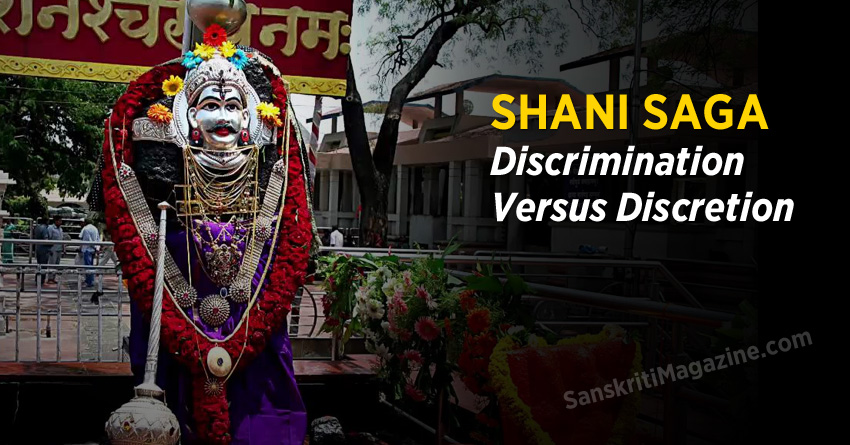
Not every temple is meant for prayer. The recent furore over women being barred entry into the Shani temple overlooks this vital fact. Shani means Saturn. Graha means ‘grasp’ or ‘impact’. This implies that celestial objects in proximity with the Earth have an impact on it.
If you allow the external to influence your well-being, celestial bodies can be fields of subtle energy influence. However, the spiritual path always asserts the dominance of your inner life over your outer. So, traditionally, astrologers would never make predictions for those on a spiritual path, or for those under the influence of a guru.
For others, however, certain shrines have offered external assistance during challenging life situations. Shani is considered to be the seventh celestial body in this system, associated with the seventh day of the week (saath, seven; hence saathurday or Saturday!). Complex astrological calculations, based on the revolutions of Saturn and Earth, and an individual’s time, date and place of birth — including latitude and longitude — were made to determine the impact of Saturn on a person’s life. Since Saturn takes approximately 30 years to orbit the sun, a person enters the phase of Saturn every 30 years. This is known as Saade Saathi in Hindi and ezharai shani in Tamil.
At this time, one is more susceptible to despondency, disease, depression or disaster. Indian mythology tells the story with customary dialectical brilliance. Surya, the Sun God, and his consort, Chhaya (suggesting the mutuality of the light and shadow), had two sons: Yama, the Lord of Death, and Shani, the Lord of Dominance. These are brothers in arms – the D-Company! They always work in tandem.
Since ancient times, powerful practices have been evolved to offset or neutralise the impact of Shani on human life. Shani temples are therefore often associated with occult processes and exorcism. This makes it inadvisable for women to enter the sanctum. Since women have been entrusted with the biological responsibility of giving birth to the next generation, the female body is more receptive to certain energies, particularly when pregnant or menstruating. Women can certainly enter, if appropriately trained; so this restriction has nothing to do with notions of impurity. But the energy situation in the sanctum could have an adverse impact on their well-being. It is how these norms are enforced that often makes them seem crude and discriminatory.
At certain hill temples, like the Velliangiri shrine, women have traditionally been denied entry, as these were in dangerous jungle areas. Today, however, these rules are defunct, and deserve to be overhauled.
In a rapidly changing society where technology has levelled the playing field, the shift from brawn to brain makes gender differences largely irrelevant. However, it is time we educated people about the highly evolved science of temple consecration in the culture of the subcontinent. It would be unfortunate if our democratic fervour led us to confuse equality with sameness, and discretion with discrimination.