IndianSanskriti

Scientific Meaning Behind Sun Worship in Hinduism

In Hinduism, Sun is called the soul of the universe. We cannot imagine even a single day without the Sun.

In a society replete with customs and beliefs, is this just faith-based or was there a more scientific meaning behind the ritual ?

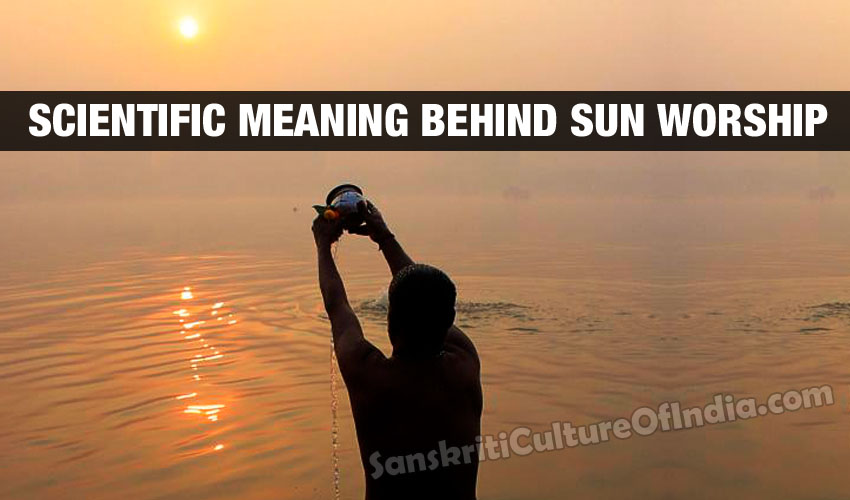
Sun worship commenced with the rising of the sun when the ancestors would offer water in a “lota”, a rounded copper utensil with a wide edge. The pouring water would create a flowing film, creating the seven colours of the spectrum through refraction by which the sun would be gazed at indirectly. Hindus believe this is helpful to the eyes, vitalizes the body and purifies the mind.

The body is made up of five elements: earth (prithvi), water (jal), fire (energy), air (vayu) and ether (aakash). It is believed proper balance of these five elements helps keep the body healthy, the sun being one of them. The solar rays consists of seven colours of the spectrum which are equally vital to the seven chakras of the body.

Rigveda states the Sun is an energy source for all living beings. The Gayatri Mantra is chanted to Surya Devta to remove ignorance and strengthen the mind. The Sun is the symbol of the Self-god. As the Self-god illuminates the mind, the intellect and the body, the Sun illuminates the world.

Vedas also state that water offered to Sun in the evening converts the drops of water to stones that cause death to the demons. For humans, demons are like all sicknesses like typhoid TB, pneumonia etc. When a devotee takes water in his hands while standing in front of or facing the sun and drops water on the ground the rising direct Sunʼs rays fall from the head to feet of the devotee in a uniform flow. This way water heated by Sunʼs rays and its colors penetrates every part of the body.

Science has now validated the importance of solar rays on the human body. Many people living in cold climatic countries suffer from SAD (seasonal affective disorder) during winter, some even going for solar therapies to alleviate moodiness and depression. Solar therapy, mainly from an alternative source, is also used to treat palliation of disease, usually from dermatological disorders. It also improves blood circulation, balances metabolism and restores function of many body systems.

Exposure to sunlight also promotes the development of the pineal gland hormone – melatonin, the amount of which is influenced by the aging process.

It seems then there that is far more to Sun worship than meets the eyes.
You may also like

Search the website

Like us on Facebook

Get daily updates via Email

Enter your email address:

Recent Posts

Purushottam Maas — The Month No Deity Would Claim, and the Lord Who Made It Supreme

Every month of the Hindu calendar has a lord — except the rare thirteenth, the Adhika Maas, born an orphan and shunned as the “impure month.” The Puranas tell how this rejected month went in grief to Bhagavan Vishnu, who claimed it, gave it His own name — Purushottam — and made it the most fruitful month of all. The origin story, the teaching, and what it means for Purushottam Maas 2026 (May 17 – June 14).

Padmini Ekadashi 2026 — The Ekadashi Even the Devas Descend to Keep

Padmini Ekadashi 2026 — The Ekadashi Even the Devas Descend to Keep

The rarest Ekadashi of the entire Hindu calendar is three days away. The Padma Purana preserves a conversation between Bhagavan Krishna and Yudhishthira about a single Ekadashi the great Rishis spend lifetimes waiting for — Padmini. The Vrat Katha of Queen Padmini of Mahishmati, the lotus teaching, and why May 27, 2026 is the morning Vaishnavas across Bharata are preparing for.

Varada Chaturthi 2026 — The Rare Ganesha Day of Purushottam Maas

Varada Chaturthi 2026 — The Rare Ganesha Day of Purushottam Maas

Once every 2.5–3 years — when the rare 13th month of Adhika Maas opens — a thirteenth Vinayaka Chaturthi appears. The Mudgala Purana calls it Varada Chaturthi, the “boon-giving” Chaturthi, and holds it as the most fruit-bearing Ganesha day of the entire calendar. Today, Wednesday May 20, 2026, is that day.

Padmini Ekadashi 2026 — The Rare Ekadashi That Comes Only in Purushottam Maas

Padmini Ekadashi 2026 — The Rare Ekadashi That Comes Only in Purushottam Maas

Padmini Ekadashi 2026 falls on Wednesday, May 27 — the Shukla Paksha Ekadashi of Adhika Maas, the rarest Ekadashi in the entire Hindu calendar (it appears only every 2.5–3 years). The Padma Purana conversation between Bhagavan Krishna and Yudhishthira, the Vrat Katha of Queen Padmini, complete vrat vidhi with jagrana, mantras, and the lotus symbolism that gives the Ekadashi its name.

Ganga Dussehra 2026 — The Day Maa Ganga Came Down to Bhagiratha

Ganga Dussehra falls on Monday, May 25, 2026 — commemorating the day Maa Ganga descended from Vaikuntha to the earth through the millennia-long tapasya of King Bhagiratha. The full account from the Valmiki Ramayana, snan vidhi, dana traditions, mantras, and the teaching of sustained sincerity.

css.php